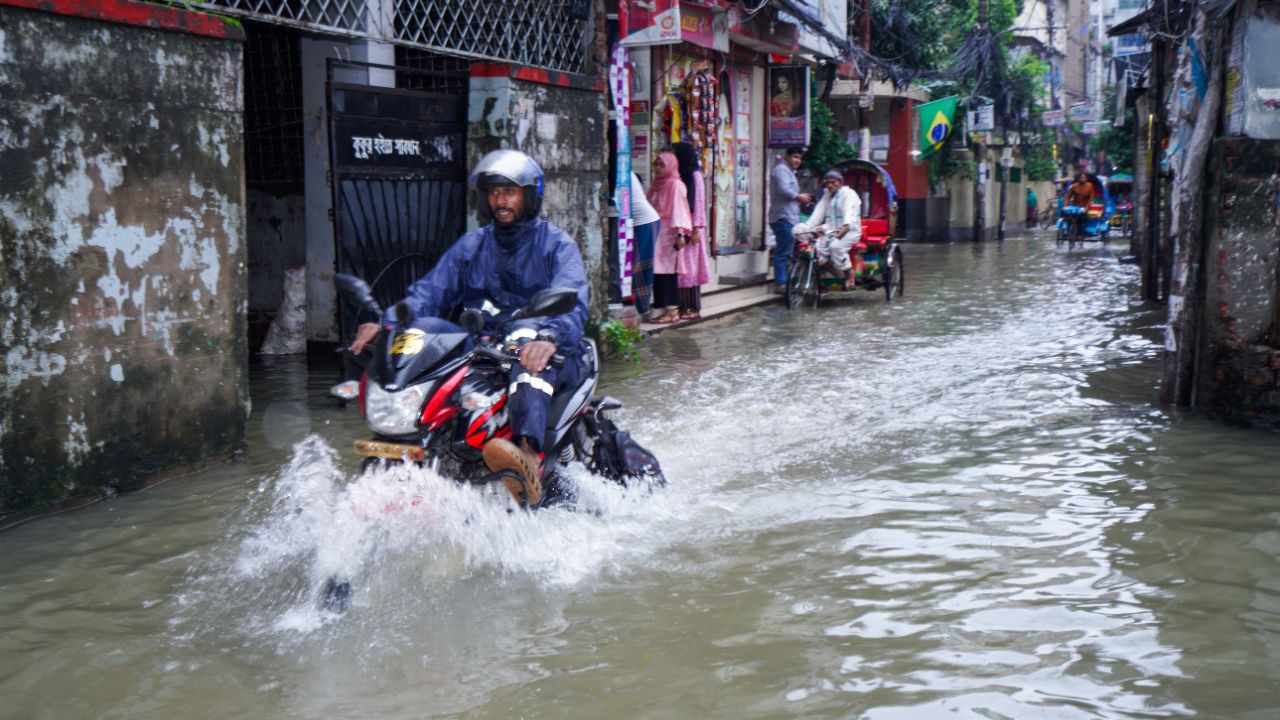



Dhaka is once again under water, proving that throwing a staggering Tk3,000 crore at the city’s chronic waterlogging over the past decade has done next to nothing to keep the capital afloat.
Despite heavy downpours routinely paralysing the streets, officials are already eyeing up yet another Tk3,800 crore mega-project.
Urban planners and city corporation insiders warn that these isolated, billion-taka schemes are completely futile without a comprehensive master plan and a drastic crackdown on indiscriminate waste dumping.
The roots of the crisis are tangled in bureaucracy and fragmented efforts.
Between 2020 and 2024 alone, Dhaka South and North City Corporations burnt through a combined Tk730 crore on piecemeal fixes. To make matters worse, drainage responsibilities were only handed over to the city corporations from Dhaka Wasa in 2021. While WASA had actually drawn up a drainage master plan back in 2015, it was effectively tossed in the bin following the handover.
Instead of coordinating, DSCC and DNCC have spent five years blindly funding separate projects without a strategy, pouring astronomical sums down the drain while the flooding crisis only deepens.

Laws remain on paper
DSCC Chief Waste Management Officer, Air Commodore Md Mahbubur Rahman Talukder, highlighted that Dhaka simply lacks the pathways to channel rainwater out. Consequently, the corporation burns through roughly Tk300 crore annually just on clearing blocked drains and canals.
The crisis peaked on Friday when torrential rain submerged key metro rail station areas like Mirpur-10, Kazipara, and Sheorapara.
DNCC Administrator Md Shafiqul Islam Khan was forced to wade through the deluge to inspect drainage efficiency, ordering immediate clearances and pleading with shopkeepers to stop treating drains as rubbish bins. He later slammed the abysmal hygiene and rampant litter at Mirpur-12’s Kitchen Market 6.
The Bangladesh Environment Protection Act 1995 bans polythene production and use, carrying penalties of up to two years in prison or a Tk2 lakh fine. Identical punishments apply under the Solid Waste Management Rules 2021 for dumping waste into drains, while the Local Government Act 2009 and the Police Act 1861 further penalise public littering.




Yet, toothless monitoring and a total lack of coordinated enforcement mean these laws remain firmly on paper. Urban planner Adil Mohammed Khan noted that areas like Mirpur, Jatrabari, and Mohammadpur face waist-deep water after just an hour of moderate rain.
He argues that flash enforcement campaigns fail without real coordination, allowing banned polythene to thrive openly. The only lasting cure is choking off polythene at the source and finally providing the public with affordable alternatives, he said.
‘Terrible failure of planning’
Calling the crisis a “terrible failure of planning”, Adil argued that Dhaka’s waterlogging has bypassed simple drain-cleaning.
Squandering thousands of crores on isolated projects without an overarching master plan is wasting public money. “The current situation proves that without a unified strategy, no project will ever deliver a sustainable solution,” he warned.
He stressed that simply hiring more cleaners or tightening laws will not eradicate polythene. Instead, grassroots vendors need realistic alternatives, and local communities must be engaged to unlock the existing system’s full potential.
Urging the city to integrate natural water flows with artificial drainage, he noted that the antiquated infrastructure in many areas is completely incompatible with modern realities. While he welcomed DSCC’s current planning via the Institute of Water Modelling, he issued a stark warning: “It has to be a real master plan.”
Partial master plan begins in DSCC
The DSCC has signed an agreement with the Institute of Water Modelling (IWM) to draft a comprehensive drainage master plan.
DSCC Chief Engineer Noor Azizur Rahman explained that while the Tk8 crore project was meant to launch simultaneously across 10 regions, cash shortages forced a phased approach. Work has kicked off using the corporation’s own funds in five densely populated, flood-prone zones.
“The ultimate goal is creating an effective, interconnected drainage network,” Rahman said. Missing links, like the block between Kakrail and Matsya Bhaban, will finally be connected. New outlets will also steer floodwaters from the New Market area to the Buriganga, and from Bakshibazar-Gulistan to the Buriganga via Sowarighat. Furthermore, DNCC sources confirmed two additional outlets are planned to channel Gulistan’s water into the Sadarghat and Shyampur canals.
“We are still in the initial stages, identifying localised problems and solutions,” noted IWM Director Tanmoy Chaki. Alongside its final reports, the IWM will propose targeted development schemes.
However, the IWM’s initial field surveys paint a grim picture: 40 out of 57 inspected sluice gates are completely broken, and rampant waste blocks almost all drainage lines around the Kutubkhali Canal.
Worse still, the DSCC’s only two existing pumping stations, at Kamalapur TT Para and Dholaikhal, are woefully inadequate. While the DSCC spans 109 square kilometres, the entire south of the capital relies on just three main drainage routes. To fix this bottleneck, officials warn that at least eight or nine new drainage channels are urgently required.
WB-backed project ahead
The local government ministry has initiated the World Bank-funded Tk3,800 crore “Metro Dhaka Water Security and Resilience Programme.” The mega-project will be jointly implemented by the DNCC, DSCC, Narayanganj City Corporation, and Dhaka Wasa.
Faruk Hasan Md Al Masud, acting superintendent engineer for DNCC’s Civil Circle, confirmed that Tk900 crore will be allocated to the northern corporation to draft its own drainage master plan. “The previous plan will be reviewed and updated,” he said, noting that many canals left out of WASA’s original blueprint will finally be included.
He added that while the DSCC is part of the overarching programme, they are handling their master plan independently, leaving the DNCC to develop its strategy under this new project.