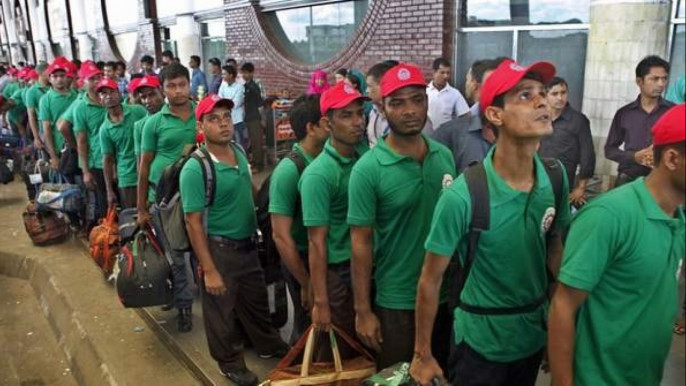



Escalating geopolitical conflict in the Middle East involving Iran, Israel, and the United States has cast a shadow of uncertainty over Bangladesh’s vital labour market, threatening roughly $13.5 billion in annual remittance earnings.
The regional instability is directly impacting millions of Bangladeshi expatriates, causing widespread disruption in employment, aviation, and safety, according to a UNB report.
The crisis has already turned tragic, with reports indicating at least three Bangladeshi nationals killed and seven others injured in the crossfire within the UAE, Bahrain, and Kuwait.
Beyond the human cost, the movement of workers has been severely crippled. Since late February, approximately 300 flights from Dhaka and Chattogram to Gulf destinations were cancelled over a nine-day period.
Stranded Workers and Financial Risk Reaz-ul-Islam, Senior Vice President of the Bangladesh Association of International Recruiting Agencies (BAIRA) and proprietor of Reaz Overseas, estimated that 55,000 passengers – the majority being migrant workers – are currently stranded.

This disruption presents a “double threat”: workers on leave are unable to return to their posts, while thousands of new recruits risk losing their life savings as their entry visas expire before they can travel.
The Middle East is the cornerstone of Bangladesh’s foreign exchange earnings, with the Gulf Cooperation Council (GCC) nations providing nearly half of the country’s total remittances.
In 2025, Bangladesh achieved a historic high of $32.8 billion in total remittances, of which more than $13.5 billion was sourced from the 4.5 million citizens working in the Middle East.




Impact on Key Markets Saudi Arabia remains the premier destination, hosting over 2.5 million Bangladeshi workers and contributing $6.5 billion to the national exchequer in the 2024-25 fiscal year.
However, the conflict has slowed infrastructure and service sector projects in the Kingdom. Analysts warn that if hostilities escalate, new recruitment under the “Vision 2030” plan could be suspended.
Similarly, the United Arab Emirates (UAE), which contributed over $4.8 billion last fiscal year, has seen its economy – a global transit hub – react sensitively to the security situation. Flight cancellations have hit UAE routes hardest, preventing thousands from returning to work in Dubai, Abu Dhabi, and Sharjah.
Call for Emergency Measures In a high-level meeting with Bangladesh Bank Governor Md. Mostaqur Rahman, eight prominent economists warned of a “major shock” to the economy.
Dr Mustafa K Mujeri, former chief economist of the central bank, recommended three urgent interventions: strengthening the crackdown on illegal “hundi” channels, forming a special crisis committee to monitor geopolitical developments, and diversifying the labour market to less volatile regions.
Immigration expert Asif Munier noted that a prolonged war would lead to job cuts and wage reductions as Gulf businesses face stagnation.
Shariful Islam Hasan, head of the BRAC Migration Programme, highlighted the “financial ruin” facing workers who have invested Tk3 lakh – Tk4 lakh each to secure overseas employment but are now stuck.
Government Response Expatriates’ Welfare and Overseas Employment Minister Ariful Haque Chowdhury expressed grave concern, stating in Sylhet that while a dip in remittances is likely, the government’s “highest priority” is the safety of citizens.
“We are providing logistical and medical support to the injured. If the situation worsens, we are prepared to consider large-scale repatriation,” the Minister added.
With the Ready-Made Garment (RMG) sector and remittances serving as the “two lungs” of the economy, stakeholders like BAIRA warn that a sustained shock to the Middle East labour market could destabilise the country’s macroeconomic balance and pressure foreign exchange reserves, which recently surged past $34 billion.