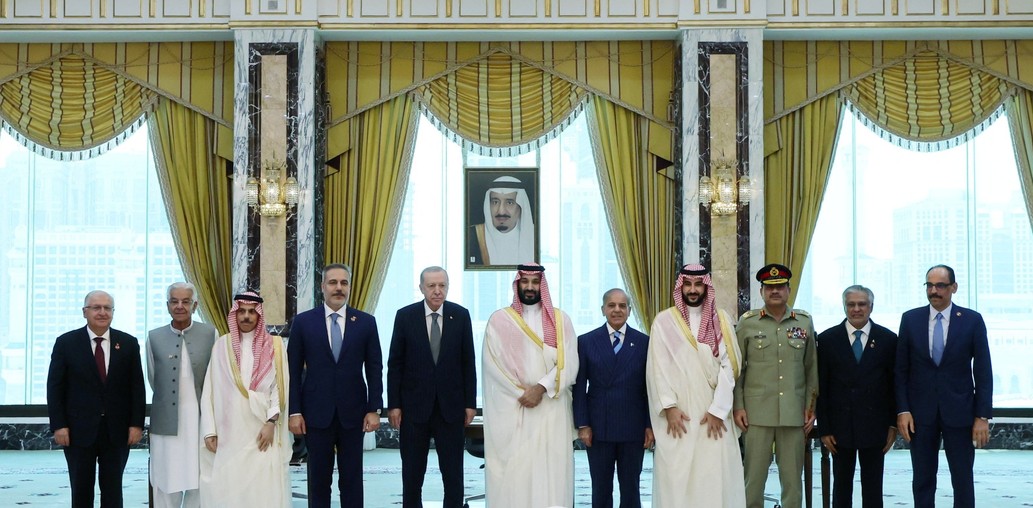



Saudi Arabia, Pakistan and Türkiye have signed the Mecca Joint Defence Agreement, which has been important to the new security dynamics of West Asia. The Mecca deal, which was signed on 7 August 2026, pledges the three countries to consider an armed attack on one country as an attack on all, thus establishing a framework for collective defence cooperation. The deal is seen by some as a ‘potential change of the regional security architecture,’ and whether it will be able to bring stability or further drive geopolitical competition depends on how the agreement will be institutionalised, how the member states deal with divergent interests, and how it will affect regional security in the long run.
It comes at a time of great uncertainty in the Middle East. The recent unrest near the Red Sea and uncertainty about the commitment of the major powers to the security of the area have raised questions about the effectiveness of traditional security mechanisms as tensions with Iran boil over. The pact therefore appears to be much more than an issue of military considerations, but also a matter of strategic autonomy of powerful Islamic-majority states.
The deal is part of Saudi Arabia’s diversification of its security ties. Riyadh has always been dependent on Western security guarantees and has been looking for enhanced strategic autonomy. The kingdom’s diplomatic outreach to a variety of international and regional partners is a sign of the kingdom’s attempt to diversify its security providers. A closer defence relationship with Türkiye and Pakistan offers Saudi Arabia access to various types of strategic capability: Türkiye’s advanced defence industry, military experience and Pakistan’s longstanding military experience and strategic weight.
However, it appears that Türkiye is motivated by the desire to project its power in the region. Ankara as a NATO member with an increasingly sophisticated defence industry, has been looking for a greater role in the affairs of the Middle East. Türkiye will be able to strengthen relations with two important partners through the trilateral agreement with Saudi Arabia and Pakistan and will diversify its diplomatic portfolio.

The pact is both good and bad for Pakistan. The city of Islamabad has longstanding security and economic cooperation with the Kingdom of Saudi Arabia, and in recent years, their relations have been expanded with Türkiye. The agreement is an opportunity for Pakistan to become more relevant in the diplomatic arena at a time when it has to grapple with economic difficulties and complex regional security issues. Its involvement also reflects the ongoing significance of Pakistan as a key player in the military arena in the Muslim world.
Yet, the agreement shouldn’t be read just as the establishment of a new NATO-like alliance. The Collective Defence Clause is similar to Article 5 of the NATO Act, but there are significant differences in institutional arrangements, political integration and the security situation. NATO has evolved over decades along with a common understanding of the geopolitical threat perception, interwoven military structures and a wide range of operational mechanisms. The Saudi-Türkiye-Pakistan deal is in its infancy, and its success will rely on political will’s capacity to turn into tangible cooperation between the three countries.
One of the main points that have been raised with respect to the agreement is Iran. Instead, Tehran and other regional powers might read the deal in the context of historical differences, especially between Iran and some Gulf countries. But officials from the countries involved have said that the pact is defensive, not targeting any country. The fact that the assurance will be secured will depend to a great extent on the way the pact will develop.




The transformation of the United States’ role is also crucial. For decades, Washington has been the pivotal, outside security figure in the Gulf. But regional states have increasingly been trying to wriggle out of the situation, in part because of their uncertain view of the extent of American involvement. Though not necessarily a sign of the decline in U.S. influence, the new regional security partnerships are a reflection of a Middle East seeking other options.
The deal also has ramifications beyond West Asia. South Asia’s ties with the Middle East in terms of trade, energy, migration and security are highly interdependent. Bangladesh, and other countries within the larger region of Asia, have a vested interest in the stability of the region, as instability in West Asia can impact energy markets, labour mobility and economic conditions. An improved regional security framework which focuses on conflict prevention, anti-terrorism, maritime security and economic cooperation can be beneficial.
History also shows that military pacts don’t necessarily ensure stability. Security arrangements can be put in place to help reduce uncertainty for members, but can be exclusionist blocs that will heighten divides. A big challenge for Saudi Arabia, Türkiye and Pakistan will be to maintain the transparency and openness of their cooperation and make it compatible with the regional peace efforts in general.
With more countries being added to the deal, including discussions with Egypt, it looks like the deal could become a larger one. But expansion would also add new layers as every possible candidate would have their own set of strategic considerations and foreign policy assessments.
So, one needs to think of the Mecca Defence Pact in the context of the overall changing of the guard in global and regional politics. It is a symptom of middle powers’ desire to shape their security zone, rather than get security from others. But its success won’t be determined by military force. The true challenge will be to see if it can spur discussions, stave off escalation and serve as a basis for joint security.
The development is an important lesson for countries like Bangladesh, which have always been proponents of peaceful coexistence and multilateral diplomacy with the great powers, and now regional security is not only the responsibility of the great powers but has become the responsibility of the states. Diplomacy, economic interdependence and a willingness of the parties to resolve differences peacefully will all play a role in determining the future of West Asian stability, as will alliances.
The Mecca deal may prove to be one of the key measures in the evolution of regional security, but it remains to be seen whether it will be used to assuage or as a trump card in the game of influence.
The writer is an Associate Professor, Department of Public Administration, University of Rajshahi.
E-mail: [email protected]