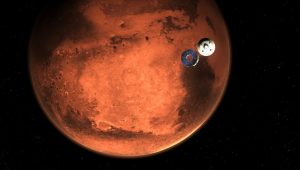





NASA’s Perseverance rover has revealed striking new details about Mars’ watery past. Using ground‑penetrating radar, the rover detected hidden sediment layers beneath the surface of Jezero Crater—clear signs of an ancient river system.
This wasn’t a gentle stream. The data suggest the channel was both wider and swifter than scientists had previously imagined, resembling mid‑sized rivers on Earth. Before Perseverance arrived, orbital images had already hinted that Jezero once contained a lake fed by a river delta.
Now, subsurface scans provide direct proof that the river was part of a much larger network.

Researchers estimate the river flowed between 3.7 and 4.2 billion years ago, carrying sand and small stones downstream. Importantly, the findings indicate the river endured for long periods rather than forming in short, violent floods. That stability strengthens the case that Mars once offered conditions suitable for microbial life.
Today, Mars is cold, arid, and wrapped in a thin atmosphere that prevents liquid water from lasting on the surface. Billions of years ago, however, the planet likely had a thicker atmosphere and a warmer climate, allowing rivers and lakes to persist long enough to reshape the landscape.



The rover gathered its underground data while traversing Jezero’s floor. Its Radar Imager for Mars Subsurface Experiment (Rimfax) sends radio waves into the ground and records the echoes from different materials.
Over 78 passes, Perseverance mapped structures as deep as 115 feet, nearly twice the depth of previous surveys. The radar images revealed steep, sloping layers typical of sediment deposited by flowing water, now buried beneath dust and volcanic debris.
China’s Zhurong rover, part of the Tianwen‑1 mission in 2021, also used radar to uncover evidence of a massive ancient ocean in Utopia Planitia, some 3,000 miles from Jezero.
That ocean may have once covered a third of Mars’ surface, leaving behind buried beaches stretching nearly a mile. US scientists, including UC Berkeley’s Michael Manga, helped analyze those results.
Reflecting on the technology, Manga remarked, “The fact that you can go to Mars with a rover and move over the surface and look underground is kind of mind‑boggling to me.”