


Farmers in Tangail’s Madhupur Upazila are increasingly turning to pesticide-free pineapple cultivation in a bid to restore the fruit’s once-renowned reputation, as concerns grow over excessive chemical use undermining its taste, aroma and heritage.
Madhupur pineapples, recognised as a Geographical Indication (GI) product, are widely celebrated for their distinctive flavour. However, growers and agriculture officials say the overuse of chemicals in pursuit of higher profits has begun to damage the fruit’s reputation.
To meet rising market demand and improve appearance, some farmers have been using chemical sprays to enhance size, colour and off-season production. In particular, a practice locally known as “season manipulation” is used ahead of Ramadan to synchronise flowering, followed by hormone applications that allow harvesting within 10 to 12 days. Although the fruit appears attractive and yellow, experts warn that it loses its natural quality, aroma and nutritional value.
Amid growing consumer awareness and declining demand for chemically treated fruit, a section of farmers is now shifting towards organic cultivation.
Farmers say organic pineapple farming requires lower production costs while offering better market prices. As a result, a growing number of growers in Madhupur—often described as the “pineapple capital”—are adopting chemical-free methods.
One such farmer, Sohel Rana, has taken a leading role in promoting safe cultivation practices.

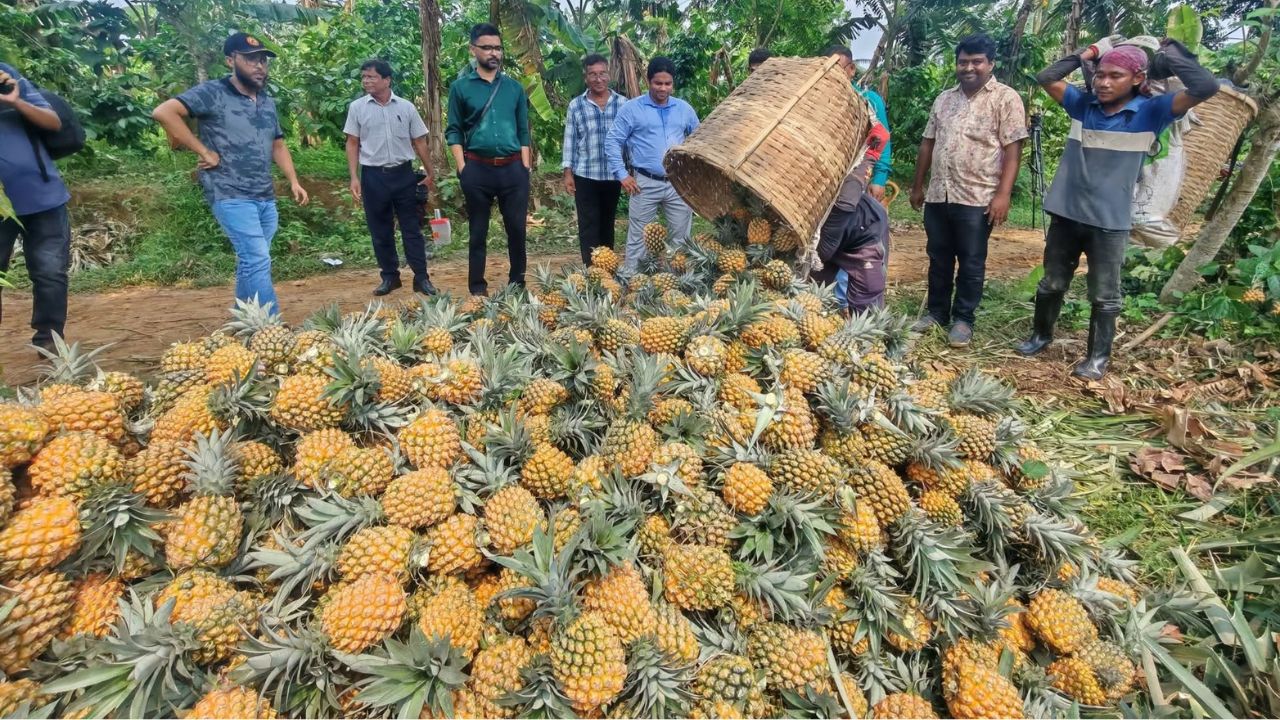
During a visit to Haguira Kuri village under Fulbagchala Union in Madhupur, Sohel Rana was seen harvesting pineapples from his orchard. Speaking to this correspondent, he said he began the initiative in 2025 with financial support from the Palli Karma-Sahayak Foundation (PKSF) and technical assistance from the NGO Society for Social Services (SSS).
He received Tk60,000 in grant support alongside his own investment to establish an organic pineapple project on four bighas of land, where he cultivated 24,000 Honey Queen saplings.
Over an 18-month cycle, around 50 workers were engaged in the project. Total production costs stood at Tk2,35,000, while he has already sold pineapples worth Tk5,28,000, with an additional Tk70,000 expected from remaining sales.



Rana said organic pineapples fetch Tk 40–45 per piece at wholesale level, compared to Tk 25–30 for chemically ripened large fruits in the conventional market.
Reviving taste and tradition
“Madhupur pineapples have an exceptional taste and aroma. But in the pursuit of profit, many farmers are using chemicals to enhance size, colour and early harvesting. This is damaging the fruit’s reputation,” he said.
He added that several local farmers, inspired by his initiative, have also begun organic cultivation, including Mizanur Rahman Sabuj, Roni Mia and Kollyan Matthew. He estimates that more than a hundred farmers in the Madhupur tract are now engaged in safe pineapple farming.
Rana also markets his produce directly to consumers across the country, including Nilphamari, Rangpur, Bogura, Sirajganj and Dhaka. In addition, he sells online through his Facebook page “SR Blog BD”, delivering orders via courier services nationwide.
Identifying chemical-free pineapples
Farmer Jewel Rana explained that naturally ripened pineapples typically turn yellow at the base while remaining green at the crown. When cut, they emit a distinct aroma and have a naturally sweet taste. Chemically ripened fruits, by contrast, appear uniformly yellow but lack fragrance and flavour.
Institutional support and concerns
According to Santosh Chandra Paul, acting executive director of the NGO SSS, the organisation has long supported agricultural diversification in the Madhupur tract through microfinance and technical assistance. Under the Sustainable Micro Enterprise and Resilient Transformation (SMART) project, around 1,800 members are currently receiving support for training and financing, enabling many to achieve self-employment through safe pineapple cultivation.
Moshiuddin Suman, deputy director of the Department of Agricultural Extension in Tangail, said varieties such as Giant Kew, Honey Queen and the imported MD-2 are widely cultivated in the region.
He warned that excessive hormone use, driven by profit motives, poses serious health risks, including long-term liver and kidney damage and even cancer.
“To preserve the heritage, aroma and GI status of Madhupur pineapples, we are continuously encouraging and training farmers to adopt chemical-free cultivation,” he said.
He added that global demand for pineapple and pineapple-based products remains strong, with Thailand and the Philippines leading exports. Bangladesh also has export potential, particularly in pineapple juice and value-added products, several of which are already being exported by domestic beverage companies.