On the banks of the Dhaleshwari River, about four kilometres from the BSCIC Tannery Industrial Estate in Savar, five-year-old Digonto once played in a small waterbody near his home in Tetuljhora. Within days, his skin broke out in blister-like lesions filled with fluid.
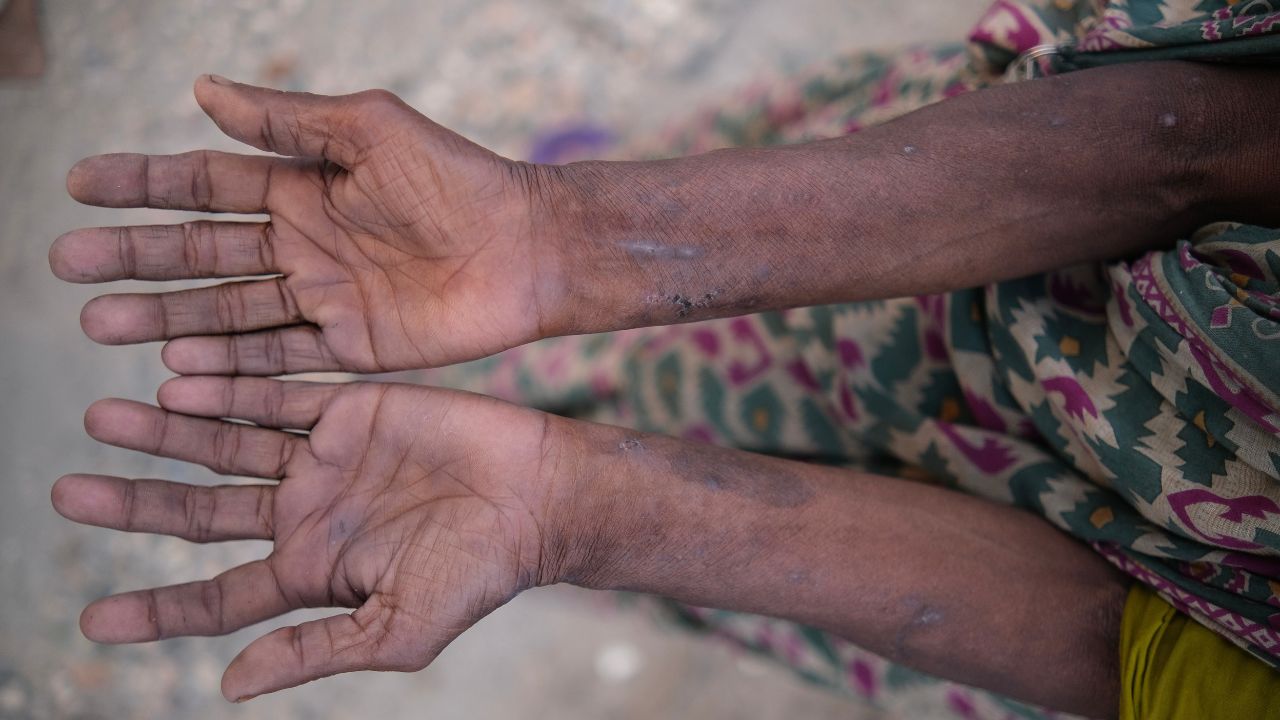
Though he recovered after being taken to a local doctor, dark scars remain on parts of his face, hands and feet.
His mother, Rani Das, still struggles to explain what happened. “We don’t usually use river water—we have a tube well at home. Maybe it was due to carelessness,” she says.
Digonto’s case is not an isolated one. It reflects a growing concern among communities living near Bangladesh’s rapidly expanding leather industry that brought in around $1.15 billion in export earnings in the 2024–25 fiscal year, making it the country’s second-largest export sector.
But beneath this economic success lies a troubling reality of environmental degradation and mounting public health risks.
Outside Gate No. 4 of the tannery estate, 35-year-old Tofazzal Mia dries animal hides in an open space. Dressed in a lungi and T-shirt, he works without gloves, a mask, or any protective gear.
When asked about safety measures, he shrugs off the concern. “We don’t need those. I’ve been doing this since childhood. By Allah’s grace, I’m still doing fine,” he says.


Nearby, in waist-deep polluted water close to a waste disposal site, Rubel and Joynal wash leather bundles. Despite prolonged exposure to contaminated water, they insist they face no health issues.
“We wash thoroughly with detergent at home. No problems,” claim Rubel. Both men say they turned to this hazardous work due to a lack of alternative employment. Rubel had previously worked in agriculture, while Joynal shares a similar story.
Their confidence contrasts sharply with scientific findings.
A recent study published in Nature Portfolio, an international weekly journal, found that between 31% and 51.6% of tannery workers suffer from skin diseases due to exposure to toxic chemicals such as chromium and formaldehyde. Around 44% experience respiratory problems, while risks of eye irritation, gastrointestinal complications and musculoskeletal disorders are also significantly elevated.
Another 2025 study titled “Prevalence of Health Diseases among Bangladeshi Tannery Workers” paints an even grimmer picture. It found that 73.9% of workers suffer from scabies, 69.6% show nail problems, 59.7% experience urticaria, and 56.6% are affected by conditions such as miliaria and folliculitis.




Against this backdrop, protective measures remain minimal. Only 26.1% of workers use gloves or masks, 16.3% wear safety boots, and just 1.1% use goggles while the use of respirators is virtually non-existent.
The impact is not limited to workers. Residents of nearby Longkar Char describe a daily struggle with pollution.
Lipa Akter, who has no direct connection to the tannery industry, says crossing the river has become unbearable. “The smell makes it hard to breathe,” she explains.
Her father-in-law once relied on fishing in the river, but no longer does. “When waste is discharged, fish disappear from this side. Even the trees around our home are dying,” she says.
A visit to the area reveals workers eating with unwashed hands, still stained from handling raw hides and chemicals. The overpowering stench seems to have become part of daily life—accepted, if not entirely ignored.
Environmental studies suggest the situation is critical. Research published in the journal Earth found that Dhaleshwari River’s total dissolved solids (TDS) average 1,364 mg/L—several times higher than the World Health Organization’s recommended range of 300–500 mg/L.
Dissolved oxygen levels are dangerously low, threatening aquatic life, while concentrations of chromium, cadmium and nickel exceed international safety standards.
The ecological risk index (ERI) was measured at 623, a level researchers describe as “catastrophic environmental risk.”
Doctors in the area are witnessing the consequences firsthand. Md Saidul Islam, working at Savar Health Complex, says, “Out of every 100 workers, 90 to 95 suffer from some form of skin disease.”
He reports frequent cases of allergies, eczema, respiratory problems caused by dust and chemical exposure, and nail infections. He also warns of long-term risks, particularly for female workers. “There may be complications during pregnancy and negative impacts on newborn health,” he says.
Physician Islam stresses the need for regular health education, mandatory use of protective equipment, and greater accountability from factory owners.
Environmentalist Atiq Rahman believes the pollution has spread beyond the river itself. “Chemical and biological contamination from industrial waste is affecting surrounding vegetation, soil and air,” he says.
He raises particular concern about groundwater contamination. “If surface water is polluted, people turn to deeper tube wells. But if those layers are also contaminated, the consequences will be far more severe.”
According to him, exposure to polluted water damages the skin’s protective barrier, increasing infection risks, while foul odours carry airborne health hazards to nearby communities.
Professor Sirajul Islam of the University of Dhaka’s Department of Geography and Environment say the problem is no longer confined to Savar. “Untreated chemicals are directly entering the river, severely degrading water quality. Toxic particles are spreading through the air to surrounding areas, affecting public health,” he explains. He also calls for urgent research into soil contamination.
BSCIC Chairman Md Saiful Islam says safety guidelines are provided when industrial plots are allocated. “Various policies and instructions are given to ensure worker safety,” he says.
Regarding waste management, he explains that solid waste is typically handled through city corporations or local government bodies, while liquid waste is managed through a central treatment system. “Some factories have also taken their own initiatives to treat waste before discharge,” he adds.
From a child’s scarred skin to workers forced into debt for medical treatment, from vanishing fish to dying trees—these are not isolated incidents. They form part of a larger pattern emerging around Savar’s tannery hub.
The story of the country’s leather industry is not just one of export growth. It is also a story of environmental neglect and a looming public health crisis for decades—one that experts warn may become increasingly difficult to reverse, even with immediate action.