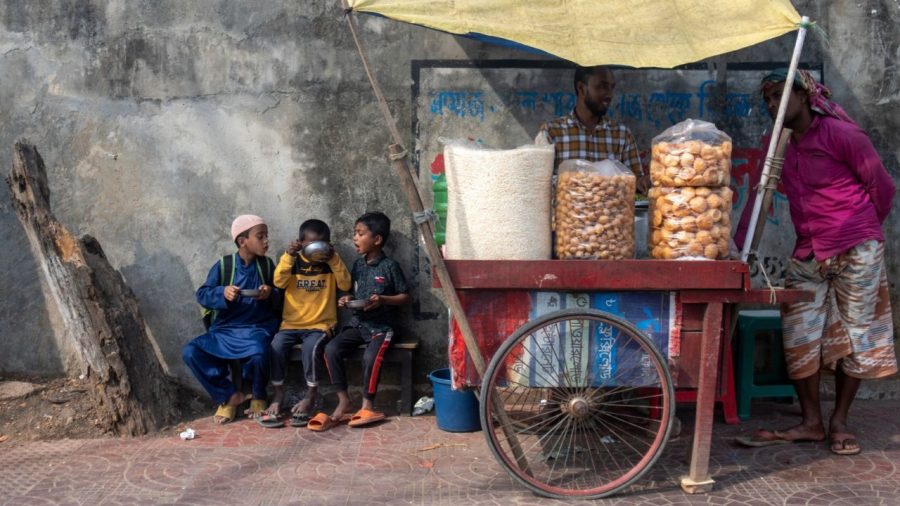



Four days after city corporation officials evicted her stall, Amena Begum, a 60-year-old chitoi pitha seller in Panthapath, resumed her small business on Thursday with lingering apprehension.
Her return coincided with a landmark announcement on Wednesday from Bangladesh Safe Food Authority requiring every street and roadside food vendor across the country – whether selling pitha, puri, singara, piyaju, or fruit juice – to obtain government registration.
For Amena, whose livelihood was upended earlier in the week, the prospect of official recognition brings hope that her daily troubles will decrease. She told TIMES that running a shop under government registration would be good and she sees no problem with it.
Mixed feelings on the pavement
Yet right beside her, the mood was far darker. Kashem Miah, whose jilapi stall had remained closed for four days under city corporation pressure, expressed deep frustration.
He questioned how many regulations the country would witness, adding that all rules seem targeted at kicking the poor in the stomach.

Across the capital, small food sellers are weighing on the practical realities of the new mandate. In Farmgate, the day after the announcement, Azgar Ali, a sugarcane juice vendor operating in front of Ananda Cinema Hall, told TIMES that he considers registration a good initiative.
He noted that if anyone demands extortion money after registration, he can tell them his shop is set up with government permission, so there is no reason to pay.




Further away in Kawran Bazar, Md Hossain, a singara and somosa vendor, expressed worry about the process. He told TIMES that knowing where to go and how to navigate the procedure poses a source of harassment, adding that small sellers would have been better off exempted.
The official roadmap
Under the directive issued by Bangladesh Safe Food Authority, registration is now mandatory across the board for roadside and street food stalls, as well as restaurants, bakeries, sweet shops, food producers, and importers, with non-compliance subject to punishment.
In addition to registration, businesses producing infant formula milk, specialised foods for the elderly or chronically ill, health supplements, special and medical diets, probiotics, prebiotics, and nutraceuticals must obtain a licence.
Applications for both registration and licensing open on 1 November.
Addressing implementation, Md Shofiqul Islam, chairman of Bangladesh Safe Food Authority, told TIMES that floating vendors will not be brought under registration in the initial step. He confirmed that registration for floating traders will carry no fees, explaining that after applications are submitted, field staff will inspect and verify information on the ground before issuing licences.
Corporate bias or consumer discipline?
The decision has drawn contrasting reactions from business representatives and consumer advocates. Sidewalk vendors support the move, but Imran Hasan, secretary general of Bangladesh Restaurant Owners Association, expressed dissatisfaction.
He told TIMES that the registration and licensing process is so complex that attempting it involves monetary transactions and bureaucratic red tape. He added that the government is making arrangements to facilitate corporate business while tying the hands of small traders.
Conversely, AHM Shafiquzzaman, president of Consumers Association of Bangladesh (CAB), welcomed the initiative.
The former secretary of the Ministry of Commerce told TIMES that establishing conditions for safe food preparation alongside registration is necessary to bring discipline and improve food quality.
However, he urged that authorities must ensure small traders face no harassment, red tape, bribes, or extortion during registration and licensing.