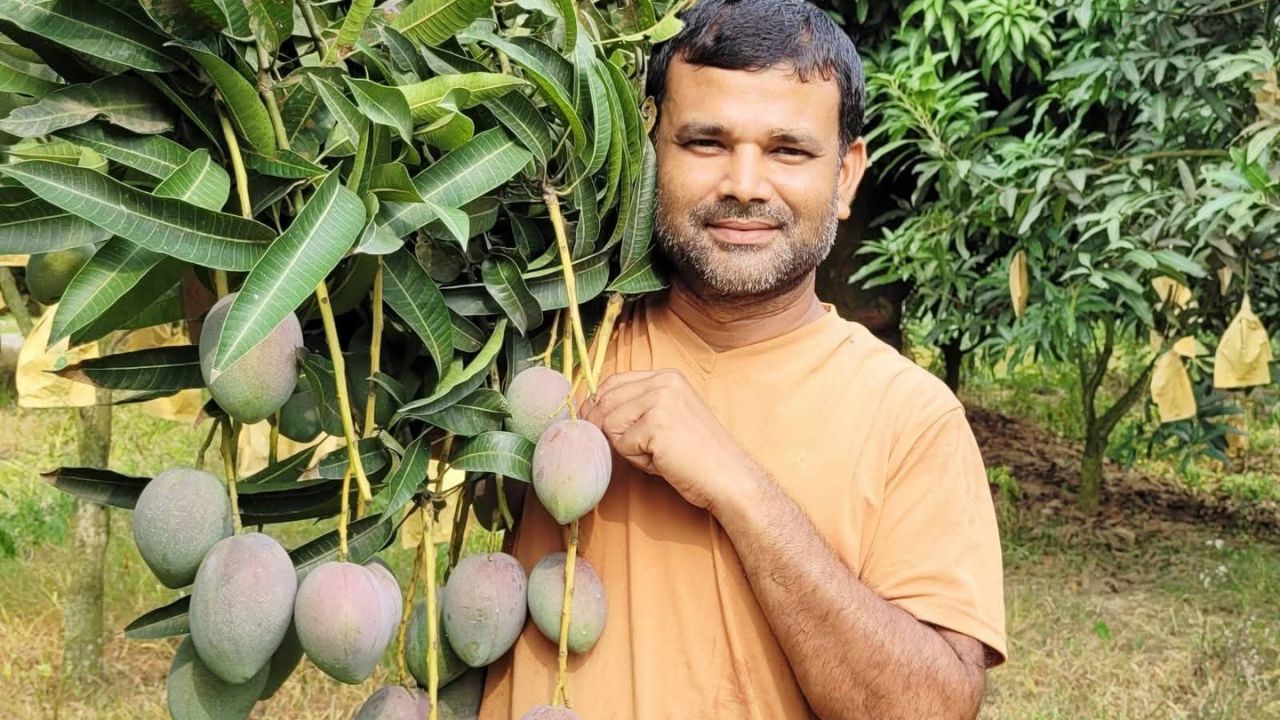



Timing can make all the difference in farming and business — and few understand that better than Sohel Rana.
When the Naogaon entrepreneur planned his mango orchard more than a decade ago, he was not merely chasing higher yields. He wanted varieties that would reach the market after the peak-season rush had faded.
That strategy is now paying off.
While traditional mango growers often struggle with falling prices amid heavy seasonal supply, Rana’s late-season Gourmati and BARI Mango-4 varieties arrive when competition has thinned and prices have surged.
“Many common mango varieties yield 40 to 60 maunds per bigha, but BARI Mango-4 and Gourmati can produce 60 to 80 maunds,” Rana, owner of Barendra Agro Park in Sapahar’s Godownpara area, told TIMES of Bangladesh.
The price gap is even sharper. During the peak season this year, mangoes sold for around Tk1,000 to Tk1,500 per maund. Gourmati entered the market at about Tk5,000 per maund before climbing above Tk15,000 towards the end of the season.
Winter-grown Katimon mangoes can fetch Tk20,000 to Tk25,000 per maund.

The returns explain why late-season varieties are spreading rapidly across Naogaon.
Rana began his journey in late 2015, collecting Gourmati and BARI Mango-4 saplings from a private nursery in Rajshahi. Today, his orchard covers 20 bighas.
The strategy requires additional investment. Gourmati is more vulnerable to diseases and pests, requiring almost all fruit to be bagged — adding around Tk10,000 per bigha to production costs. Rana says the extra expense is small compared with the premium prices the variety commands, while BARI Mango-4 costs less to cultivate.
His orchard reflects a wider transformation in Naogaon, now Bangladesh’s largest mango-producing district.
Extending the mango season
Until around five years ago, mangoes largely disappeared from markets after July. Now, as the main harvest ends, another season begins in Naogaon’s orchards.


Trees remain heavy with Gourmati, BARI Mango-4, Ashwina and Katimon — varieties that ripen after traditional favourites such as Gopalbhog, Himsagar and Langra.
The longer season is reshaping farm economics. Demand for late varieties remains strong, allowing growers to earn four to five times the prices seen during the peak harvest.
In Sapahar, mango trading continues after the traditional season, with buyers and sellers sourcing fruit from orchards where late varieties are still being harvested.
Gourmati currently sells for Tk6,000 to Tk8,000 per maund, depending on quality, while BARI Mango-4 and Katimon fetch around Tk5,000 to Tk6,000. Amrapali, available in limited quantities, sells for Tk24,000 to Tk25,000 per maund, while Banana Mango fetches Tk11,000 to Tk12,000.
The contrast with peak season is stark. From early April to mid-July, varieties including Gopalbhog, Himsagar, Langra, Amrapali, Nakfazli and Haribhanga flood markets simultaneously, pushing prices down and squeezing growers’ margins.
Late-season varieties are changing that equation.
Cultivation expands
Agriculture department data show that Gourmati cultivation in Naogaon has expanded to 1,250 hectares this year, while BARI Mango-4 covers 3,445 hectares. Ashwina is cultivated on 350 hectares.
Katimon, a popular year-round variety from Thailand, has grown even faster, with cultivation nearly tripling to 995 hectares.
The district has set a production target of 75,500 tonnes for late-season varieties alone this year.
This growth comes within an already massive mango economy. Naogaon has cultivated mangoes on 30,310 hectares this year, with the Department of Agricultural Extension setting a production target of 3.78 lakh tonnes. The crop’s potential market value has been estimated at around Tk4,000 crore.
Of this, mangoes worth about Tk3,500 crore have already been sold, while around 1,100 tonnes have been exported, signalling the industry’s gradual expansion beyond the domestic market.
Agriculture officials credit research-backed varieties with extending the mango calendar.
Scientists at the Bangladesh Agricultural Research Institute’s Chapainawabganj Regional Horticulture Research Centre developed BARI Mango-4 in 2003 and Gourmati, also known as BARI Mango-12, in 2012.
Gourmati and BARI Mango-4 generally remain available from mid-July to mid-September, adding nearly two months to the conventional season. Katimon extends availability further, offering fruit during much of the year.
For agricultural experts, the shift represents more than higher prices. With changing climate patterns and growers focusing more on profitability and market timing, late-ripening varieties are emerging as one of the most promising segments of Bangladesh’s fruit industry.
“Late-variety mangoes have now become a blessing for farmers. Previously, the mango season would end within three months. Now mangoes are available for six to seven months,” said Manjur Rahman, deputy director of the Department of Agricultural Extension in Naogaon.
He said late-season mangoes could gain stronger international markets if farmers adopt safe production methods, modern orchard management and consistent export-quality standards.
For Rana, the lesson is simple: growing mangoes is only half the equation. Knowing what to grow — and when to sell — can make all the difference.