When the doors of Dhaka Cantonment closed behind a young widow on a grey morning in 1981, no one imagined that Bangladesh was watching the quiet beginning of a political revolution. Khaleda Zia stood there with two little boys beside her, the world collapsing around her, yet a different history silently preparing to rise.
She had lost her husband, President Ziaur Rahman, to sudden and violent death. She had no political training. No public ambition. No plan for power. But destiny had other plans.
In the decades that followed, she became one of the most influential leaders in South Asia, a three-time prime minister, the first elected woman to lead Bangladesh, and the lone figure who stood fearlessly against military rule at a time when few dared to speak up.
This is the story of a housewife who never asked for politics but carried its weight with unshakeable resolve.

A widow, two children, and a nation in crisis
On 30 May 1981, when Ziaur Rahman was assassinated, Khaleda Zia was living a quiet life inside the cantonment. She looked after her sons, Tarique and Arafat, stayed at home, and avoided the public eye.
Politics did not interest her. Tragedy traumatised her. And her family wanted her far away from the turmoil that had taken her husband’s life.
But BNP was on the brink. Leaders were split. Senior figures feared extinction. In their eyes, only one person carried the moral authority to hold the party together: the late president’s wife.
They requested. They insisted. They pleaded.
Khaleda Zia refused. The grief was raw. The risk was terrifying. And the world she knew no longer existed.

Yet something else was unfolding – an awakening. BNP’s young leaders believed she could unite them. Observers sensed she carried the stature to stand up to the military establishment. Even the military feared her possible rise.
Slowly, reluctantly, she stepped forward.

The quiet entry that changed everything
On 3 January 1982, Khaleda Zia accepted BNP membership. It was a small, understated beginning. Later that year, on 7 November, she placed flowers at Ziaur Rahman’s grave and spoke publicly for the first time. That speech marked the arrival of a new force in Bangladeshi politics.
Her confidence grew. Her presence unsettled both opponents and sceptics inside her party. She represented loyalty, legitimacy, and the spirit of resistance. BNP workers saw her as the leader who could restore direction. By early 1983, she became the party’s senior vice-chairman. Soon after, she emerged as BNP’s acting chief.
In 1984, she was elected chairperson unopposed.


From reluctant leader to symbol of defiance
It was during the 1980s when Khaleda Zia transformed into a national figure. Bangladesh struggled under military rule, and streets across the country filled with growing unrest. She became the voice of that resistance.
Authoritarian pressure did not silence her. Arrests did not break her. She walked in processions that police charged with batons. She addressed rallies blocked by curfews. She travelled across the country to unite opposition forces. And people saw in her a rare quality—fearlessness without theatrics.
By 1991, when Bangladesh returned to parliamentary democracy, the country chose her to lead it. At age 45, she became the nation’s first woman prime minister—just ten years after stepping into politics.
A decade of power, turbulence and unforgettable moments
Her first term (1991–96) shaped the political structure of modern Bangladesh. Her government restored parliamentary governance. She oversaw reforms that strengthened institutions after years of military dominance.
Her second term (2001–06) was more turbulent. Violence, polarisation and mistrust overshadowed achievements. Critics accused her government of failing to control rising extremism. Supporters argued she was targeted by powerful domestic and international forces.
Yet, through every crisis, one pattern repeated: Khaleda Zia refused to withdraw. She refused to surrender. She refused to disappear.

The fall, imprisonment and years of suffering
The 1/11 military-backed government arrested her in 2007. She spent a year in prison. BNP faced its biggest organisational collapse in history. After the 2008 polls, her party suffered a crushing defeat.
Then came the case that would reshape the next chapter of her life the Zia Orphanage Trust corruption case.
In 2018, she was sentenced to prison. The damp old jail worsened her health rapidly. Specialists advised treatment abroad, but successive appeals from her family were rejected.
In March 2020, as Covid-19 gripped the world, the government released her temporarily under strict conditions. She stayed confined between her home and the hospital, fighting illness after illness – liver cirrhosis, kidney disease, heart complications, arthritis and diabetes.
Her world shrank to hospital rooms, specialist units and long nights of pain.
Yet, she endured. Quietly. Stoically. With the same resolve that marked her rise.
A leader at 80, still fighting
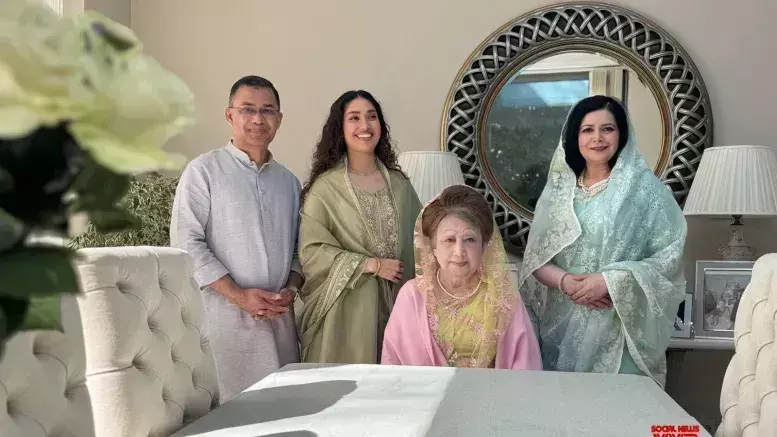
Today, at 80, Khaleda Zia lives with the weight of a long political life and the fragility of a body that has suffered too much for too long.
She was admitted to Evercare Hospital on 23 November, after doctors found a lung infection. Her condition deteriorated, forcing the medical board to shift her to the CCU.
International specialists from Johns Hopkins University and London Clinic joined her treatment. Tarique Rahman, from London, monitored her care hour by hour.
She remains weak and vulnerable. But she is also dignified, determined and calm – much like the woman who survived the storm of 1981 and went on to reshape a nation.
A life larger than politics
Khaleda Zia’s story is not simply about elections, power or party history. It is about a woman who walked into politics because grief demanded it, because people trusted her, and because fate refused to let her remain in the shadows.
Her journey was never easy. It was marked by loss, struggle, imprisonment, illness and endless attacks. But it was also marked by resilience, courage and a rare ability to inspire millions.
As she prepares for yet another battle – this time for her life – Bangladesh watches with a heavy heart and quiet hope.
A woman who carried a nation on her shoulders now needs its prayers.
A leader who never stopped fighting now deserves peace.
And a figure who defined an era stands once again at a crossroads, reminding us that human strength is not measured by victory, but by how long one keeps standing.