





On the quiet banks of the Shitalakshya River, in the historic town of Sonargaon, the rhythmic clatter of wooden looms still echoes through narrow lanes. Here, in Narayanganj, Jamdani is not merely woven; it is lived. Passed down through generations, this delicate textile carries within its centuries of memory, devotion and artistry.
The word “Jamdani” comes from Persian: jam meaning flower and dani meaning vase. True to its name, the fabric blooms with motifs that seem to float weightlessly across its sheer surface. Woven traditionally from the finest muslin cotton, Jamdani is often described as the most artistic of all handloom textiles. It is a gossamer cloth adorned with geometric patterns, floral vines, paisley forms and scattered butis that appear suspended in the air.
To watch a Jamdani being woven is to witness patience in its purest form. The base fabric is created on a loom as usual, but the motifs require an entirely different rhythm. Using a supplementary weft technique, artisans insert each design manually, thread by thread. There are no shortcuts, no mechanical imitations of the hand’s instinct.
A weaver may complete only a few centimetres in a day. A single saree can take months, sometimes close to a year, to finish.
It is this extraordinary craftsmanship that earned recognition from UNESCO in 2013, when Jamdani weaving was inscribed on the list of Intangible Cultural Heritage of Humanity. But long before global acknowledgement, Jamdani had already secured its place in history.

During the Mughal era, the fabric flourished under royal patronage. Emperors known for their appreciation of luxury prized Jamdani for its refinement and ethereal beauty. The weavers of Bengal, particularly Muslim artisans, perfected increasingly intricate patterns inspired by nature, like jasmine blossoms, mango motifs and curling creepers.
Jamdani travelled beyond Bengal to royal courts in Persia and Southeast Asia, becoming a symbol of prestige and cultivated taste.
Yet the true magic of Jamdani lies not only in its history but in its structure. Unlike embroidery, where patterns sit atop the cloth, Jamdani’s motifs are woven directly into the fabric. They appear to float because of the painstaking insertion of extra threads during weaving. Turn a genuine Jamdani over, and the reverse side mirrors the design, though slightly textured where threads have been clipped. Minor irregularities are visible not as flaws, but as proof of the human hand.




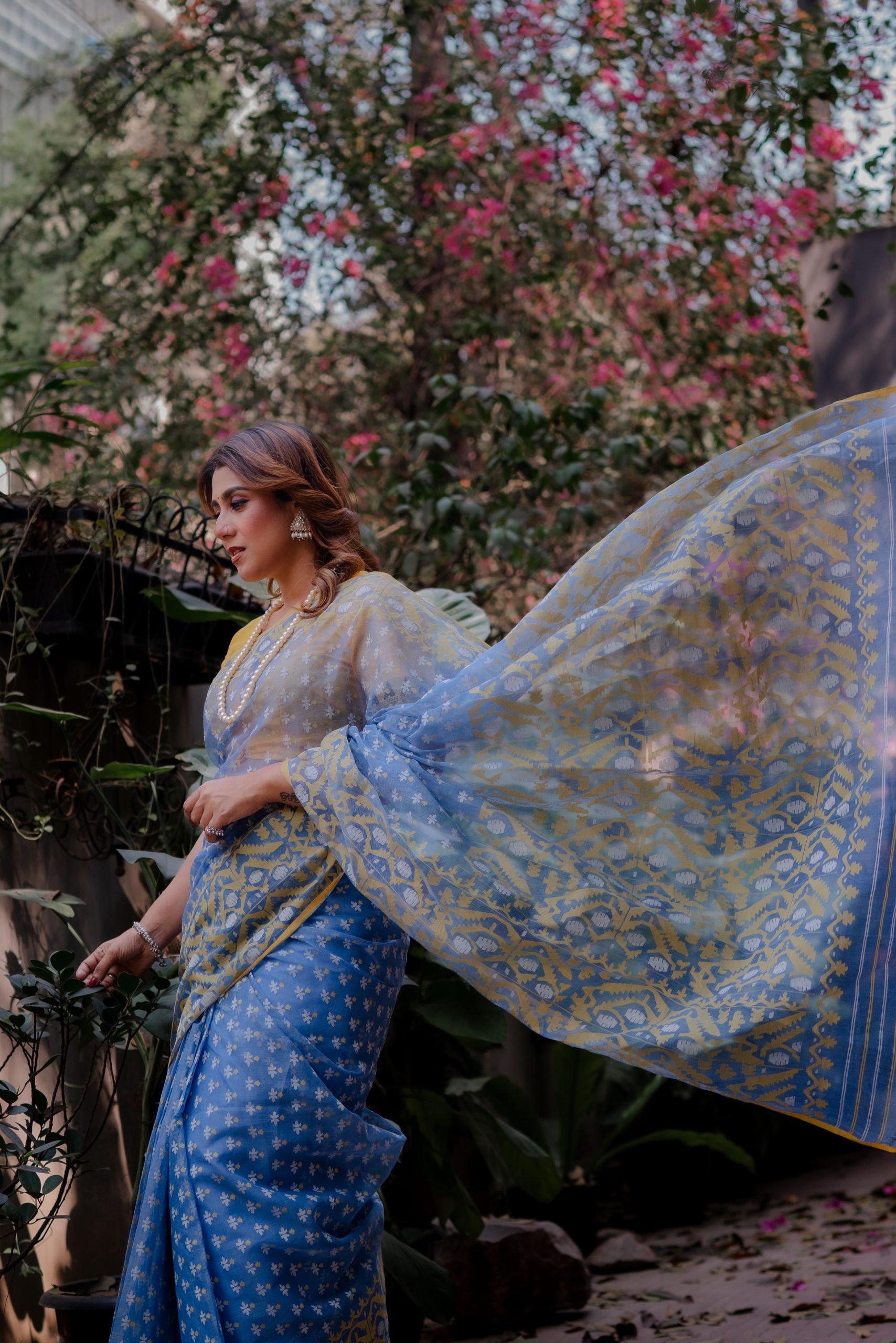
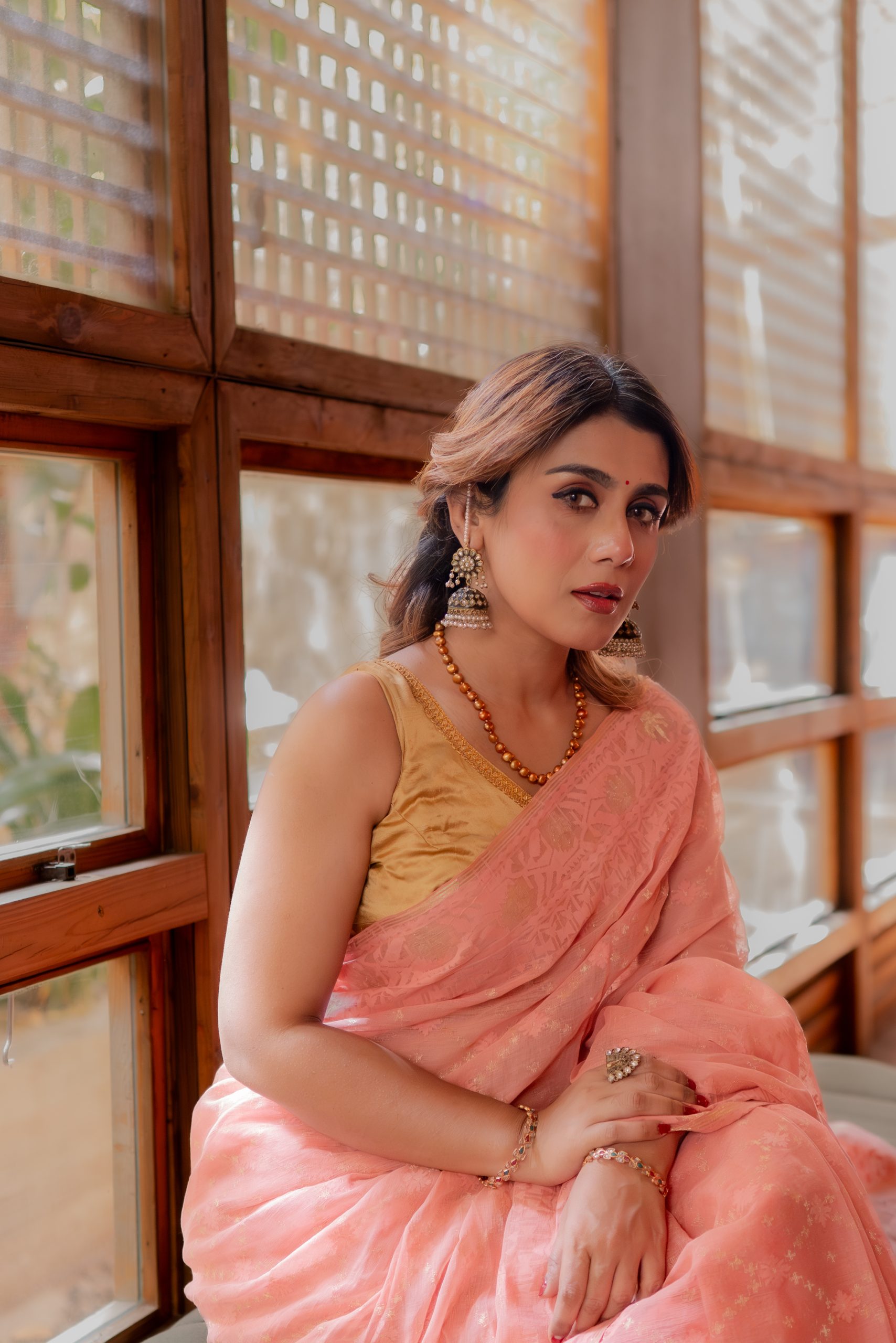
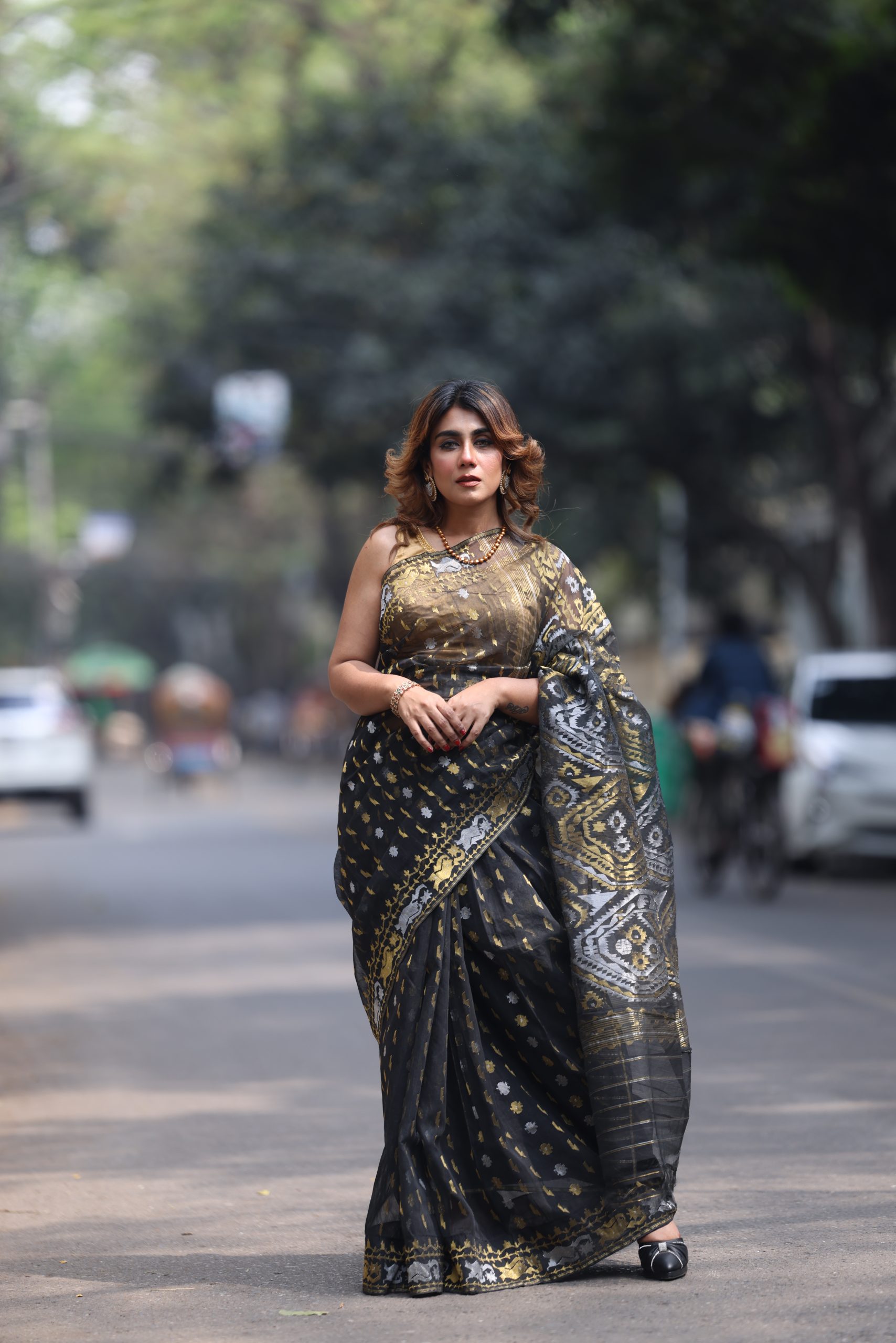
Traditionally, Jamdani sarees were woven in whites, off-whites and soft pastels, accented with contrasting motifs in grey or muted tones. Occasionally, gold thread added a touch of regal opulence. Today, contemporary weavers experiment with bolder colours while preserving classical patterns. Variations such as densely woven “Hajar Buti” styles and minimalist border-focused “Paar Kaaj” designs cater to diverse tastes.
Mohammad Nahidul Rasel, a Narayanganj-based artisan, talked about the different Jamdani designs and motifs like “korola paar,” “phool paar,” “dalim paar,” “jui phool,” and hundreds more. He had also described how families have adapted newer motifs in this art, yet sticking to the old, classic selections.
He further discussed about the thread counts. Locally known as ‘Shana,’ if the Jamdani is woven of 2200 shana, it means 2200 threads have been used to weave one single piece. Also, the number of threads in a square inch of a fabric, known as the thread count, determines Jamdani’s finish.
Starting from the count of 20, an 80 count is known to be good enough, above 80 count is a premium quality, and 100 is the highest modern count. Although historical versions were off a much higher count. Lower counts produce a thicker, tougher fabric perfect for everyday use, whereas higher counts yield a softer, finer texture best suited for special occasions.
Jamdani is a lot more than just a textile. Its significance is multifaceted. The Jamdani saree has long associated with elegance and status. For weavers, it’s a vital occupational identity and a medium of immense pride, with the weaving skill and knowledge passed down through generations. Whereas in the modern day, donning a Jamdani saree is a true statement of cultural pride, retaining strong social and economic importance for artisans.
“It is only by the grace of the Almighty that artisans like us can weave this art form,” shared Rasel. “What truly makes us happy is the completion of Jamdani. When we finally look at the complete piece, measuring about 21 feet including the blouse piece, it’s a feeling like no other.”
Yet beneath the beauty lies uncertainty. The modern market is unforgiving. Machine-made replicas produced on power looms mimic Jamdani’s appearance at a fraction of the price. The slow, thread-by-thread process cannot compete with industrial speed. Rising costs of fine cotton, shrinking profits and exploitation by middlemen have made survival increasingly difficult for traditional weavers. Many younger members of weaving families seek alternative livelihoods, reluctant to embrace a craft that demands so much and pays so little.
Distinguishing authentic Jamdani from imitation has therefore become essential. A genuine piece feels light and breathable; its motifs are integrated seamlessly into the weave. The reverse side reveals the same design, slightly textured. Each motif is subtly unique, shaped by the artisan’s hand. Authentic sarees often carry handloom or Geographical Indication certification in Bangladesh, offering assurance of origin.
Owning a Jamdani also requires responsibility. The delicate weave demands gentle washing or professional dry cleaning. It should be folded carefully in soft muslin cloth and stored away from direct sunlight. Periodic refolding prevents permanent creases, and ironing should be done on low heat through a protective layer. Properly cared for, a Jamdani does not simply last; it evolves, softening over time and gathering stories with each wear.
Encouragingly, Jamdani is experiencing a quiet revival. Designers and ethical fashion advocates are reintroducing it to global audiences, blending tradition with modern silhouettes. Online platforms now allow artisans to reach buyers far beyond local markets.
Sarees, once confined to regional appreciation, are now seen across South Asia, Europe and beyond. Rasel thinks, “Besides other initiatives, a keyway to hold onto Jamdani is to learn more about it. Only then will you fall in love with this textile, it’s guaranteed.”
Perhaps Jamdani’s greatest strength lies in its resilience. It has survived the fall of empires, colonial disruption and industrial competition. It endures because it represents something deeper than fashion. It is heritage woven into cotton, devotion measured in threads and a testament to the enduring spirit of Bangladeshi artistry.