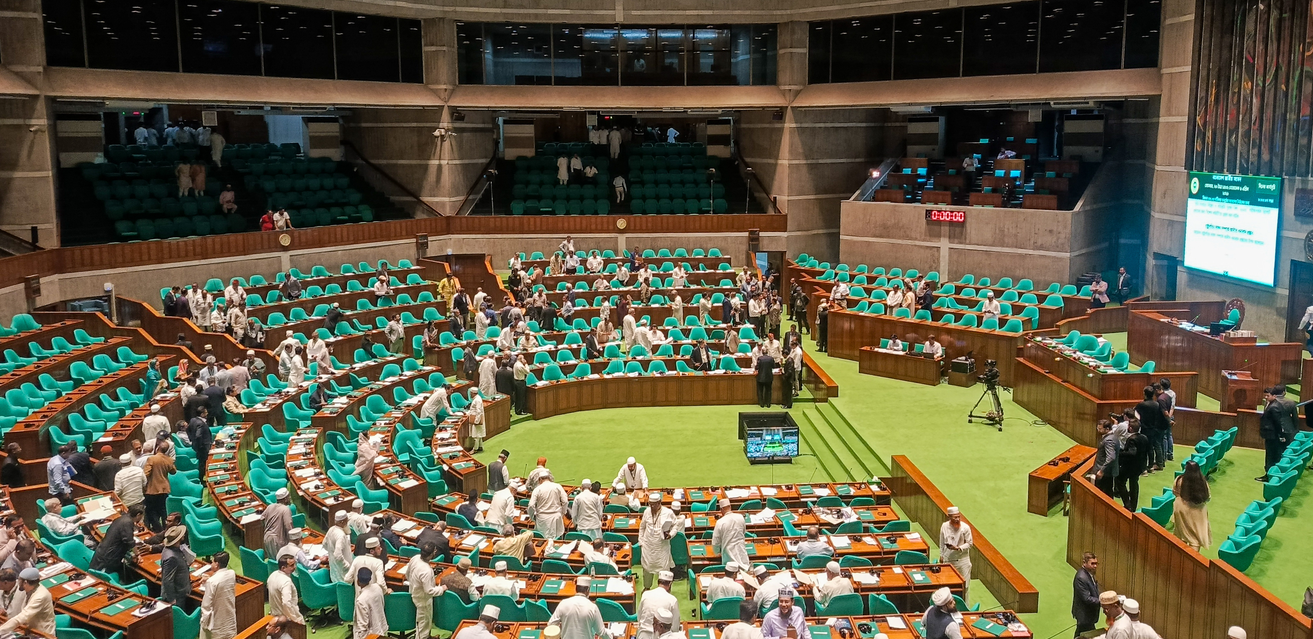



Following the February 2026 general election, Jamaat-e-Islami emerged as the largest opposition party in parliament, with its 11-party alliance securing around 77 seats. The result has placed Jamaat in a new political position. From being a traditional opposition force known for ideological politics, the party is now attempting to project itself as a potential governing alternative. Its ‘shadow cabinet’ or ‘shadow government’ is central to that effort.
Jamaat Ameer and Leader of the Opposition, Shafiqur Rahman, has said the initiative aims to strengthen government accountability and present alternative policy positions. If implemented, it would be the first formal shadow cabinet arrangement in Bangladesh’s parliamentary history. However, the move has also triggered a broader debate: is Jamaat building a genuine alternative governing structure, or is it primarily an attempt to reshape its political image?
For a party seeking greater national acceptance, the challenge is not simply creating a shadow cabinet. The bigger test is whether it can convince voters that it has the expertise, vision and credibility required to govern.
A shadow cabinet could help Jamaat move beyond traditional opposition politics centred on criticism and political campaigns. For Jamaat, this could be an opportunity to demonstrate that it can address complex national issues such as the economy, foreign policy, energy, administration and public services. The initiative also reflects the party’s effort to expand beyond its traditional support base.
However, a shadow cabinet requires more than political appointments. Its success depends on whether Jamaat can develop genuine policy capacity or whether the initiative remains largely symbolic.
A shadow cabinet is an opposition-led alternative governing structure where senior leaders act as ‘shadow ministers’ for specific portfolios. Their role is to monitor government performance, challenge policies and present alternative programmes. Rather than simply opposing the government, a shadow cabinet functions as a ‘government-in-waiting’, allowing opposition parties to prepare for a possible transition of power.

However, shadow ministers have no constitutional authority. They cannot control ministries, issue government orders or access official resources like actual ministers. Their influence depends on parliamentary scrutiny, research capacity, media engagement and public confidence.
Several questions remain about how Jamaat’s proposed structure would operate. Will it include only Jamaat leaders, or will alliance partners receive meaningful representation? Will key portfolios be assigned to elected politicians, or will experts and professionals also be included? These questions matter because the Jamaat-led alliance includes parties with different political backgrounds and priorities.
Maintaining unity within a shadow cabinet could prove challenging, particularly when dealing with sensitive issues such as economic policy, constitutional reform and foreign relations.
An effective shadow cabinet requires research teams, policy experts and regular engagement with parliament, media and citizens. Without these foundations, the initiative risks becoming a symbolic exercise rather than a credible alternative government.




The shadow cabinet system is most closely associated with the United Kingdom, where opposition parties have used the model for decades. Labour and Conservative shadow teams have played an important role in developing alternative policies and preparing leaders for government.
Shadow ministers regularly challenge government decisions on issues ranging from the economy and security to foreign affairs. Australia and Canada also have formal opposition shadow cabinets, where opposition leaders monitor government departments and present alternative policies. India, meanwhile, does not have a formal shadow cabinet system, although opposition parties have occasionally created similar arrangements.
International experience shows that shadow cabinets can strengthen democracy, but only when supported by strong institutions, access to information and a culture of parliamentary accountability. Without these conditions, they can become largely symbolic political exercises.
If implemented seriously, Jamaat’s initiative could introduce a new dimension to parliamentary politics. It could encourage opposition parties to move beyond protests, boycotts and street mobilisation towards policy-based engagement. A shadow cabinet could also improve parliamentary debate by forcing both government and opposition to focus on competing policy ideas.
For Jamaat, it could provide valuable governance experience and allow its leaders to demonstrate their ability to manage national issues. However, these benefits will depend on whether the party can show that the initiative serves the public interest rather than only party interests.
Jamaat’s shadow cabinet initiative has triggered mixed reactions on social media, with discussions ranging from support to criticism and satire across platforms such as Facebook and YouTube. A section of online debate focused on mocking the term ‘shadow cabinet’, with users creating memes and humorous references. Critics questioned the practicality of the initiative. Some critics also described the move as a publicity strategy rather than a meaningful democratic reform.
Jamaat’s biggest challenge remains public trust. The party continues to face criticism and public debate over allegations related to its position during the 1971 Liberation War and questions surrounding its ideological identity.
A shadow cabinet presents opposition leaders as potential future ministers, meaning they will face greater scrutiny. Simply announcing a structure will not be enough. Jamaat will need to demonstrate openness, policy competence and a broader appeal beyond its traditional supporters.
Another challenge is transforming political influence into governing capacity. A functioning shadow cabinet requires economists, researchers, legal experts and sector specialists who can develop practical alternatives to government policies. Electoral success alone does not guarantee administrative expertise. Jamaat will need to prove that it has the technical ability to deal with complex national challenges.
Bangladesh’s opposition politics has historically been dominated by confrontation. Street movements, protests and electoral battles have often taken priority over continuous policy engagement. A shadow cabinet requires a different political culture – one based on research, parliamentary scrutiny and constructive criticism. Whether Jamaat and other opposition parties can make that transition remains uncertain.
Jamaat’s shadow cabinet initiative represents a significant experiment in Bangladesh’s parliamentary politics. The idea could strengthen democratic accountability by encouraging a more organised and policy-focused opposition. But Jamaat’s real challenge lies beyond announcing the initiative.
The party must answer difficult questions: Can it develop practical policies? Can it attract experts beyond its traditional support base? Can it overcome concerns surrounding its past and convince a wider section of society that it represents a credible national alternative?
If the shadow cabinet becomes a serious platform for policy debate, it could introduce a new chapter in Bangladesh’s opposition politics. But if it remains only a political branding exercise, its impact is likely to be limited.
A democracy is tested not only by how parties exercise power but also by how responsibly they prepare to earn it.
The views expressed in this article are solely those of the author
The writer is the Chief News Editor, Daily TIMES of Bangladesh