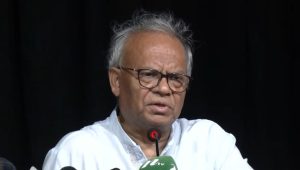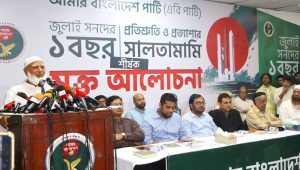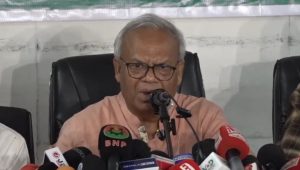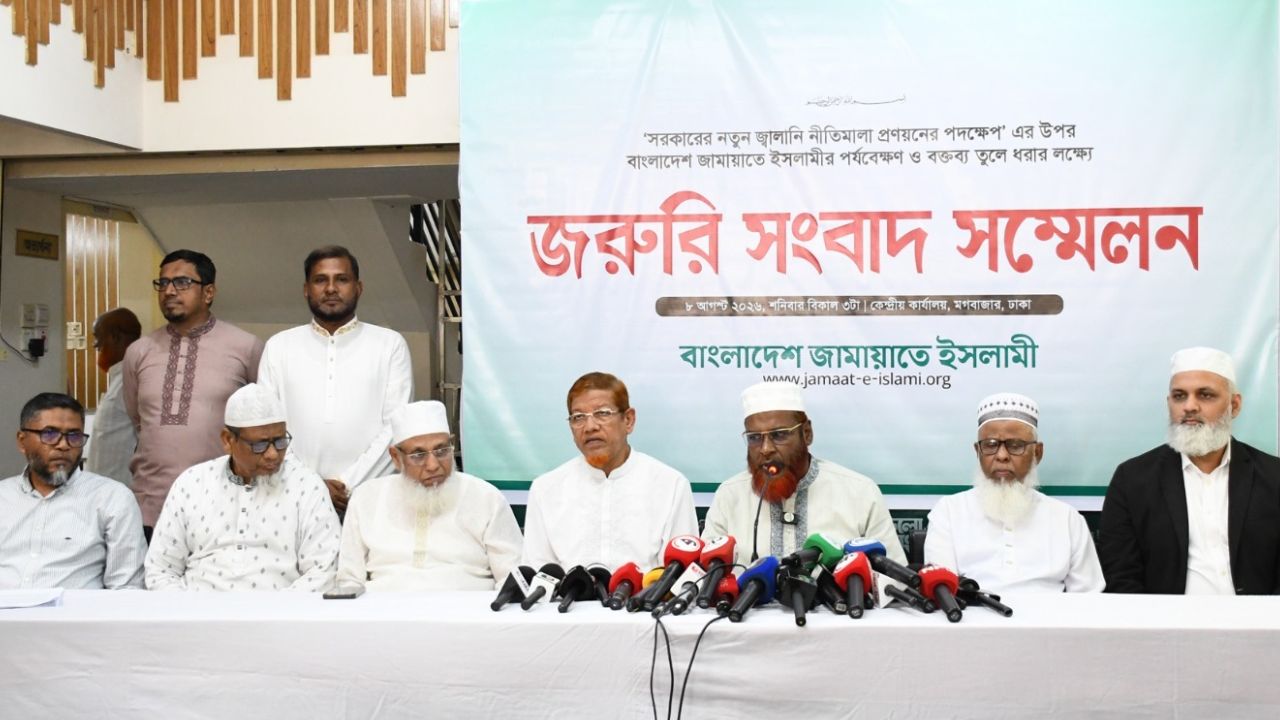



Jamaat-e-Islami Secretary General Mia Golam Porwar has demanded the immediate suspension of the government’s initiative to hand over the import, storage, and marketing of refined fuel oil to private sector, describing it as a “licence for corruption and looting” rather than genuine reform.
Speaking at a press conference at the party’s central office in Moghbazar on Saturday, Porwar characterised the move as a “second edition of old looting” and a transfer of state assets rather than fair competition.
He said in clear terms that the initiative is not a reform, but a handover.
In a written statement, Porwar alleged that the government has remained silent in public about its plans to privatise the refined fuel sector, while decisions are being made through conspiracies behind closed doors and hidden files.
He warned that general public would pay a heavy price for this decision, which would drive up bus fares, the cost of diesel for irrigation pumps, and the price of rice.
Just four days after a new chairman took charge, Energy and Mineral Resources Division directed that draft guidelines for the private-sector import, storage, transport, distribution, and marketing of refined fuel oil be prepared within four days.

Porwar questioned why the draft policy being worked on inside the ministry has not been made public. He said a policy allowing private-sector fuel sales was first introduced during the final days of fallen Awami League government, which benefited a specific group.
He asked what the meaning of the blood shed in July was if the same model returns today.
He argued that despite BPC proving to be a profitable institution in two consecutive financial years, it is being falsely portrayed as a loss-making entity to justify the privatisation of refined fuel oil import, storage, and marketing.



Porwar warned that privatisation would leave the government and public with no control, no accountability to parliament, and no audit mechanisms. He said if a public institution performs poorly, it can be reformed, but if a private company hikes prices, the public is left completely helpless.
Stressing that fuel oil is not an ordinary commodity, Porwar raised national security concerns regarding the supply chain. He questioned who the state would direct during a disaster or war if the supply chain goes into private hands.
He asked what would happen if a company refused to import oil due to lack of profit, and who would deliver oil to remote chars, haors, and hills on unprofitable routes. He highlighted that BPC does this despite incurring losses, whereas a private company would have no incentive to do so.
During the press conference, Porwar demanded to know from the Ministry of Power, Energy and Mineral Resources whether a draft policy on the private-sector import and marketing of refined fuel oil was currently in progress, and if so, whether it would be published on its website.
He also questioned what study or cost-benefit analysis had formed the basis of this decision and whether such analysis would be made public.
Moreover, he asked for disclosure of the names of companies that have submitted proposals or applied, alongside the technical basis for slashing the bidding period from 42 days to 10 days, raising concerns over whether this reduction had limited the number of bidders.
He further questioned whether there had been any reassessment of permission granted to a private company for fuel marketing during the tenure of the fallen government, and if not, the reasons behind it.
In demanding an immediate suspension of the move to transition the sector to private hands, Porwar insisted that the draft policy and all related documents be made public, with at least 60 days allocated for public feedback.
He further demanded that open hearings be held under the Parliamentary Standing Committee, and that BPC be reformed rather than privatised.
Additionally, he called for the implementation of the project to construct the second unit of Eastern Refinery (ERL-2) and the initiative to expand strategic storage capacity within a declared timeline.
He concluded by demanding the withdrawal of all recommendations aimed at curtailing the legal protection of workers and employees within the energy sector.
Porwar clarified that the party is not opposed to a market economy or private investment, but opposes unaccountable handovers and expansion of opportunities for corruption.
The press conference was also attended by Jamaat Amir ANM Shamsul Islam, Assistant Secretary General AHM Hamidur Rahman Azad, Central Executive Committee members Abdur Rob, Shahabuddin, and Md Rezaul Karim, Central Working Committee members Jahidur Rahman and Najibur Rahman, and Central Majlis-e-Shura member Ataur Rahman Sarkar.