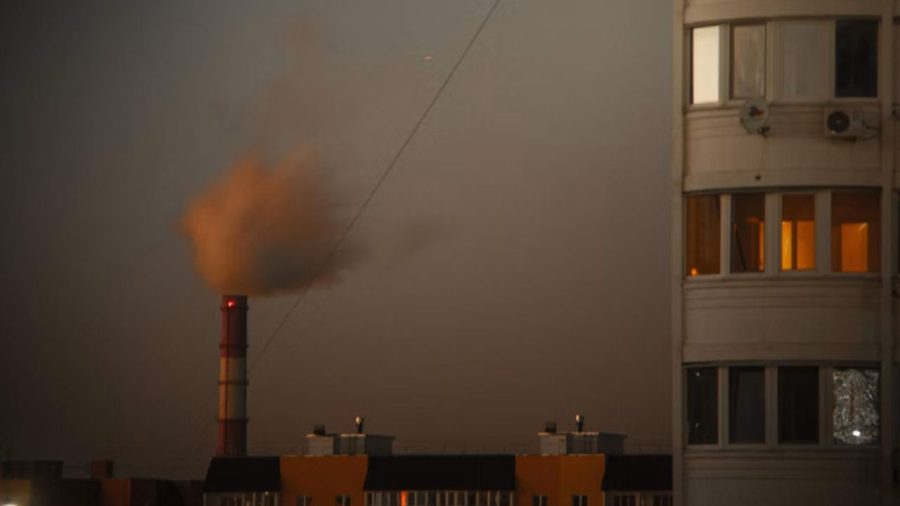



For years, homemaker Tanbeen Sultana avoided stepping outside her home in Dhaka’s Basabo Buddhist Temple area, hoping to protect herself from the city’s dust and pollution.
She kept her home clean, believing it would shield her from polluted air. But the threat had already entered her home.
Tanbeen developed breathing problems and a lung infection. Doctors said prolonged exposure to harmful gases and dust particles was responsible, despite her having no previous history of allergies.
“Even after keeping the house clean, I could not escape dust,” she told TIMES.
Her experience reflects a largely overlooked reality: indoor air can be just as harmful – and sometimes more dangerous – than outdoor air.
While air pollution discussions usually focus on traffic fumes, construction dust and industrial emissions, homes and workplaces often escape attention. Experts say poor building design, inadequate ventilation and household practices are turning indoor spaces into hidden sources of pollution.
Ahead of the International Day of Clean Air for blue skies on 7 September, a study published in the international journal Indoor Environments has highlighted the severity of the problem in Dhaka.
The research, led by Professor Sakhawat Hossain of the Department of Public Health and Informatics, found that indoor PM2.5 levels in Dhaka homes were nearly five times higher than the safe limit set by the World Health Organisation (WHO).
Analysing 43 homes, the study found an average PM2.5 concentration of 75.69 micrograms per cubic metre, compared with the WHO’s recommended 24-hour limit of 15 micrograms.

Levels ranged from 14.42 to 296.63 micrograms per cubic metre.
According to Sakhawat, four major factors account for nearly two-thirds of indoor pollution.
Polluted outdoor air is the biggest contributor, accounting for 40 per cent. It enters homes through doors, windows and ventilation gaps.
Cooking is another major source. Cooking for more than one and a half hours increases pollution levels, contributing 11 per cent. During cooking, PM2.5 levels can rise to 181 micrograms per cubic metre.
House size also matters. Homes larger than 1,200 square feet record higher pollution levels because more outdoor air enters indoors, contributing 6 per cent.
Assistant Professor ZHM Manzur Murshed of Ruet’s Department of Architecture said poor kitchen design often worsens pollution.




“Kitchen designs often ignore proper workflow, lighting and ventilation. Even small kitchens can be made safer through better design,” he said.
He recommended cross-ventilation, high-level windows and ventilation shafts to allow smoke and hot air to escape.
Household habits also contribute. Dry sweeping can send settled dust back into the air, while mosquito sprays used in closed rooms can sharply increase pollutant levels. Researchers recommend cleaning floors with wet cloths instead.
Md Shamim Hossain, a communication officer at a private insurance company, told TIMES that indoor air quality remains a neglected issue in most offices. He said office spaces are typically sealed due to the use of air conditioning, leaving little or no provision for fresh air circulation. Although some offices have exhaust or ventilation fans, these are often inadequate to meet required standards.
He added that frequent power outages in recent weeks have caused air conditioners to shut down, increasing the risk of suffocation in enclosed workplaces. However, Section 52 of Chapter V (Health and Hygiene) of the Bangladesh Labour Act 2006 requires every establishment to ensure adequate ventilation and effective arrangements for the circulation of fresh air in every workroom.
The study found that 60.5 per cent of homes kept windows open for more than eight hours a day, allowing polluted outdoor air to enter continuously. Homes with smokers also recorded higher pollution levels.
For 37-year-old Ridi Khatun, the kitchen has become both her workplace and a health risk.
She works online from home and sells cooked food through her own page, spending five to six hours daily in the kitchen. She recently developed breathing problems.
“Most middle-class kitchens in Bangladesh have poor ventilation. Many have exhaust fans, but they often fail to remove smoke effectively,” she said.
Dr Mohammad Tanvir Islam of Bangladesh Medical University said indoor air pollution was increasingly emerging as a cause of respiratory illness.
“Smoke and fine particles from cooking do not remain confined to kitchens. In poorly ventilated homes, they spread throughout the house, putting all family members at risk,” he told the Times.
He recommended proper chimneys, adequate windows and effective exhaust systems.
Researcher Sakhawat advised reducing indoor exposure by keeping windows closed during periods of severe outdoor pollution, using HEPA-filter air purifiers where possible and avoiding mosquito coils and sprays.
However, experts say air purifiers are not a solution for the wider population.
Air and noise pollution expert Ahmad Kamruzzaman Majumder said air purifiers remained largely affordable only for higher-income groups.
“Air purifiers cannot bring a major public health improvement. Controlling pollution sources is the real solution,” he said.
Indoor pollution is also a major concern in rural areas.
A study titled “Structural Dependencies Perpetuate Disproportionate Childhood Health Burden from Air Pollution” found that Bangladesh lags behind other Southeast Asian countries in adopting cleaner cooking technologies.
Women and children, particularly pregnant women and newborns, face the greatest risks from smoke produced by burning wood, cow dung and coal. Such exposure increases respiratory infections and birth-related complications.
Ziaul Haque, director of the Air Quality Management Branch of the Department of Environment, said expanding access to cleaner fuels could reduce pollution.
“Providing solar-powered stoves, LPG or LNG in rural areas can help reduce air pollution. A project in this regard is expected to begin around 2028,” he said.
BAPA General Secretary Alamgir Kabir said indoor air quality remained largely absent from Bangladesh’s pollution discussions.
“While outdoor air pollution is widely discussed, there are no specific enforceable guidelines or regular monitoring systems for indoor air quality,” he told the Times of Bangladesh.
He warned that poorly maintained air conditioners could also spread dust and pollutants.
“Without regular cleaning and servicing, air-conditioning systems can spread harmful particles and create additional health risks,” he said.