



A father who confronted a madrasa teacher accused of sexually abusing his seven-year-old daughter is facing death threats and a campaign for his punishment, as religious preachers and groups rally behind the accused and downplay the alleged abuse as “just a kiss”.
The father told several news outlets on Friday that he had received death threats from different quarters, including threatening comments on social media, leaving him concerned for his safety.
In a Facebook post, he wrote: “Fear is not in my dictionary! Do not dream of silencing me with threats. Remember, I am Bangladesh.”
Supreme Court lawyer Syed Mamun Mahbub told TIMES that the BNP government must decide whether to allow “mob rule” as the previous interim government under Muhammad Yunus had allegedly done.
He said the interim administration had emboldened religious hardliners and militant extremists, and called on the government to arrest those threatening the father.
Responding to claims that the teacher had merely given the child a “small kiss”, Mahbub said, “Two people were sentenced to death in Saudi Arabia for a small kiss.”
The incident occurred at Qariul Quran International Madrasa in Auchpara, Tongi. On Wednesday, the child’s father confronted the institution’s vice-principal, Maulana Musleuddin. A video circulating on social media shows Musleuddin admitting to touching the child inappropriately during questioning. He also allegedly threatened to beat the child if the incident was disclosed.

The father, a bodybuilder, became visibly agitated and eventually slapped the teacher, who fell to the floor. Police subsequently took Musleuddin to the station, and he was shown arrested after the father filed a case.
Officer-in-Charge of Tongi West Police Station Md Arif Hossain said police would take action in accordance with the law.
The incident has drawn support for the accused teacher from sections of the Qawmi madrasa community, with some preachers dismissing the alleged abuse and others mobilising against the father.
The group Touhidi Janata, which has repeatedly faced criticism over taking the law into its own hands in recent years, has also criticised the father for slapping the teacher, questioning why he resorted to violence instead of legal proceedings.
Shane Sahaba Jatiyo Khatib Foundation, which is campaigning against the father, held a gathering near Tongi College Road on Friday, demanding his punishment. Speakers claimed that mobs and social media rumours of rape and sexual abuse were being used to turn the public against madrasa education.


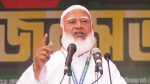
Its chairman, Mufti Shamim Mazumder, claimed they had contacted the officer-in-charge and senior police officials and had received assurances that the father would be brought under the law.
However, Tongi West police chief Md Arifur Rahman told TIMES that police were unaware of the death threats against the father. He said the father could seek protection through the court and that police would take steps accordingly. Until then, he would have to ensure his own safety, the officer added.
Threatening rhetoric has also appeared openly on social media.
Mufti Ishaq Mahmud Kamalpuri, a hadith teacher at Alaudddin Jamia Madrasa in Gazipur, posted the father’s photograph, called him a troublemaker and wrote that a declaration had already been made to beat him publicly and hit him with shoes wherever he was found.
Religious speaker Sheikh Faizullah Arkami, from Brahmanbaria, described the father as a disgrace and demanded his prosecution for allegedly creating a mob and attacking an “innocent teacher” inside a madrasa.
In a video posted on Islamic speaker Abdullah bin Abdur Razzaq’s Facebook page, he said during a religious gathering: “Committing sodomy or rape does not make a person a kafir. But committing shirk does.”
A comment on the Shane Sahaba foundation’s post by an account named Shafiqul Islam urged people to support the organisation, asking, “A child was kissed… is that such a big crime?”
Other comments asked how saying “come, let me kiss you” could amount to sexual abuse, while one user claimed the teacher had intended to show affection because the girl had performed well in an examination.
Popular Islamic speaker Zubayer Ahmed Tashrif also posted a video claiming that the teacher had merely talked about kissing the child, asking, “So what if he gave her a kiss? Does that justify beating him like this?”
A longstanding problem of madrasa abuse
The Tongi incident is not the only recent case of alleged sexual abuse in Qawmi educational institutions, with parents and local residents increasingly demanding accountability.
On Wednesday, residents vandalised a madrasa and the home of a teacher in Savar, Dhaka, following allegations that he had repeatedly raped a 13-year-old student. Police faced a crowd while attempting to rescue the accused teacher’s wife and son.
On Thursday night, a teacher at Nure Madina Women’s Madrasa in Kadamtala village of Dari Bhauadanga, Pabna Sadar, was accused of attempting to rape a female student. An agitated crowd vandalised and set fire to parts of the madrasa on Friday morning before handing the teacher, Abu Yusuf, over to police.
Abu Ahmed Faizul Kabir, senior coordinator at human rights organisation Ain o Salish Kendra, told media that its observations suggested most reported cases of rape and sexual harassment in educational institutions occurred in madrasas. Cases involving the rape or sexual abuse of male students were also appearing at a worrying rate, he said.
Ijazul Islam, executive director of Human Rights Support Society, told TIMES that sexual abuse in madrasas was not new but might now be receiving greater public attention. The actual number of cases could be higher than media reports suggest because many incidents remain concealed, he added.
International Islamic researcher Mariam Sheibani has also studied sexual abuse in madrasas. In an article, she argued that suppressing discussion or concealing allegations against religious teachers to protect an institution’s reputation only worsens the problem.
Islamic scholar Faraz Rabbani has described sexual abuse as an act of oppression, placing responsibility on the perpetrator rather than the victim.
Mojibur Rahman, a professor at the Institute of Education and Research at Dhaka University, told TIMES that many residential madrasa students came from low-income families, while inadequate supervision and accountability increased their vulnerability.
He also stressed the need for educational institutions to establish sexual harassment prevention committees in line with High Court directives.
Rezwana Karim Snigdha, a professor of anthropology at Jahangirnagar University, said child sexual exploitation should be examined beyond individual institutions, taking into account broader social, economic and political contexts.