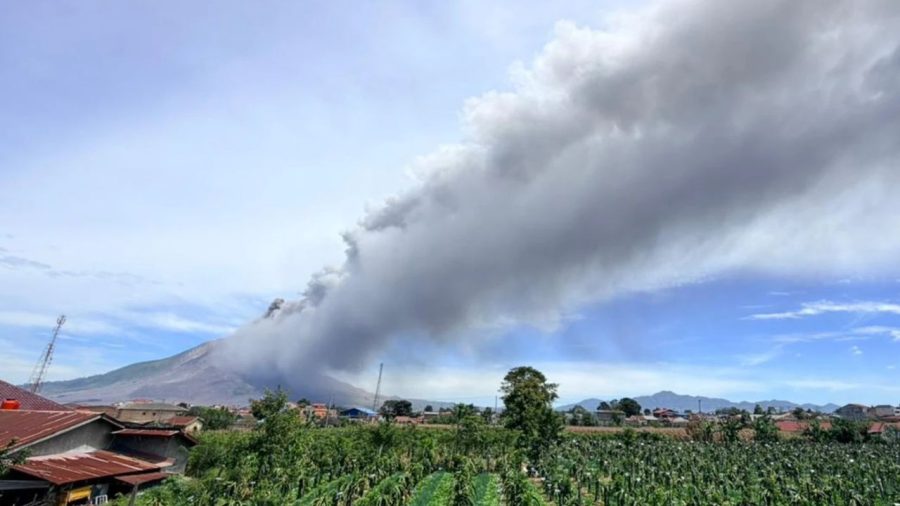

Around 170,000 passengers were left stranded after a volcanic eruption forced Indonesian authorities to suspend operations at eight airports, officials said Sunday.
Jakarta’s Soekarno‑Hatta International Airport was the first to close Sunday morning after ash from Anak Krakatau was detected in nearby airspace, BBC reports.
The transport ministry said 1,558 flights had been delayed, with airports to remain shut until 09:00 local time Monday.

The volcano began erupting late Friday night, producing continuous seismic activity, lava fountains and booming sounds across surrounding regions. Authorities reported two further eruptions early Sunday.
The suspension mainly affected flights to and from Singapore, as well as other international routes including Doha, Sydney and Kuala Lumpur. Transport Minister Dudy Purwagandhi said the decision to close more airports followed tests confirming volcanic ash had spread toward West Java. He urged airlines to expedite ticket refunds and provide timely updates to passengers to avoid overcrowding at airports.


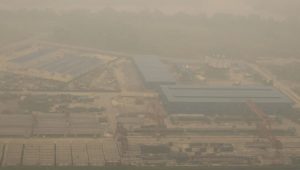
Indonesia’s meteorological agency BMKG said ash reached 20,000ft (6,000m) eastward over Java and up to 50,000ft (15,000m) westward toward Sumatra. Authorities confirmed no tsunami warning was linked to the latest activity in the Sunda Strait between Java and Sumatra.
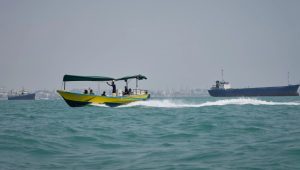
Health Minister officials advised residents in affected areas to stay indoors and wear masks to guard against respiratory, eye and skin risks. Local newspaper Kompas reported several schools cancelled activities Saturday after students complained of eye irritation, while fishermen also suspended trips at sea.
One resident, Aldi Candra Prayogi, told the outlet that since Friday evening “it felt like small grains of sand had gotten into my eyes,” requiring eye drops for relief. He added the ash was so thick he had to sweep his yard every five minutes.
Anak Krakatau, or “Child of Krakatoa,” has been sporadically active since emerging from the sea in the early 20th century within the caldera left by the 1883 eruption of Mount Krakatoa.
The volcano partially collapsed in December 2018, triggering a tsunami that killed more than 400 people and displaced thousands along the coasts of Sumatra and Java. Scientists later found some of the rock slabs that slid into the sea measured 70–90m high.
The eruption is part of the Pacific “Ring of Fire,” a 40,000km arc of volcanoes and seismic faults stretching from South America to New Zealand. The zone accounts for about 90 per cent of global earthquakes and hosts 75 per cent of the world’s active volcanoes — some 452 in total.