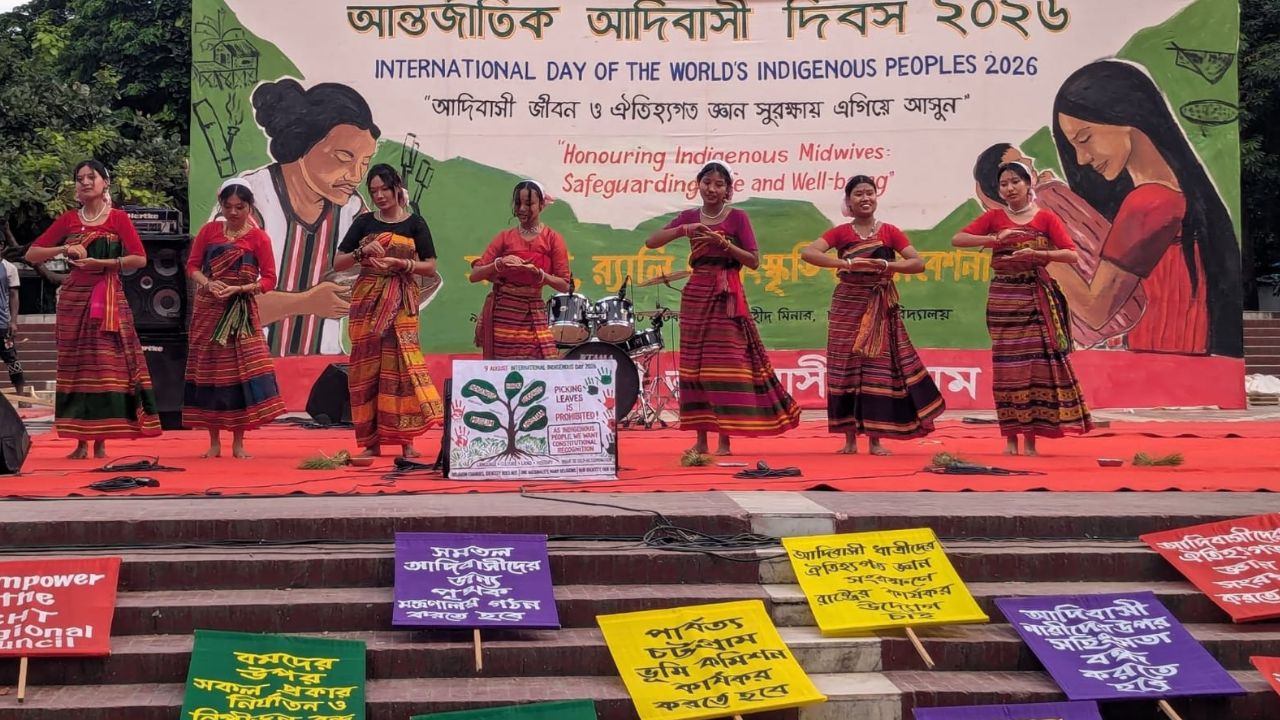



The International Day of the World’s Indigenous Peoples was observed on Sunday in Dhaka and different parts of Bangladesh through discussions, rallies and cultural programmes, with calls for constitutional recognition, land rights and protection of Indigenous languages, cultures and identities.
Programmes were held in the capital as well as in the Chittagong Hill Tracts, greater Sylhet, Mymensingh and northern Bangladesh, organised by indigenous, social and human rights organisations.
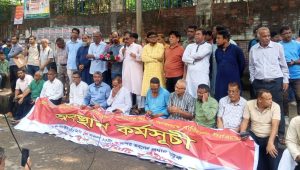
In Dhaka, Bangladesh Adivasi Forum organised a discussion, mass gathering and cultural programme at the Central Shaheed Minar, bringing together Indigenous leaders, academics, rights activists, political representatives and members of civil society.
Human rights and women’s rights activist Khushi Kabir, former lawmaker and Parbatya Chattagram Jana Samhati Samiti Vice-President Ushatan Talukder, former Dhaka University professor Sukomal Barua, Transparency International Bangladesh Executive Director Iftekharuzzaman, Bangladesh JASAD leader Mushtaq Husain, Manusher Jonno Foundation Executive Director Shaheen Anam and ALRD Executive Director Shamsul Huda attended the programme.
Writer and journalist Sohrab Hasan, Supreme Court lawyer Sara Hossain, Dhaka University teacher Robaet Ferdous, writer and researcher Ishita Dastidar and Bangladesh Adivasi Forum Assistant General Secretary Gajendranath Mahato were also among those present, alongside representatives of different political, social and rights organisations.

In a welcome address, Bangladesh Adivasi Forum General Secretary Sanjeeb Drong said Indigenous peoples had been campaigning for their right to self-determination for nearly three decades.
“More than four million Indigenous people live in Bangladesh. We believe the Bangladesh state will provide constitutional recognition to Indigenous peoples and protect their rights to language, identity, land, culture and self-identity,” Drong said.
He said the coexistence of different ethnic communities had enriched Bangladesh with diverse languages, cultures and traditions, describing that diversity as one of the country’s strengths.


“This diversity is the beauty and strength of our country. To protect Indigenous languages, cultures and traditions, land grabbing and displacement in the name of development must stop. At the same time, the state must take effective measures to ensure their land and cultural rights,” he added.
Speakers at the gathering said Indigenous peoples in both the hills and plains continued to face challenges involving land dispossession, displacement, discrimination, violence against women and access to justice.
They alleged that Indigenous communities in the Chittagong Hill Tracts continued to lose land and face human rights violations through what they described as militarisation and state repression.
Referring to the Chittagong Hill Tracts Accord signed on 2 December 1997, speakers said the agreement was approaching three decades since its signing, yet its full implementation remained incomplete.
They also described the situation of Indigenous peoples in the plains as precarious, saying land dispossession, displacement, violence against women, discrimination and lack of justice had pushed many communities further into marginalisation.
Speakers called on Indigenous students and young people to strengthen unity and continue their movement for the establishment and protection of Indigenous peoples’ rights.
To address these issues, Bangladesh Adivasi Forum placed an eight-point demand at the gathering, calling first for the constitutional recognition of Indigenous peoples along with their right to self-determination, and the full implementation of the Chittagong Hill Tracts Accord through a time-bound roadmap.
The forum also demanded the establishment of a separate ministry and land commission for Indigenous peoples living in the plains.
Additionally, it called for action against media outlets or institutions that, according to the forum, spread distorted, partial or false information about Indigenous peoples, while also demanding an end to repression and the immediate withdrawal of what it termed false cases filed against members of Indigenous communities.
The forum urged the government to ratify International Labour Organisation Convention No 169, implement ILO Convention No 107 and take measures in line with the United Nations Declaration on the Rights of Indigenous Peoples adopted by the UN General Assembly in 2007.
Finally, the demands included official state observance of the International Day of the World’s Indigenous Peoples and proper implementation of a five per cent reserved quota for indigenous peoples from both the plains and the Chittagong Hill Tracts.
The International Day of the World’s Indigenous Peoples is observed globally on 9 August each year to raise awareness about the rights, cultures, languages, traditions and challenges faced by Indigenous peoples around the world.