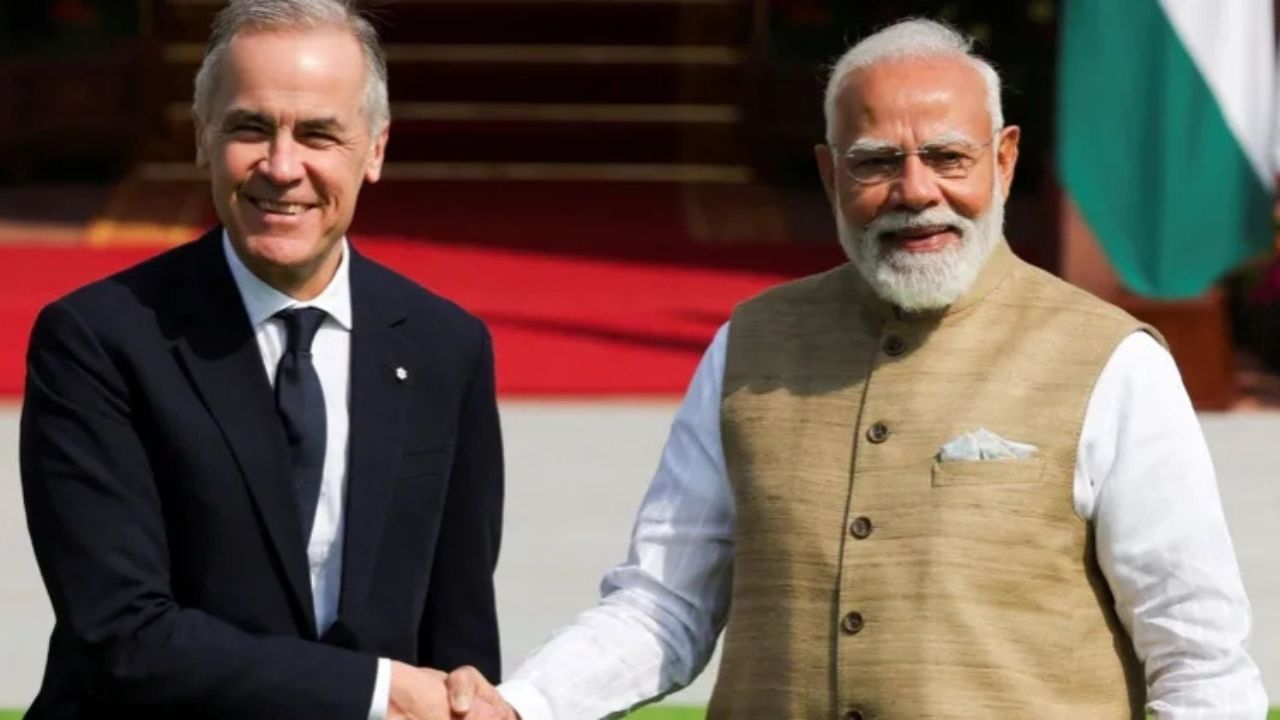

India and Canada have signed a 10-year civil nuclear energy agreement as Prime Minister Narendra Modi and Canadian Prime Minister Mark Carney met in New Delhi to rebuild relations that had sharply deteriorated in recent years.
The two leaders agreed to deepen cooperation in nuclear energy, technology, critical minerals, space, defence and education.
They also pledged to conclude a long-pending free trade agreement by the end of 2026.
Both countries aim to cushion the impact of US trade tariffs and diversify their economic partnerships.
Bilateral ties had plunged after former Canadian prime minister Justin Trudeau alleged Indian involvement in the 2023 killing of Sikh separatist Hardeep Singh Nijjar in Canada.

India firmly rejected the allegation. The dispute triggered diplomatic expulsions and suspension of visa services, pushing relations to a near standstill.
Since assuming office last year, Carney has taken steps to restore engagement. His government has stated that it does not believe India is currently linked to violent crimes or threats in Canada, although some lawmakers and members of the Sikh diaspora contest that position.
Canada’s intelligence agency, the Canadian Security Intelligence Service, recently reiterated that its assessment of foreign interference threats, including those involving India, remains unchanged.




Foreign Minister Anita Anand said she would not personally describe the situation as a halt to interference activities, though she supported renewed diplomatic engagement to move discussions forward.
During talks at Hyderabad House, Modi described the civil nuclear agreement as a landmark step that ensures long-term uranium supply from Canada.
He said both sides will collaborate on small modular reactors and advanced nuclear technologies.
India and Canada will also expand cooperation in artificial intelligence, supercomputing and semiconductors. The two countries plan to jointly host a renewable energy summit.
Carney said Canada stands ready to meet India’s growing nuclear fuel requirements and announced the launch of a strategic energy partnership.
He highlighted what he called unprecedented engagement between the two governments over the past year.
On trade, Modi said both sides aim to raise bilateral trade to $50 billion and conclude a comprehensive economic partnership agreement soon.
Carney expressed optimism that negotiations, which have continued for more than a decade, could reach completion within the year.
Analysts say shifting geopolitical realities have prompted renewed outreach. Canada seeks to broaden trade links beyond the United States, while India looks to diversify imports and reduce its energy dependence on Russia.
Public sentiment in Canada appears supportive of restoring ties. A recent Angus Reid survey found that half of respondents believe it is the right time to rebuild relations with India.
More Canadians now hold a favourable view of India than of the United States amid ongoing tariff tensions.
Earlier in the visit, Carney met India’s External Affairs Minister S Jaishankar to discuss advancing a forward-looking partnership.
His four-day tour began in Mumbai with meetings focused on boosting trade and investment. He will next travel to Australia and Japan as part of Canada’s wider Indo-Pacific engagement strategy.