


When a plane crashes, a government falls, a cyclone devastates a coastal community, or war erupts, people instinctively reach for their phones. Before they read the story, they see the image. That first photograph often becomes the public’s first understanding of what has happened.
Today, however, that first image is no longer guaranteed to be real.
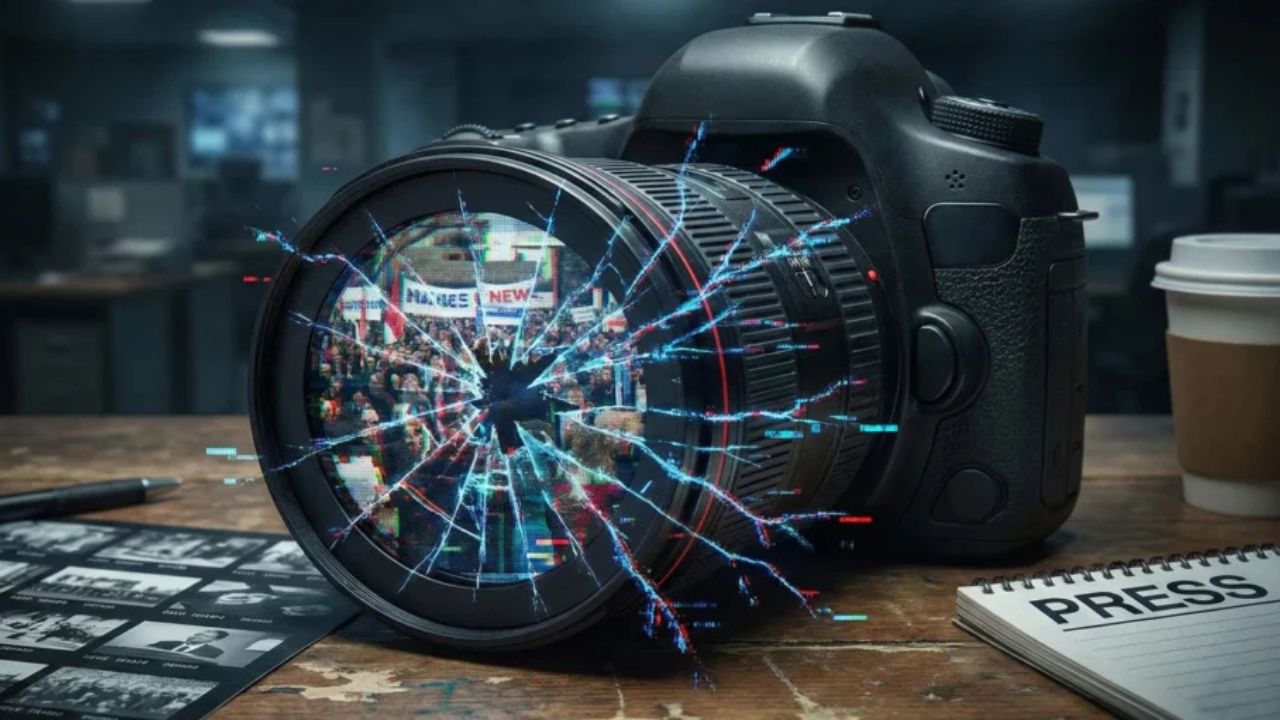
Artificial intelligence has transformed the way visual content is created. Alongside authentic news photographs, social media is increasingly flooded with AI-generated images, manipulated visuals, recycled photographs taken out of context, and sensational “news cards” designed to attract clicks rather than inform the public. Many of these images spread faster than verified reporting, creating confusion before journalists have even reached the scene.
This is one of the greatest challenges journalism faces today.
For photojournalists, it raises a fundamental question: What makes a news photograph valuable?
The answer is not its resolution, artistic quality or ability to go viral. A news photograph matters because it documents reality. It is made by someone who was physically present, witnessed the event firsthand and works within a professional framework of verification, editorial oversight and ethical responsibility.

An AI image can imitate reality. A photojournalist records it.
That distinction is becoming increasingly important.
Today, when major news breaks, many social media pages and even some digital news platforms quickly publish AI-generated illustrations or dramatic graphics before verified photographs become available. These images may capture attention, but they also blur the line between documentation and imagination. Even when labelled as illustrations, they can influence public perception and contribute to misinformation during moments when accuracy matters most.
In an age where fabricated visuals can be produced within seconds, authentic journalism becomes even more valuable.


During my time as a Chevening South Asia Journalism Fellow at the University of Westminster in London, I had the opportunity to discuss these challenges with journalists from across South Asia. Although we came from different countries and worked in different political, economic and media environments, many of our concerns were remarkably similar.
How do news organisations maintain public trust? How do they respond to rapid technological change? How do they survive financially while continuing to invest in quality journalism? And how do they protect credibility in an era where misinformation spreads faster than verified reporting?
These conversations became one of the most valuable parts of the fellowship.
Beyond lectures and seminars, the programme created a space where reporters, photojournalists, editors and broadcasters exchanged experiences from their own newsrooms. We discussed editorial decision-making, verification processes, digital transformation, audience engagement and the future of journalism. Hearing how different organisations approached similar challenges offered lessons that no textbook could provide.
For journalists working in developing countries, these exchanges were particularly meaningful. Many newsrooms operate with limited resources while facing enormous pressure to produce fast, accurate reporting. Learning how other organisations strengthen fact-checking, organise visual verification, invest in long-term reporting and adapt to changing technologies offered practical ideas that could be applied back home.
International fellowships play an essential role in strengthening journalism because they provide something daily newsroom life rarely allows: time to reflect, learn and exchange knowledge across borders. Journalism becomes stronger when practitioners challenge one another’s assumptions, compare experiences and build professional networks beyond their own countries.
For photojournalists, this exchange is especially valuable.
A photographer documenting climate change in Bangladesh may learn new visual approaches from a journalist covering drought elsewhere in South Asia. A newsroom confronting election misinformation may share verification techniques that later become useful during another country’s political crisis. The profession grows stronger when knowledge moves across borders instead of remaining confined within individual organisations.
At the same time, these experiences reinforced my belief that technology should support journalism—not replace it.
Artificial intelligence has enormous potential. It can assist with transcription, translation, archive management, image searches and newsroom workflows. Used responsibly, these tools can help journalists work more efficiently.
When a school is struck by tragedy, when protesters confront police, when a refugee family crosses a border, or when floodwaters swallow an entire village, the public deserves photographs made by journalists who were there—not images imagined by algorithms.
Every published news photograph carries a responsibility. Editors must know where it was taken, when it was made and whether it truthfully represents the event. A genuine photograph contains evidence that can be examined, verified and placed into historical record. An AI-generated image, no matter how realistic, cannot provide that evidence. It cannot confirm what happened because it never witnessed the event.
The photographs that shape our collective memory—from wars and revolutions to humanitarian disasters and moments of hope—carry their power because they are authentic records of real lives. They allow future generations to understand history through evidence rather than imagination.
As artificial intelligence continues to evolve, the value of truthful visual journalism will only increase. The future of photojournalism is not defined by competing with machines. It is defined by offering something machines cannot: human presence, professional judgment, ethical responsibility and eyewitness testimony.
Technology will continue to change the tools we use. But it cannot replace the courage required to stand in the middle of history as it unfolds.
That is why photojournalists still matter.