





Two years after a devastating flood swept away thousands of homes in Cumilla, many victims are still living with the scars of that night, and the disappointment of promises that never materialised.
Along the banks of the Gumti River in Burichang, Malu Mia still remembers the terrifying night in August 2024 when the river suddenly turned violent.

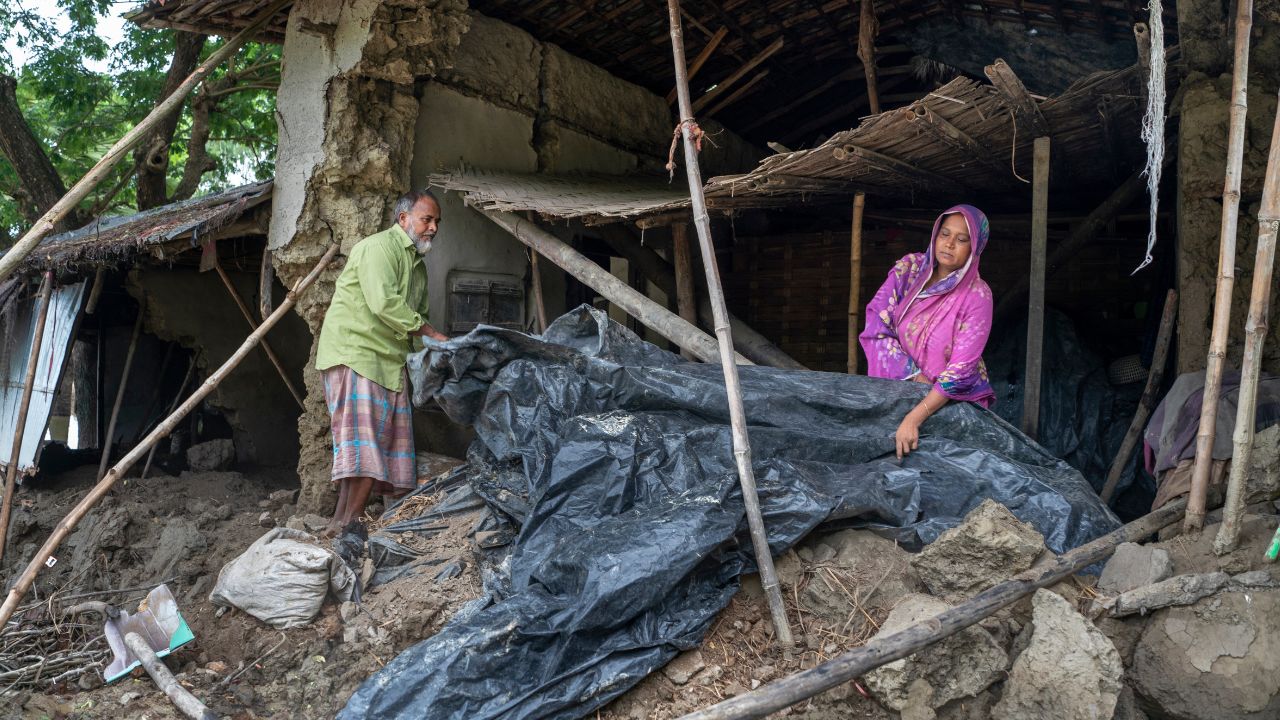
As floodwaters surged through the area in the middle of the night, the current carried away his small tin-roofed house within minutes. When the water finally receded, all he could recover were a few pieces of corrugated tin.

“I took only our quilts and bedding and somehow reached higher ground that night. In the morning, I saw from a distance that my house and many others had disappeared,” Malu told TIMES of Bangladesh.
For the next eight to 10 days, he and hundreds of other displaced residents lived under makeshift tents on raised riverbanks.
When he finally returned home, there was little left to return to. The place where his house once stood was buried under waist-high mud. It took him and his wife several days to clear the sludge.
“I cried so much. The government took our names and made lists of those who lost their homes. But no house was built for us. Later, I somehow managed to build one on my own,” he said.
Malu, a marginal farmer who spends much of the year working as a day labourer, had hoped government assistance would help him rebuild. Instead, he had to borrow money to buy tin sheets and put up a shelter himself.
His neighbour Selim Mia faced the same struggle. Without a fixed occupation or a stable income, recovering from a disaster became an almost impossible task.
Their stories reflect a wider reality in Cumilla, where thousands of flood victims who lost their homes in 2024 are still waiting for meaningful rehabilitation.
The flood triggered an extraordinary wave of public support following the mass uprising that year. Thousands of people donated money, while the interim government held discussions with 44 non-governmental organisations and announced plans to create a fund worth thousands of crores of taka.
The government also repeatedly pledged to rebuild houses for those who had lost everything.
But for many victims, those promises remain unfulfilled.
Thousands of homes destroyed, only 70 rebuilt
Government data shows that the 2024 flood completely destroyed 8,674 houses in Cumilla, while another 74,081 houses were partially damaged.
The district relief and disaster management department estimated that losses in the housing sector alone exceeded Tk1,000 crore.
Yet, two years later, only 70 houses have been constructed for flood victims through government initiatives.
Cumilla District Relief and Disaster Management Officer Md Abed Ali said the houses were built under the project titled “Housing Construction for Helpless and Homeless People in Flood-Affected Areas” under the Chief Adviser’s Office.
The Bangladesh Army constructed the houses in six upazilas of Cumilla.
Of the 70 houses, 29 were built in Burichang, 10 each in Chauddagram, Brahmanpara and Monoharganj, six in Cumilla Sadar South and five in Nangalkot.
Waiting beside the Gumti
In Indrabati village along the Gumti River, elderly resident Dhirendra Chandra Das lost his mud house when the flood struck. Despite waiting for government assistance, he received none.
He spent a month staying at a neighbour’s house before a local organisation, Abul Foundation, built him a corrugated-sheet-roofed shelter.
The village is home to many low-income Hindu families, most of whom lived in mud houses before the disaster. After the flood, they lacked the money to rebuild. Many said they did not receive any government support.
Another victim, Golam Kibria of Burbaria village, managed to save his half-brick-built house, but his mud house was completely destroyed.
Although he repaired the surviving structure, he has been unable to rebuild the other house even after two years because of financial hardship.
“After the flood, we were repeatedly told that assistance would be provided to rebuild damaged homes. But in reality, nothing happened,” he told TIMES.
Burichang bore the brunt
Among all areas in Cumilla, Burichang suffered the worst damage.
According to the district relief and disaster management office, nearly 16,500 houses were damaged in the upazila, including 4,143 that were completely destroyed.
Mud and corrugated-sheet-roofed houses suffered the most severe damage.
Floodwaters from the Muhuri River in Feni, combined with upstream flows, also affected thousands of homes in Laksham, Monoharganj, Nangalkot and Chauddagram upazilas in southern Cumilla.
At the time, several reports highlighted complaints from residents that they had received neither adequate relief nor proper rehabilitation support.


