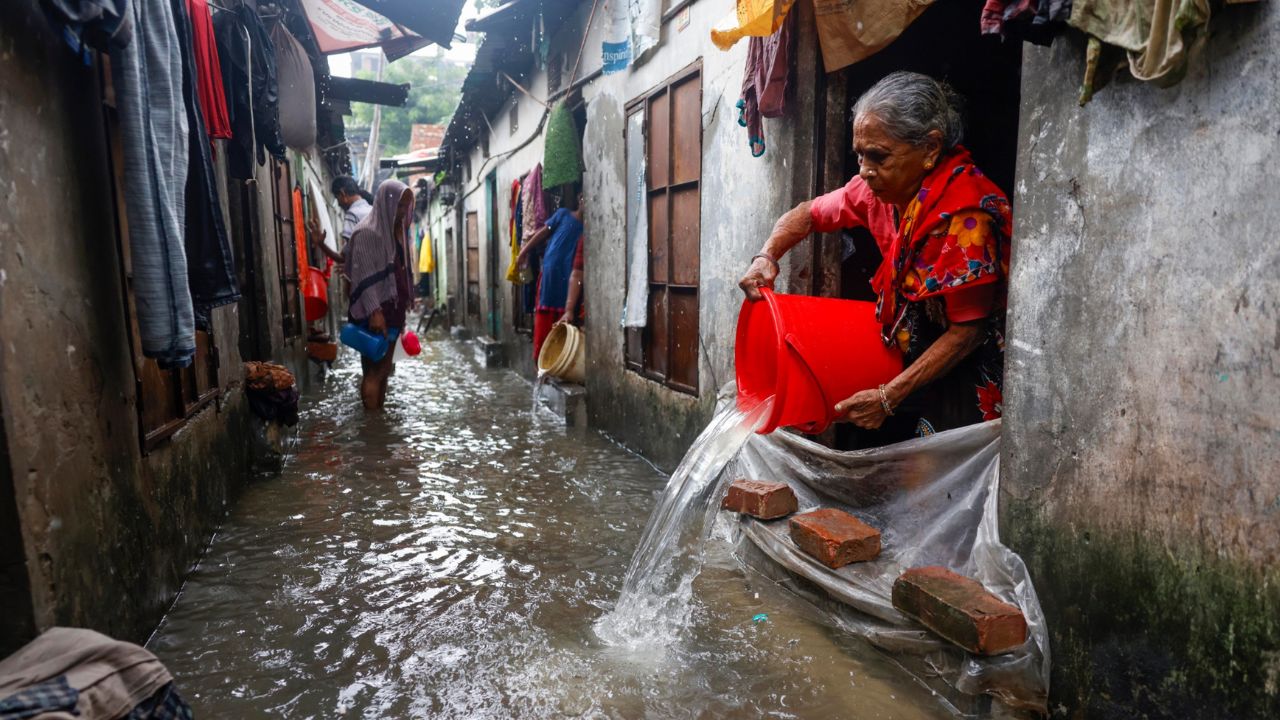



Continuous rainfall for the second day has left large parts of Dhaka waterlogged, stranding hundreds of thousands indoors and putting them in difficulty.
Since Monday morning, heavy rain has inundated roads and alleys, triggering traffic congestion in key areas. Low‑income residents have been hit hardest, with floodwater entering every slum and leaving several hundred thousand residents stranded.
According to the Bangladesh Bureau of Statistics (BBS), Dhaka has 3,394 slums with about 646,000 registered residents. However, UNICEF data from recent research suggests the actual number of slum dwellers exceeds 40 lakhs.
Surveys by BUET and others show Dhaka North City Corporation (DNCC) has 1,639 slums and Dhaka South City Corporation (DSCC) has 1,755. Karail slum alone houses more than 300,000 people.

Major slums include Karail, Sat Tola in Mohakhali, Chalantika in Mirpur, Adabor, Begunbari, Mohammadpur, Bhashantek, Jhilpar, Hazaribagh, Kamalapur, Member slum, and Kalapani.
After two days of rain, many homes in these areas have been inundated. Residents have taken shelter on nearby roads and open spaces. Most are low‑income workers — rickshaw pullers, garment workers, and women employed as domestic helpers.


Karail slum, situated along the Gulshan‑Banani Lake between Mohakhali, Gulshan, and Banani, is Dhaka’s largest, spread over nearly 100 acres and divided into Jamai Bazar and Bou Bazar sections. More than 300,000 people live there. Rain has flooded the lake and surrounding areas, worsening waterlogging.
Residents report knee‑deep to waist‑deep water inside homes, leaving families without space to stand. Parents are particularly worried about children. Food and clean water shortages have emerged, with daily wage earners roaming nearby streets seeking help.
Rickshaw puller Rahman, a Karail resident, said, “There is no way to move inside the slum. Everyone is trapped. No one has come to check on us.”
Conditions are similar in Sat Tola, Chalantika, Adabor, Begunbari, Mohammadpur, Bhashantek, Jhilpar, Hazaribagh, Kamalapur, Member, and Kalapani slums. Residents said most belongings are soaked, food and water are unavailable, and cooking is impossible.
Jamila Khatun of Chalantika slum said, “Water is everywhere. With small children, we have nowhere to stay. Even under makeshift polythene shelters by the roadside, food and water are unavailable. Buying is not an option either.”
The Bangladesh Meteorological Department recorded 97 millimeters of rainfall in Dhaka and surrounding areas over the past 24 hours. By its classification, this falls under “very heavy rainfall.”