The government is moving towards higher-cost borrowing to plug a widening budget gap, as revenue collection falls short and uncertainty grows over the timely release of International Monetary Fund (IMF) loan tranches, officials say.
The government has already borrowed more than its target from the domestic banking sector, leaving limited room for further financing at home.
Officials at the Economic Relations Division (ERD) say the government is increasingly relying on non-concessional foreign loans with higher interest rates and stricter conditions to meet urgent expenditure needs.
According to them, these loans typically come with shorter grace periods and faster repayment timelines, raising concerns about future debt sustainability.
Some of the loans also have very low or even negative grant elements, making them riskier compared to concessional financing, they added.
Economists warn that the country may be entering what they describe as a “vicious cycle”.
They say rising borrowing costs and growing repayment obligations could significantly increase fiscal pressure in the coming years, particularly as debt servicing is expected to rise sharply by 2030.
According to ERD sources, a recent meeting of the standing committee on non-concessional loans held at the Planning Ministry approved five proposals worth a total of $1.9 billion.

Of this amount, around $1.6 billion consists of non-concessional loans, with $1.3 billion earmarked for direct budget support to address immediate financial pressures.
The Asian Development Bank is set to provide $750 million under a programme titled “Strengthening Economic Management and Governance, Subprogramme 2”.
This includes $300 million in concessional financing and $450 million from its Ordinary Capital Resources window as budget support.
Additional budget support is expected from several development partners.
The Japan International Cooperation Agency will provide $500 million, the Asian Infrastructure Investment Bank $250 million, and the OPEC Fund for International Development $100 million.
Besides, negotiations have begun over a proposed financing package of more than $1 billion from the Islamic Development Bank to modernise and expand Eastern Refinery Limited, as part of efforts to strengthen energy security.




Officials say the proposed funding will be structured under a Shariah-compliant forward lease model, which carries stringent conditions.
These include strict pre-disbursement requirements, market-based floating pricing, and a six-month deadline to complete contractual formalities.
The loan pricing will be linked to the six-month Secured Overnight Financing Rate, with an added spread.
The facility is expected to have a five-year grace period and a total repayment tenure of 15 years.
However, repayments will begin during the construction phase, with instalments due every six months.
Officials warn that failure to meet agreed timelines could result in the cancellation of the financing.
Alongside this, multiple wings of the Economic Relations Division (ERD), covering the Americas, Japan, the World Bank, the Middle East, Nordic countries, Europe and the United Nations, are continuing discussions with development partners to secure further funding.
A meeting was also held on Monday with the Asian Infrastructure Investment Bank regarding budget support.
Officials present at the talks said the response from the lender had been positive.
Speaking on condition of anonymity, several ERD officials told TIMES of Bangladesh that the government is facing growing fiscal stress and has asked the ERD to actively explore borrowing options from development partners.
They said the government had initially been reluctant to rely heavily on loans.
However, economic pressures linked to conflict in the Middle East have forced a shift towards external borrowing.
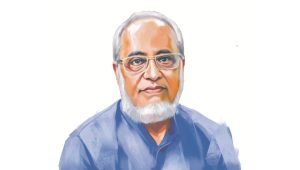
Economist Mustafa K Mujeri, executive director of the Institute for Inclusive Finance and Development, said the country was facing a significant financial strain.
“The core of the problem is a major shortfall in revenue collection,” he said.
“As in previous years, the revenue target is unlikely to be met, and tax revenue remains below 7 per cent of GDP, which is a serious concern.”
He said the government had already exceeded its borrowing target from the domestic banking sector.
At the same time, delays in meeting conditions have held up budget support from the International Monetary Fund.
“As a result, the government is now compelled to seek loans from international sources under tougher terms and higher interest rates to meet urgent expenses such as fuel and essential imports,” he added.
Mujeri said any borrowed funds must be directed towards productive and priority sectors to strengthen the country’s repayment capacity.
He also called for stricter controls on corruption and waste in public spending, alongside urgent reforms to tax policy.
“Increasing revenue mobilisation is the only sustainable way out of the crisis,” he said.