


The government has launched a comprehensive initiative to restore the Buriganga River, the historical lifeline of the capital, by operationalising Effluent Treatment Plants (ETPs) and maintaining rigorous enforcement against industrial polluters and illegal encroachers.
According to officials from Ministry of Environment, Forest and Climate Change, Department of Environment (DoE) is now conducting regular monitoring of water quality at seven strategic points along Buriganga and across other pollution-prone industrial zones.
To improve the river’s navigability, Bangladesh Inland Water Transport Authority (BIWTA) is carrying out consistent dredging operations to remove toxic sediment.
DoE Director General Md Lutfor Rahman told BSS that efforts are focused on restoring the river’s natural flow by increasing water movement.

He emphasised that work is underway to bring ETPs online to ensure industrial liquid waste is scientifically treated, rendering it environmentally safe and reusable, before discharge.
The urgency of these measures is underscored by the current state of the river; a recent inspection revealed that the water has turned black and emits a foul odour due to the direct dumping of untreated industrial effluent, plastic, and household garbage.
Untreated factory waste typically contains hazardous substances such as heavy metals, toxic chemicals, dyes, and oils, posing a severe threat to public health and aquatic life.




Proffesor AKM Saiful Islam of the Institute of Water and Flood Management (IWFM) at Bangladesh University of Engineering and Technology (BUET) said halting the direct disposal of household waste is a primary requirement for reducing pollution.
He advocated for waste to be channelled through sewerage systems to treatment plants, the demarcation of river boundaries, the removal of illegal structures, and continuous dredging to extract contaminated silt.
The restoration efforts are backed by a robust legal framework, including the National Environment Policy 2018 and the Environment Conservation Rules, 2023.
The Solid Waste Management Rules, 2021, formulated under the Bangladesh Environment Conservation Act, 1995, alongside mandatory environmental clearance certificates for industrial units, are expected to play a vital role in managing waste in the country’s water bodies,.
On the enforcement front, the BIWTA is conducting drives to evict illegal dockyards and structures encroaching on the riverbanks. Md Saiful Islam, BIWTA director (ports and transport), informed BSS that 307 waste discharge outlets have been identified along the Buriganga.
He noted that notices have been served to the owners of illegal establishments, warning of legal action if they continue to discharge waste directly into the river.
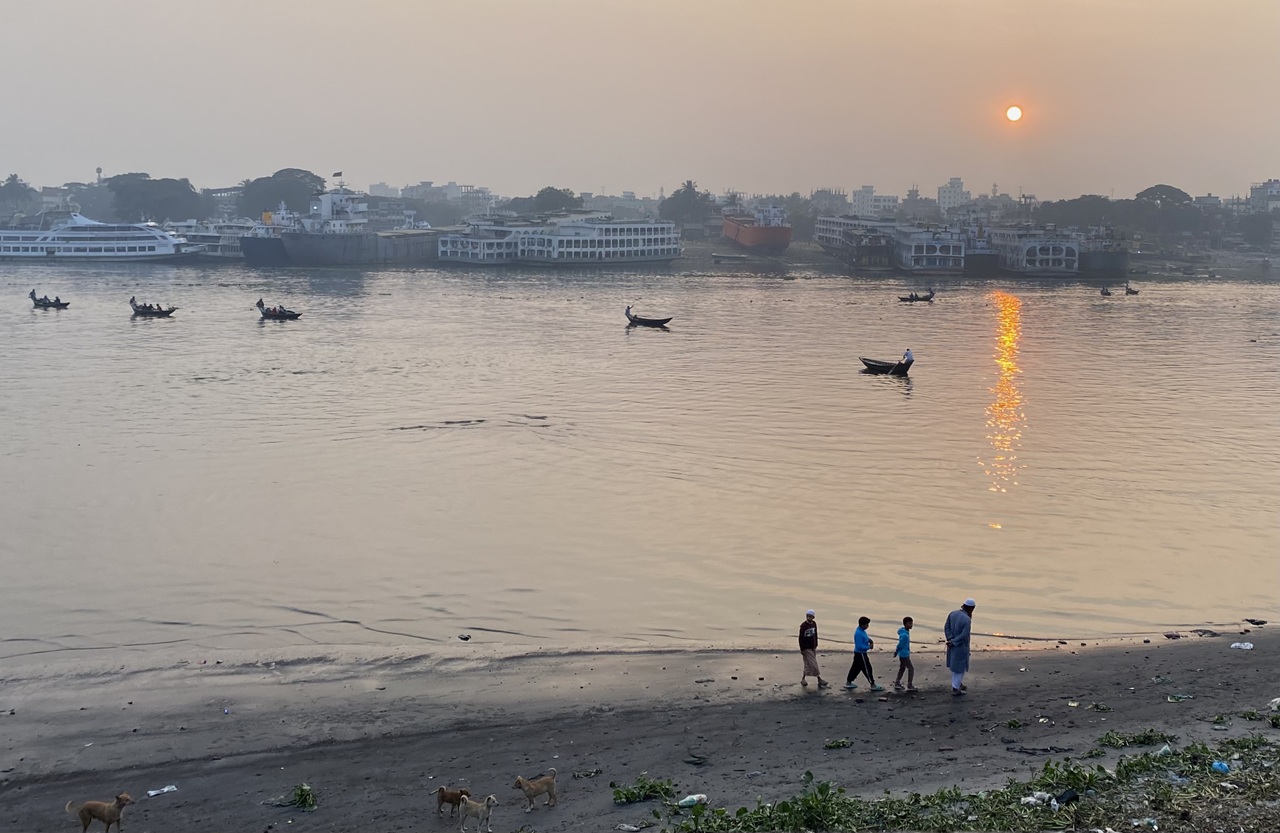
The Buriganga, which flows through Dhaka and Narayanganj, is approximately 29 kilometres long with an average width of 302 metres. Listed as River No. 47 by the Bangladesh Water Development Board (BWDB), it has been central to the existence of Dhaka city since its establishment 400 years ago.
Recent government inspections also extended to the Turag, Shitalakkhya, and Balu rivers as part of the broader campaign to clean the capital’s waterways.