


The monsoon found its most graceful expression beneath the sprawling trees of Bakultala at the Faculty of Fine Arts, Dhaka University, as hundreds of dancers transformed a rainy Friday morning into a celebration of movement, music and togetherness.
‘Ghonoghota 2′, the second edition of the monsoon dance festival jointly organised by Arthy Ahmed Dance Academy and the Faculty of Fine Arts, unfolded in an atmosphere where art, nature and emotion blended seamlessly.
The festival marked the academy’s first production since celebrated dancer and choreographer Arthy Ahmed received the Ekushey Padak 2026, Bangladesh’s second-highest civilian award.

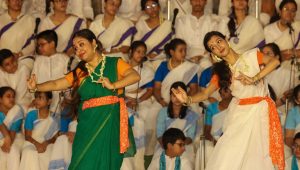
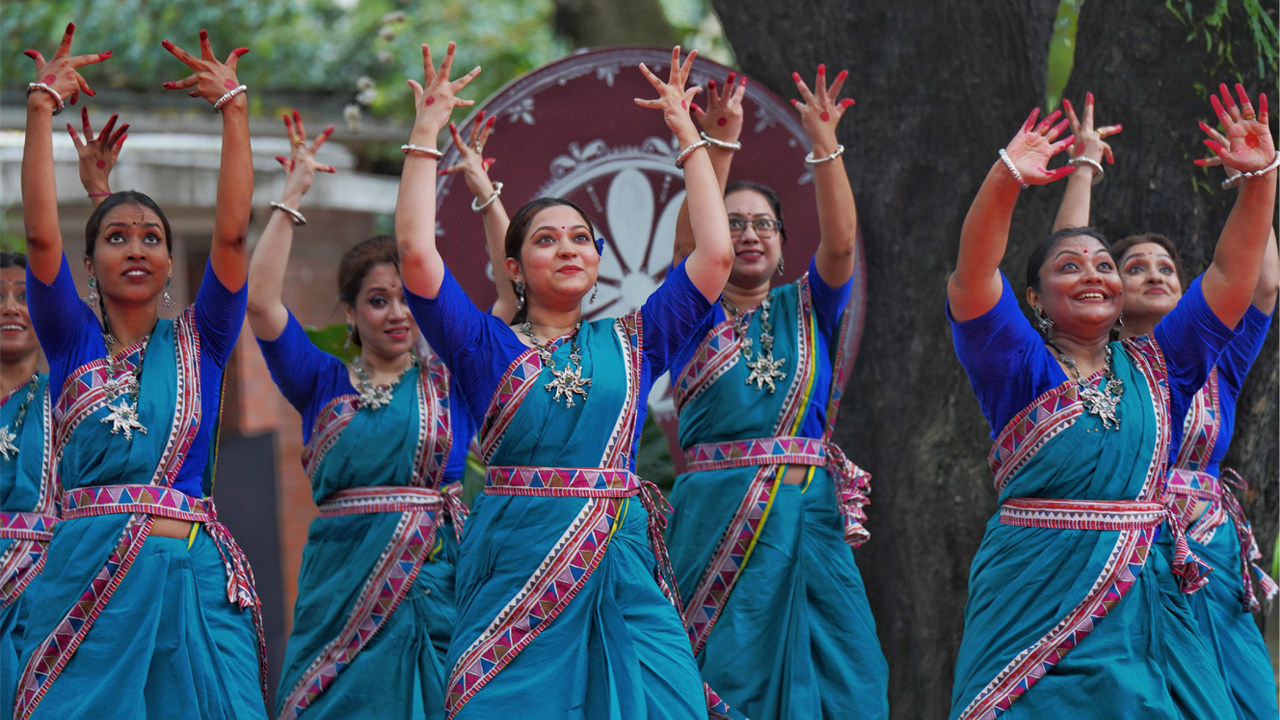
More than 300 performers, aged between three and 70, took the stage, turning Bakultala into a vibrant cultural gathering. Children, students and professionals from diverse backgrounds performed side by side, with many making their first appearance on a major stage.
The audience enjoyed 16 dance productions inspired by the timeless works of Rabindranath Tagore, Kazi Nazrul Islam and Bengal’s folk heritage. The repertoire featured Megh Boleche Jabo Jabo, Hridoy Amar Nachere, Aji Jhoro Jhoro, Pagla Hawar Badol Dine, Rim Jhim Jhim Jhim Ghono Deya Boroshe, Meghero Domuro Ghono Baje, Esho Shyamolo Shundoro, Trishnar O Shanti, Rumjhum, Pran Bhoriye Disha Hariye, Bipulo Torongo Re, More Bhaboran Eki Hawa, Badolo Baul Bajay, Nil Anjon Ghono and Bristir Gaan, before culminating with Amra Shobai Raja, performed by the entire ensemble.




Many spectators embraced the organisers’ dress code of white, blue and green, adding to the festival’s visual harmony.
Speaking at the event, Arthy Ahmed said, “Ghonoghota is not just a dance performance; it is a platform where people’s cherished dreams find expression. Here, age is never a limitation. Through this festival, we wanted to celebrate the monsoon as a season of Bengali culture, human connection and collective joy.”
She said the enthusiastic response to last year’s inaugural edition inspired a larger festival this year after nearly four months of preparation.
The event also carried a humanitarian message. In collaboration with JAAGO Foundation, donation booths were set up to collect funds for people affected by the recent floods in the Chattogram Hill Tracts.
According to the organisers, doctors, engineers, teachers, journalists, researchers, scientists, social workers, homemakers and people from many other professions joined the performances, reflecting the academy’s belief that dance transcends age and occupation.
For one unforgettable morning, Bakultala became more than a performance venue. It blossomed into a living canvas where rain-soaked melodies, graceful choreography and compassion came together, reminding the audience that culture is at its most powerful when it celebrates both beauty and humanity.