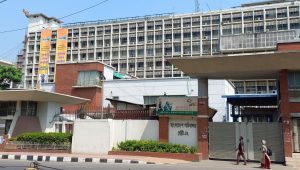



For Joy Biswas, a government-allocated low-rent flat in Dhaka’s Baunia Badh area of Mirpur was supposed to mark a new beginning. Instead, he returned to the slum where he grew up.
“I calculated the expenses beyond rent and decided to return to where I was raised to take over my father’s business,” Joy explained.
Asked why he chose to leave despite the flat’s better living environment, he added, “I look at the financial calculation first. If incomes were higher, nobody would live in a slum.”
His experience highlights a recurring flaw in Bangladesh’s urban housing policy: relocating low-income families into formal housing fails if living costs outpace their ability to pay.
The previous Awami League administration began allocating rental flats to slum dwellers in August 2021.
At Kalshi, near Mirpur Section 11, five 14-storey buildings were constructed on six bighas of land. Each tiled unit, measuring between 620 and 719 square feet, features two bedrooms, a balcony, a drawing room, and a bathroom.
Although the Tk4,500 monthly rent seemed affordable, additional living expenses quickly became onerous. Consequently, many beneficiaries have abandoned the flats to sublet them and return to informal settlements.
“Many people sublet the units at double the rent and move back to the slums,” noted local resident Habibur.
Meanwhile, the new BNP administration is planning another major housing initiative for slum dwellers. Initial discussions with China cover potential developments in Gulshan’s Karail, Mohakhali’s Sattala, and Mirpur’s Bhashantek, with an estimated preliminary cost of Tk10,000 crore.
However, historical precedents in Bangladesh suggest final expenditures will inevitably exceed original forecasts.

When flat life becomes unaffordable
Rafiqul Islam, a Baunia Badh resident, explained that rent represents only a fraction of his monthly expenditure.
“On top of the Tk4,500 rent, we have to pay a Tk1,400 service charge,” he said. He spends around Tk3,000 further a month on gas cylinders and extra electricity costs, pushing his total monthly outlay beyond Tk15,000. “Most people here earn between Tk15,000 and Tk20,000 a month. What will we eat, and how will we support our families?” he asked.
Another resident, Moyna Begum, added, “In the slum, we paid just Tk500 for electricity and water combined. Here, we face hefty gas and electricity bills. After covering these costs, putting food on the table has become a struggle.”
Urban planner Adil Muhammad Khan told TIMES of Bangladesh that many rehabilitation projects fail because they overlook residents’ earning capacity.
“If a family spending Tk4,000 in a slum is forced to pay Tk7,000 or more in a new housing development, plus maintenance costs, it simply becomes unaffordable,” he noted.
Government struggles to recover rent
The Baunia Badh project is being implemented by the National Housing Authority.


Abu Huraira, executive engineer of Dhaka Division-1, said many allocated residents are not living in the flats.
“Many low-income residents who received allocations are renting out the flats to others for around Tk10,000 instead of living there,” he said.
The project currently has around Tk2.5 crore in outstanding rent.
According to the official, recovering the investment under the current rent structure would take nearly 100 years.
“In reality, the building cannot be rented out in this way for 100 years,” he said.
According to the Bangladesh Bureau of Statistics’ Population and Housing Census 2022, around nine lakh slum dwellers live in Dhaka Division.
“Simply shifting people into high-rise buildings without increasing their income does not improve their quality of life. Instead, this high-cost model pushes the government towards financial losses and waste of resources,” Adil Muhammad Khan said.
Bhashantek’s failed model
The problems facing Baunia Badh have revived concerns over the failed Bhashantek rehabilitation project in Mirpur-14.
In 1998, the Awami League government planned to build 7,560 flats for slum dwellers. In 2003, the Ministry of Land signed an agreement with North South Property Development Limited to implement the project on around 48 acres of land.
Later investigations found allegations of fraud and irregularities involving around Tk500 crore until 2016.
A 2019 UNDP Bangladesh report, Housing Solutions for the Urban Poor in Bangladesh, said the project failed due to weak management and the sale of flats to higher-income groups.
The report recommended low-interest, long-term loans and microfinance support for slum dwellers instead of conventional housing finance.
Karail residents remain uncertain
The BNP’s election manifesto includes a commitment to build flats for Karail slum dwellers.
Following the Aminbazar cleaners’ housing model, the party plans to construct flats measuring between 500 and 600 square feet.
Non-governmental organisation Dustha Swasthya Kendra surveys found around 35,000 families, comprising nearly 1,50,000 people, live in Karail, Bhashantek and Sattala slums.
However, land ownership remains the biggest challenge.
Karail land is controlled by the Postal and Telecommunications Division and Rajuk, while Sattala and Bhashantek involve multiple government agencies.
Resolving ownership disputes and deciding project financing and management could take years.
On 25 April, Rajuk Chairman Md Riaz Ul Islam said at a seminar, “Karail slum dwellers supposedly do not want modern flats; they want to remain the way they are.”
However, Karail resident Shahin Islam said, “Previously, we lived in one room. When Tarique Rahman talked about constructing buildings, we became hopeful.”
Adil Muhammad Khan warned that repeating the same high-rise model could recreate the problems seen in Bhashantek and other projects.
Experts call for a different model
Adil Muhammad Khan supports a lower-rise housing approach.
He said four- to five-storey “walk-up” buildings could reduce construction and maintenance costs compared with high-rise projects.
“This is essentially a model based on aggressive urbanisation, which is not always compatible with people’s natural lifestyles and human dimensions,” he said.
Dhaka North City Corporation initially estimated that three planned projects would cost around Tk5,500 crore, with each unit costing Tk15 lakh.
However, the Ministry of Local Government has sent a Tk10,000 crore proposal to China. The government has said Beijing has given preliminary consent to the proposal.
State Minister for Local Government Mir Shahe Alam, however, said that 20-storey buildings will be constructed for residents of the Karail, Sattala, and Bhasantek slums, where they will pay only utility bills rather than rent.