




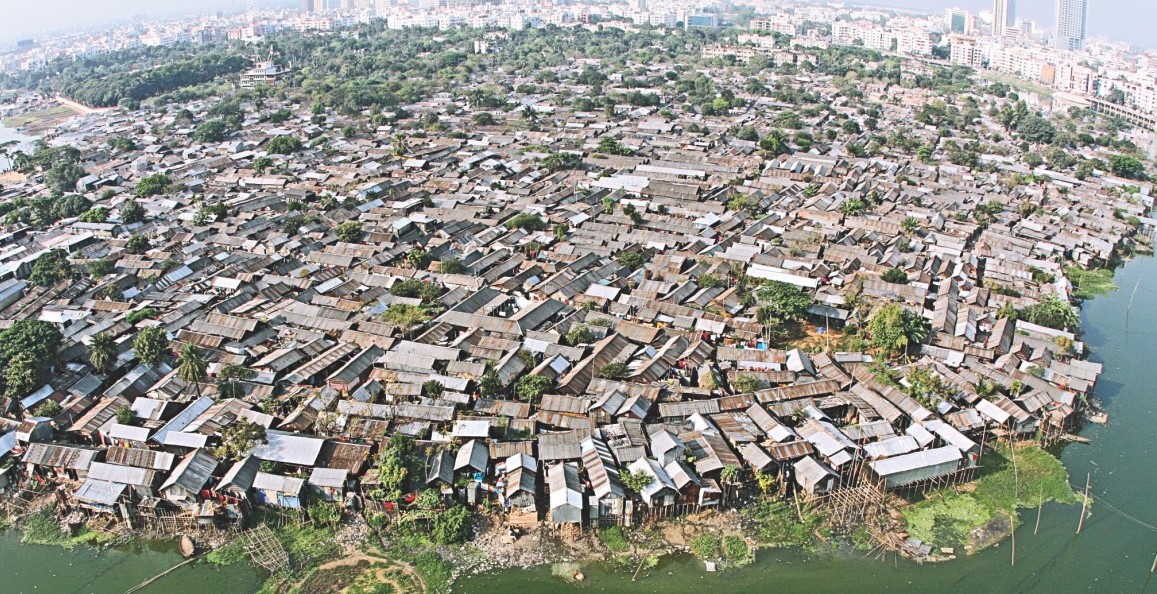
Few places in Dhaka embody a greater urban contradiction than Korail. Occupying some of the capital’s most valuable land, the city’s largest slum sits at the heart of Dhaka, surrounded by affluent neighbourhoods, a busy commercial district and the Gulshan-Banani Lake. Covering almost 100 acres and home to an estimated 100,000 to 200,000 people, Korail represents not only one of Bangladesh’s largest informal settlements but also one of the capital’s greatest urban redevelopment opportunities.
In 1961, the area was acquired by the then Telephone and Telegraph (T&T), now Bangladesh Telecommunication Company Limited (BTCL). BTCL’s use of the land for transmission equipment became increasingly obsolete, prompting about 90 acres to be formally handed over to the Public Works Department (PWD) in 1990. The transfer was allegedly in violation of a previously established agreement with former private landowners. Legal complications followed, and BTCL eventually reclaimed the land from the PWD. As a result, three parties became stakeholders in the disputed ownership of the Korail area: BTCL, the PWD and the former private landowners.
In the early 1990s, due to an unresolved ownership dispute, various T&T affiliates, local strongmen and influential political elites unofficially occupied sections of the uninhabited land. They went on to informally rent out land and housing to impoverished city dwellers at low rates. As urbanisation accelerated and evictions took place elsewhere in Dhaka, including Agargaon, demand for low-cost housing increased. Under these pressures, the number of inhabitants and the extent of the settlement grew into the Korail slum as it exists today.
According to the 2011 Population Census, around 40,700 people lived in Korail. A 2012 report by the Economic Empowerment of the Poorest estimated that the settlement had grown to more than 20,000 families. The residents comprise a significant part of Dhaka’s workforce in the garment industry, transportation, construction, land development, domestic services, waste management, small industries and the informal sector. Despite their significant contribution to the economy, slum dwellers from Korail and elsewhere remain excluded from basic services, principally because slums are considered ‘illegal settlements’. There have also been repeated attempts to evict residents, the latest in 2012. However, High Court orders issued in 1999, 2000 and 2008 stated that eviction must not take place without rehabilitation.
The Information and Communication Technology Division plans to establish the Mohakhali ICT Village under the Private Sector Development Support Project on a 19-hectare site within Korai. Following a writ petition filed in 2012 by Ain o Salish Kendra and Bangladesh Legal Aid and Services Trust (BLAST), the High Court directed the ICT Division to take appropriate measures for the rehabilitation of slum dwellers who came to Dhaka in search of livelihoods. In 2014, the Bangladesh Hi-Tech Park Authority published a report suggesting six options for the resettlement of the residents. Despite these initiatives, no meaningful progress has been made in either rehabilitating residents or putting this strategically located land to productive use.
In many ways, Dhaka is like Singapore. Major development projects in the city-state, including the MRT system and other infrastructure, were carried out without disrupting residents’ daily lives. Unlike cities such as Kuala Lumpur in Malaysia, where either the capital was relocated or new cities were developed to accommodate rising demand for offices and housing or to ease traffic congestion, Singapore modernised while making efficient use of its existing urban space. Singaporean architects and developers could serve as a valuable model for Bangladesh. Their expertise in modern urban planning and innovative building design could greatly benefit Dhaka.
Singapore is widely recognised as one of the world’s smartest cities. According to the IMD Smart City Index, published by the Swiss business school IMD and the Singapore University of Technology and Design, the city has successfully adopted digital technologies to improve the lives of its residents. Transport functions efficiently, industry and commercial areas are well integrated, and planning authorities have maintained a clear vision of creating a vibrant live-work-play city within a tropical garden. Water, waste management and sewerage systems are among the best in the world. Looking at public safety, mobility, governance and health, the index assessed how cities maintain green spaces, strengthen institutions and digitalise access to employment while ensuring the security of their citizens.
While there is no universal definition of a smart city, the concept emerged with the advent of the Internet of Things. Smart cities are committed to improving the provision and development of urban services through digital technology.
The proposed models could be as follows. The Government of Bangladesh could invite the Government of Singapore to select architects and contractors to invest in and develop the area into a city within a city, similar to Makati in Manila. The area could include modern office buildings, an IT incubation centre, five-star hotels, high-end residential developments, restaurants and other commercial facilities. The project could be awarded through a competitive bidding mechanism, with the highest bidder securing the work. As most of the land is owned by the government, handing over possession and obtaining the necessary legal clearances from the High Court would be comparatively easier.
The project could be implemented under a long-term build-operate-transfer arrangement, subject to periodic renewal. The operator would determine lease rates for commercial establishments based on project costs and prevailing market rates while charging management fees for maintenance.
As part of the project, the selected firm or firms would develop another site, possibly near Madani Road, to provide residential housing for Korail residents. Before redevelopment begins, a comprehensive survey should be conducted to determine the actual number of residents and households. Construction of the rehabilitation housing should be completed before work starts at the Korail site. The developer should also arrange commuter services, as many women living in Korail work as domestic helpers in the Gulshan and Banani areas.
The proposed model could generate several important benefits. Slum dwellers would enjoy permanent and hygienic living conditions instead of remaining in informal settlements. The government would generate significant recurring revenue from one of the capital’s most valuable land assets. At the same time, Dhaka would gain a modern business district that could encourage more foreign companies to establish offices in the capital and strengthen Bangladesh’s appeal as an investment destination.
For more than three decades, Korail has remained caught between legal disputes, competing redevelopment plans and repeated promises of rehabilitation. Numerous studies, proposals and court directives have sought to shape its future, yet there has been little meaningful progress in either rehabilitating residents or making productive use of this strategically located land.
A redevelopment model that combines modern urban planning with proper rehabilitation could transform Korail into a smart city while ensuring that existing residents are not left behind. Such an approach could create a new business district for Dhaka, generate substantial economic value for the government and improve the living conditions of thousands of families. The challenge is no longer a lack of studies or proposals. It is turning those proposals into action.
The views expressed in this article are solely those of the author
The writer is the CEO of Brummer & Partners Bangladesh


