




Ambassador of Bangladesh to Germany Muhammad Zulqar Nain has said the Bose-Einstein theory will serve as a catalyst for quantum technology cooperation between Bangladesh and Germany.
The embassy of Bangladesh to Berlin, Germany said this in a press release on Tuesday.
This follows the legacy of Satyen Bose, a teacher at the University of Dhaka, who in 1924 wrote to Albert Einstein regarding the loss of kinetic energy in subatomic particles near absolute zero.
Einstein agreed with the findings, leading to the joint development of the Bose-Einstein Condensate theory, which is recognised as the fifth state of matter.
Practical proof of this theory was established in 1995, revealing that subatomic particles achieve superconductivity at absolute zero, providing the fundamental driving force for quantum computing.

Unlike conventional computers using zero and one bits, quantum particles utilise superposition and entanglement to solve complex analytical problems at extraordinary speeds.
Experts believe the Bose-Einstein Condensate theory will offer solutions to challenges such as decoherence, scalability, and error correction. By functioning as a ‘super atom’ near absolute zero, these particles require fewer qubits and significantly enhance processing speed.
Quantum computing is set to revolutionise fields including medicine, logistics, cybersecurity, simulations, and artificial intelligence due to its exponential processing power.
For instance, Google’s Sycamore quantum processor completed a calculation in two minutes in 2019 that would have taken the most powerful supercomputer 47 years to finish.



However, the benefits of this technology will depend on national policies and human resource capabilities. There is growing concern in international diplomatic circles regarding a global quantum divide, as wealthy nations possess the necessary cryogenic atmosphere and resources that many developing countries lack.
With the developed world already allocating $31 billion for quantum research, discussions regarding commercialisation are currently underway in London.
Quantum policies must encompass education, communication, and security, as quantum computers can easily break current cryptographic passwords using Shor’s algorithm reverse hashing.
This necessitates a focus on post-quantum cryptography and algorithms. Bangladesh is advised not to plan future digital infrastructure without considering these challenges, while also integrating quantum science into its educational curriculum and establishing a national quantum policy.
The job market for quantum computing is robust, with a 2021 McKinsey report showing three times more job advertisements than qualified applicants.
Germany has emerged as a premier destination for studying this field, offering English-taught, world-class programmes with minimal tuition fees and collaborations with the Max Planck Society and Fraunhofer-Gesellschaft.
Notable institutions include Munich Technical University (TUM), which offers a research-focussed Master’s in Quantum Science and Technology in collaboration with MCQST, and Leibniz University Hanover, which provides an M.Sc. in Quantum Engineering.
Other key entities include the Quantum Initiative Rhineland-Palatinate (QUIP), TU Chemnitz, which focuses on condensed matter physics and graphene, and TU Braunschweig, offering an M.Sc. in Quantum Technologies.
Research is also being conducted by the DLR Quantum Computing Initiative and Forschungszentrum Jülich (FZJ).
Industrial applications are being explored by QUTAC, a consortium including major corporations like BASF, BMW, Volkswagen, and Siemens, while the Center for Integrated Quantum Science and Technology (IQST) in Baden Wuttemberg focuses on photonics and biology.
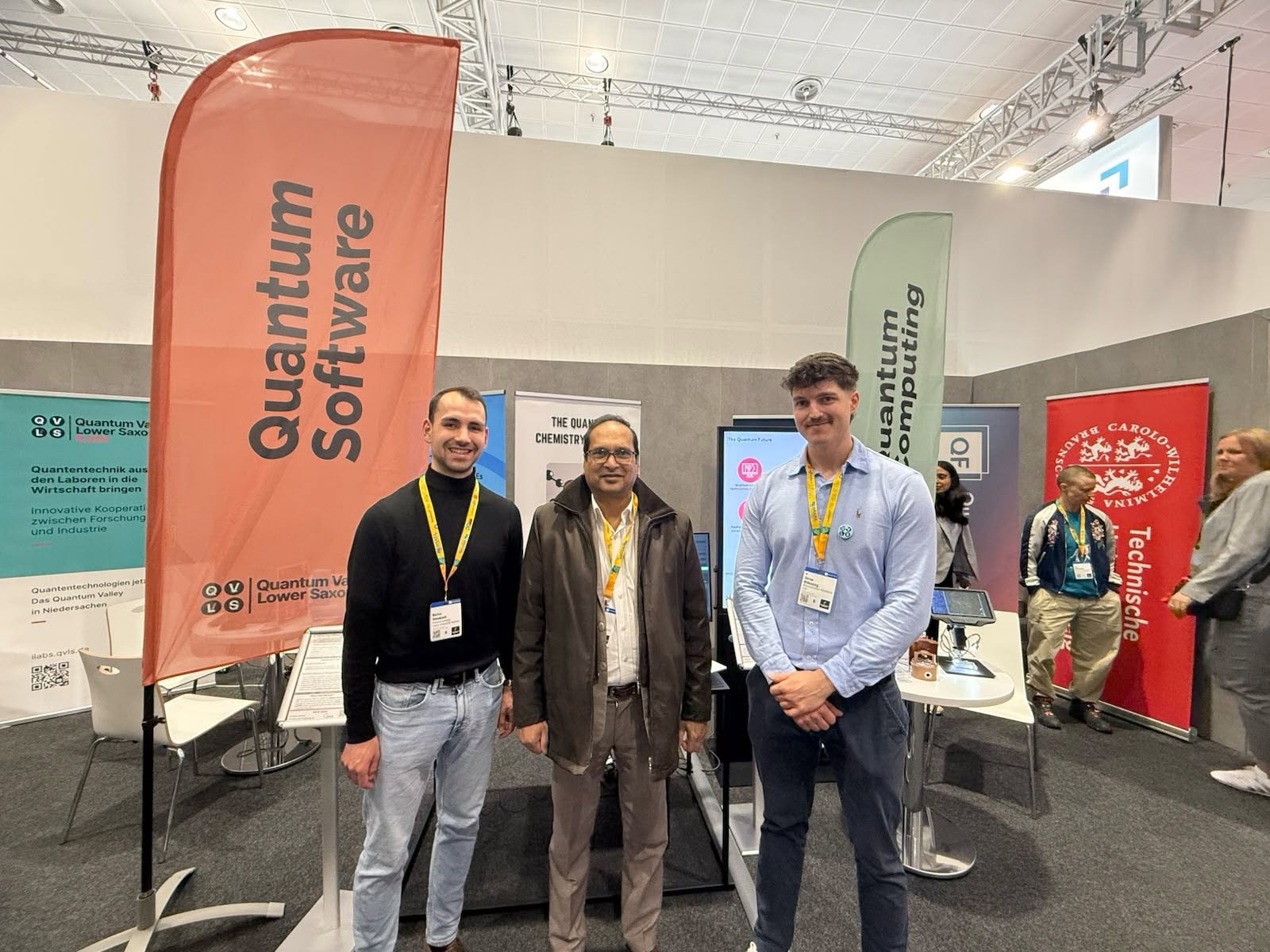
Muhammad Zulqar Nain recently held discussions with various German universities and research institutions regarding cooperation in quantum education and research.
Candidates with STEM degrees, particularly those with a background in quantum mechanics, are encouraged to apply for these opportunities after coordinating with relevant professors for scholarships.