
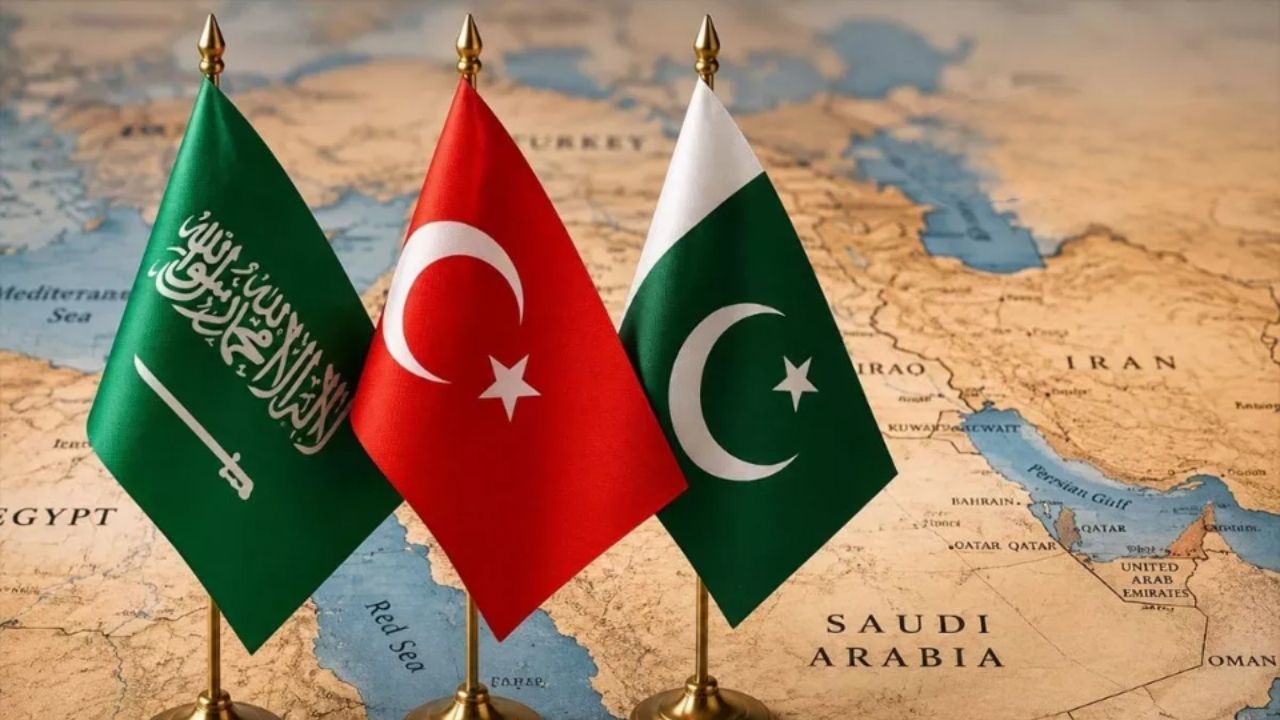



The proposed Mecca Joint Defense Treaty, signed by Saudi Arabia, Türkiye and Pakistan, has generated considerable interest in Bangladesh. Dhaka has not received an invitation yet, but its response has been broadly positive. That alone is enough to begin a much larger conversation. The real question is not whether Bangladesh can gain from joining the alliance. It almost certainly can. The more difficult question is whether those gains would justify the strategic costs of becoming part of a military arrangement whose consequences may extend far beyond the Middle East.
The attraction is obvious. The three founding countries bring together resources that Bangladesh could find useful. Saudi Arabia has enormous financial resources, energy power and geopolitical influence. Türkiye possesses an increasingly sophisticated defence industry, including drones, missiles, naval capabilities, sensors and electronic warfare technology. Pakistan offers a large professional military, defence infrastructure, combat experience and nuclear capability. Together, they could create a significant platform for military technology, intelligence cooperation, training and defence production.
For Bangladesh, the technological dimension may be particularly attractive. A broader relationship could potentially move beyond buying finished equipment towards training, technology partnerships and joint development. In an era when artificial intelligence, drones, surveillance systems and electronic warfare are rapidly transforming warfare, access to such cooperation could strengthen Bangladesh’s defence capabilities without requiring it to develop everything independently.
There is also an economic argument. Saudi Arabia is one of Bangladesh’s most important sources of employment opportunities and remittance income, as well as a longstanding development partner. Millions of Bangladeshis depend directly or indirectly on the Saudi economy. A deeper strategic relationship could therefore create opportunities in investment, employment, infrastructure and economic cooperation.
The maritime argument may be even more consequential. Bangladesh’s economic lifeline extends far beyond the Bay of Bengal. Energy imports, including LNG and petroleum, connect the country through the Indian Ocean to the Arabian Sea and ultimately to the Middle East. Any disruption along those routes can quickly become an economic problem at home. A closer security relationship with an influential power in the region could therefore provide Bangladesh with greater strategic access and potentially strengthen the security of its commercial routes.

But this is precisely where the logic of the Mecca Pact becomes complicated. Economic geography does not necessarily require military alignment. Bangladesh needs access to the Indian Ocean and the Arabian Sea, but it does not automatically follow that it needs to become part of a collective defence structure to secure that access. The distinction matters because defence alliances create obligations, expectations and perceptions that ordinary economic partnerships do not.
The most important concern is the principle that an attack on one member can be treated as an attack on all members. Even if the pact is primarily defensive and does not currently resemble NATO in terms of command structure or a permanent joint military, collective defence arrangements can acquire political momentum of their own. A country may join an alliance intending only to strengthen its security, yet eventually discover that the security concerns of its partners have become part of its own strategic calculations.
For Bangladesh, the biggest complication is not Saudi Arabia or Türkiye. It is Pakistan. Pakistan’s presence inevitably gives the pact a South Asian dimension. India’s response will therefore matter enormously to Dhaka. New Delhi is already sensitive to any strategic development involving Pakistan, and a Bangladesh-Pakistan military relationship could be interpreted through the prism of India’s own security concerns. What Bangladesh might see as a defensive arrangement could be perceived elsewhere as a shift in the regional balance. Dhaka’s relationship with India is too important to be treated as collateral damage in another country’s strategic architecture. India is Bangladesh’s immediate neighbour and an indispensable factor in its trade, connectivity, energy security and regional diplomacy. Any decision that creates unnecessary suspicion in New Delhi would require exceptionally strong justification.




There is also a larger danger. Strategic competition rarely remains confined to formal alliances. If India perceives the Mecca arrangement as strengthening Pakistan’s strategic position, it may seek deeper cooperation with other powers, including Israel. That could intensify military and geopolitical competition across South Asia. The result could be more proxy competition, greater strategic anxiety and a more militarised regional environment. Bangladesh would then face the classic dilemma of the smaller state. It could become more secure in one direction while becoming more vulnerable in another.
This does not mean Bangladesh should reject the Mecca Pact outright. It means Dhaka should resist the temptation to confuse access with alignment. There is a useful distinction between participating in defence cooperation and becoming part of a collective military commitment. Bangladesh already demonstrates that distinction. It has participated in a Saudi-initiated maritime defence arrangement aimed at protecting freedom of navigation around the Bab al-Mandeb Strait, the Red Sea and the Gulf of Aden. Yet that participation did not mean Bangladesh was required to enter the war when Houthi attacks occurred.
Indeed, Bangladesh may have something distinctive to offer precisely because it is not a traditional military power. Its long experience in UN peacekeeping provides credibility in training, operational discipline and international security cooperation. Rather than trying to become another major military contributor, Dhaka could carve out a specialised role in training, peacekeeping expertise, disaster response, maritime security and compliance.
There is another reason for caution. Alliances are built not only on what they promise today but also on what they might become tomorrow. The Mecca Pact is still developing. Its command structure, institutional mechanisms, long-term membership and precise obligations remain important questions. Calling it a Muslim NATO may be politically attractive, but the comparison can also obscure the fact that the alliance does not currently possess NATO’s established military command system or integrated armed forces.
Bangladesh has always had to balance multiple relationships. It needs Saudi Arabia for economic and labour opportunities, Türkiye for technology and defence cooperation, Pakistan for broader regional engagement, India for geography and connectivity, China for trade and infrastructure, and other major powers for investment and international diplomacy. The country’s greatest strategic asset may therefore be its ability to maintain relationships across competing centres of power. Joining a formal military alliance could narrow that diplomatic room.
The irony is that Bangladesh may gain more from the Mecca Pact by remaining selectively engaged with it than by rushing to become a full member. It can deepen defence cooperation with Türkiye, expand economic ties with Saudi Arabia, improve maritime coordination and explore intelligence and technological partnerships while preserving the freedom to make independent decisions during regional crises.
Bangladesh should also ask a less glamorous but more important question: what problem is membership actually intended to solve? If the answer is access to military technology, there are bilateral partnerships. If the answer is maritime security, there are regional and international maritime mechanisms. If the answer is investment and employment, Saudi Arabia offers enormous scope outside a military alliance. If the answer is training, Bangladesh already has substantial international peacekeeping experience.
The wise course, therefore, is neither enthusiastic alignment nor reflexive rejection. Dhaka should wait for the terms, examine the obligations, assess India’s likely response, calculate the economic and maritime benefits, and determine exactly what Bangladesh would be expected to contribute. Most importantly, the decision should be subjected to a national strategic debate rather than treated as a routine diplomatic development.
The views expressed in this article are solely those of the author
The writer is an academic, journalist, and political analyst. E-mail: [email protected]