When climate scientists warn about the possible arrival of a Super El Niño, the world usually reacts with the language of probability. There is a 66 percent chance of a strong event, and a 96 percent chance it will continue through winter. Ocean temperatures are crossing thresholds. Wind patterns are weakening. Forecast models are flashing red. Yet for millions of ordinary people, especially in vulnerable countries like Bangladesh, these percentages are not abstract scientific calculations. They are warnings about crop failures, rising food prices, water shortages, disease outbreaks, power disruptions, and economic instability. The real question is not whether El Niño will become stronger. The real question is whether modern societies are genuinely prepared for a climate system that is becoming increasingly unpredictable.
Human civilisation has developed an unusual confidence in technology, infrastructure, and economic growth. We have built smart cities, digital economies, artificial intelligence systems, and trillion-dollar financial markets. Yet a warming patch of water in the Pacific Ocean can still disrupt global food chains, trigger inflation, collapse harvests, and displace millions of people. That contradiction exposes a deeper truth about modern civilisation. Despite all our scientific advancements, humanity remains extremely vulnerable to climate instability.
El Niño is not new. It has existed for centuries as part of a natural climate cycle. Normally, it appears every two to seven years and lasts between nine and twelve months. But what makes the current situation alarming is not merely the possibility of a strong El Niño. The real danger lies in the collision between natural climate variability and human-induced global warming. Scientists have repeatedly warned that climate change is amplifying weather extremes. When an already warming planet experiences a strong El Niño, the consequences become more severe, more expensive, and more politically destabilising.
The numbers alone should concern policymakers. According to the World Meteorological Organisation, the years between 2015 and 2024 were among the hottest on record globally. The previous Super El Niño of 2015 to 2016 pushed global temperatures to record highs. That event triggered droughts in parts of Africa, forest fires in Southeast Asia, coral bleaching in the Pacific, and agricultural disruption across multiple continents. The World Bank estimated that weather-related disasters already cost the global economy hundreds of billions of dollars annually. A stronger climate shock today would hit a world already burdened by inflation, debt crises, geopolitical conflict, and food insecurity.

Many governments still treat climate disasters as temporary emergencies instead of structural economic threats. This is a serious mistake. El Niño is not simply about hotter weather. It affects monsoons, fisheries, river systems, crop cycles, energy production, public health, and migration patterns. In India and Southeast Asia, reduced monsoon rainfall could damage rice production and increase food prices for hundreds of millions of people. In parts of Africa, drought conditions could intensify hunger and water scarcity. In Latin America, floods and storms may destroy infrastructure and agriculture simultaneously.
Bangladesh should pay particular attention. The country already ranks among the most climate-vulnerable nations in the world despite contributing less than 0.5 percent of global carbon emissions. Around 40 million people in coastal areas face increasing environmental risks from cyclones, salinity intrusion, floods, and rising sea levels. A strong El Niño could further disrupt rainfall patterns and intensify heatwaves. Dhaka already struggles with urban heat stress, poor drainage systems, waterlogging, and air pollution. During prolonged heatwaves, electricity demand rises sharply because of increased cooling needs, placing additional pressure on an energy sector already facing fuel import challenges.
Agriculture remains another major concern. According to the Bangladesh Bureau of Statistics data, agriculture still employs more than 35 percent of the country’s workforce directly or indirectly. Rice production depends heavily on predictable rainfall and irrigation systems. A weak monsoon or prolonged dry conditions could damage crop yields and raise food prices significantly. Lower-income households would suffer the most because food inflation disproportionately affects poorer communities. Bangladesh experienced sharp inflationary pressure after recent global supply disruptions. Another climate-driven shock could deepen economic hardship further.




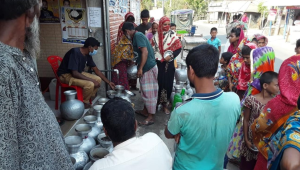
Public health risks are equally alarming. Heatwaves increase cardiovascular and respiratory illnesses, particularly among elderly populations and low-income workers. Water scarcity and flooding also create ideal conditions for waterborne diseases such as cholera and diarrhoea. According to international health studies, extreme heat already kills hundreds of thousands of people globally every year. Yet heat related deaths often remain underreported in developing countries because monitoring systems are weak.
Still, perhaps the most worrying issue is psychological complacency. Modern societies have normalised climate anxiety without truly changing behaviour. Every year brings new records. The hottest month. The hottest ocean temperatures. The most expensive storms. The largest wildfire season. Yet public attention moves quickly from one crisis to another. Climate disasters have become so frequent that they are increasingly treated as background noise.
There is also a dangerous inequality within climate preparedness. Wealthier nations possess stronger infrastructure, larger emergency funds, advanced forecasting systems, and insurance mechanisms. Poorer countries often rely on external aid after disasters occur. This creates a deeply unfair global reality. Nations that contributed the least to global warming frequently face the worst consequences. Climate justice, therefore, cannot remain a fashionable conference slogan. It is becoming a question of survival.
Another uncomfortable reality is that governments often prioritise visible infrastructure projects over invisible resilience systems. Politicians prefer bridges, flyovers, airports, and mega projects because they produce immediate political value. Investments in drainage systems, early warning networks, climate-adaptive agriculture, urban cooling plans, and public health preparedness receive far less attention because their benefits are gradual and less visible. But climate resilience is no longer optional infrastructure for the future. It is economic insurance for the present.
The coming El Niño should therefore force societies to rethink preparedness beyond disaster response. Preparation cannot simply mean distributing relief after floods or opening cooling centres during heatwaves. It must involve redesigning cities, protecting wetlands, strengthening healthcare systems, modernising agriculture, diversifying energy sources, and creating long-term climate adaptation strategies. Universities, media institutions, and schools must also play a larger role in climate literacy because misinformation and political denial continue to delay meaningful action.
The frightening reality is that humanity may already be entering an era where climate extremes become permanently normalised. Scientists continue to debate whether this El Niño will officially reach Super El Niño status. But for ordinary citizens facing rising temperatures, expensive food, unstable weather, and uncertain futures, the scientific label may ultimately matter less than the lived consequences. The Pacific Ocean may be thousands of miles away from Bangladesh, but its warming waters could still shape the lives of farmers in Rangpur, garment workers in Gazipur, and families living beside fragile coastal embankments.
The world often behaves as if climate disasters are temporary interruptions to normal life. Increasingly, they are becoming normal life itself.
The writer is an academic, journalist, and political analyst. E-mail: [email protected]