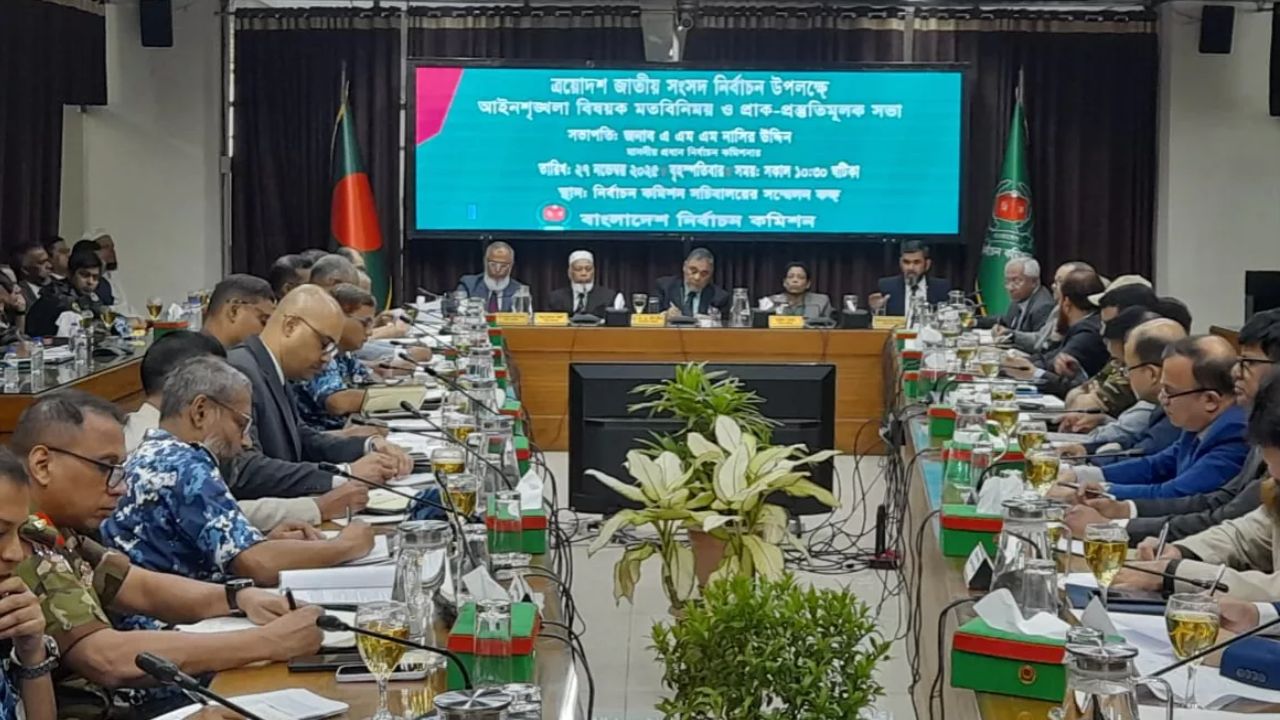

The Election Commission on Thursday provided law enforcement agencies with the deployment outline for security arrangements ahead of the national election expected in early February 2026.
“We’ve given them the framework. The respective forces will now prepare the detailed plan. Whether they deploy static teams, reserve units or striking forces at polling stations is entirely their decision.
The Home Ministry will determine the number of personnel and the duration of deployment,” EC Senior Secretary Akhtar Ahmed told reporters after a meeting at Nirbachan Bhaban.

Top representatives of the Army, Navy and Air Force attended the meeting, along with officials from the Home Ministry, Police, RAB, Border Guard Bangladesh, Coast Guard, Ansar and VDP, the Armed Forces Division, DGFI, NSI, NTMC, SB and CID.
Chief Election Commissioner AMM Nasir Uddin chaired the discussion, which focused on the deployment of security personnel, maintaining law and order during the polls, ensuring the safety of election officials and materials, and removing illegal arms and unauthorised campaign posters.



The Senior Secretary said the Commission does not have its own security force and relies on coordinated support from law enforcement agencies. “They have assured us they will begin field-level work from day one and play an effective role,” he said.
Asked about the magistracy power of the armed forces, Akhtar Ahmed said the armed forces are currently under the definition of law enforcement agencies. “Their magistracy power will remain valid until February 2026,” he said. When asked if this could conflict with election laws after the schedule is announced, he replied, “I don’t see anything contradictory here.”
Explaining the deployment outline, he said the plan consists of three components: static deployment at polling stations; static and mobile checkposts alongside patrols based on geography and road access; and a central reserve force.
“There will also be a central reserve force. So there are essentially three components—static, mobile and central reserve. These will now be designed by the respective forces based on our guidelines,” he said, adding that the conventional “striking force” falls under these components to ensure mobility, deterrence and timely response.
“We will also use NTMC’s capabilities, and cybersecurity will be closely monitored,” he said. “Actually, this is our strategic plan.”