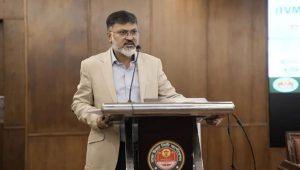
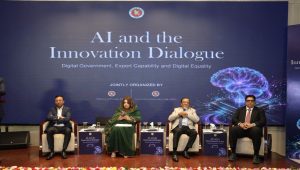
The Faculty of Social Sciences at the University of Dhaka (DU) held a discussion on Wednesday to mark the university’s 105th founding anniversary, focusing on democracy, higher education and the faculty’s role in addressing national challenges, the university said in a press release.
The programme, titled Restoring Democracy and Higher Education at the University of Dhaka: The Role of the Faculty of Social Sciences, took place at the Professor Mozzaffar Ahmed Chowdhury Auditorium. Discussions centred on Bangladesh’s democratic development, the quality of higher education, research, social values and the university’s contribution to national intellectual leadership.
Professor Dr Abdus Salam, Pro-Vice-Chancellor of the University of Dhaka, attended the event as chief guest. Professor Dr Wahiduddin Mahmud, economist, and Professor Dr Mahbub Ullah, political and social thinker, spoke as guest discussants. The programme was chaired by Professor Dr Mohammad Moinul Islam, Acting Dean of the Faculty of Social Sciences, and moderated by Professor Robayet Ferdous of the Department of Mass Communication and Journalism. The event opened with a musical performance by former University of Dhaka student and singer Mridula Samaddar.

In his welcome remarks, Professor Dr Mohammad Moinul Islam said the Faculty of Social Sciences has 237 faculty members across its 16 departments engaged in teaching and research. Referring to the absence of research funding from the University Grants Commission for the University of Dhaka during the current year, he stressed the importance of securing research funding from government as well as national and international sources.
He said the faculty plays an important role in developing theoretical and practical knowledge, leadership, creative thinking and social responsibility. He also highlighted academic freedom, coordination among teachers, students and the administration, interdisciplinary research and long-term reform planning as key elements in advancing higher education.




Professor Dr Mahbub Ullah said knowledge begins with doubt and questioning, adding that the university’s success in knowledge creation depends on raising meaningful questions on issues affecting the state and society. Referring to Barrington Moore’s theory, he said the development of a strong and independent bourgeois class plays an important role in establishing democracy and that Bangladesh’s democratic development is closely linked to its socio-economic class structure.
Recalling the university’s history, he said it was established in 1921 after overcoming challenges following the annulment of the Partition of Bengal and had since played a historic role in the Language Movement, the Education Movement, the movement against military rule, the Six-Point Movement, the mass uprisings and the Liberation War.
Professor Dr Wahiduddin Mahmud said civic awareness, reasoned public debate and public reasoning are fundamental to democracy. While maintaining international standards in teaching and research, he said, the university should also prioritise Bangladesh’s own social, economic and policy issues.
He said good governance, social capital, justice, ethics and accountability are essential for an effective democracy, while citizens should remain committed to collective welfare as well as personal interests. He also emphasised strengthening social values and cooperation to address identity crises and social divisions, adding that accountability at every level is essential for national progress.
In his address, Professor Dr Abdus Salam underscored the need for stronger coordination among teachers, students and the university administration. He said the University of Dhaka must prepare for advances in information technology and artificial intelligence and make better use of its institutional strengths while addressing existing challenges.
The programme concluded with a question-and-answer session on research related to identity crises, improving the quality of the university’s research journals and enhancing the international recognition of research conducted at the University of Dhaka. Speakers also stressed the importance of interdisciplinary research, locally grounded knowledge creation, rigorous peer review and greater participation in international research networks, according to the press release.