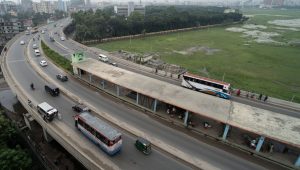
The modern face of Dholaikhal is defined by swirling dust, suffocating traffic congestion, and the deafening, day-long screech of iron being cut.
Amidst the clusters of trucks, rickshaws, and mountains of scrap parts on the pavements, there exists a junction known as “Loharpul” (Iron Bridge). However, to search for an actual canal or an iron bridge at this sweltering intersection today would seem like a cruel joke.
Four centuries ago, this very Dholaikhal served as the lifeline of ancient Dhaka and its primary line of defence. Standing proudly across it was “Loharpul,” the first suspension bridge in the city’s history.
A bridge remembered
While the name ‘Loharpul’ persists, generations of residents have never actually seen the bridge. Md Nazrul Islam, a veteran resident and local businessman, told the TIMES of Bangladesh, “I heard the stories of this Loharpul from my father.
“Even during the British period, large boats used to pass under this bridge.”
Islam witnessed the bridge in a dilapidated state during his youth. He noted that after independence, the historic structure was demolished under the guise of road widening and the construction of culverts.
“Now, the new generation refuses to believe that an entire large canal lies buried under this road, or that a suspension bridge once stood here,” he added.

Islam Khan’s visionary canal
Historical records show that Islam Khan, the first Subedar of Dhaka, initiated the excavation of this canal between 1608 and 1610 AD during the reign of Mughal Emperor Jahangir.
According to the renowned historian and archaeologist Nalini Kanta Bhattasali, the canal served two primary purposes: acting as a moat to protect the city – including the Moghbazar-Tejgaon areas – from external invaders, and providing internal navigation while preventing waterlogging.
The canal originated from the Balu River, flowed through Demra, and traversed Dhaka before meeting the Buriganga River near Mill Barracks in the south-west. It was divided into two main branches.
The first branch flowed through the primary residential and commercial hubs of Old Dhaka, touching Farashganj, Sutrapur, Narinda, Maishundi, and Dholaikhal. During the monsoon, this branch was a vital artery for transporting goods and people.
Traders from Farashganj and Narinda used large boats to bring merchandise directly into the city from the Buriganga. The historic Loharpul was situated over this section, connecting Sutrapur and Farashganj.



The second branch turned westward, passing near the then Shahbagh area and moving through Dhaka-Tejgaon towards Kawran Bazar. The famous ‘Amber Bridge’ once stood over this branch, linking Shahbagh and Kawran Bazar.
Historian Jatindramohan Ray, in his book Dhakar Itihas, described its course, noting its journey from the Balu River to the Buriganga near Faridabad.
A hub of festivities
For many years, the economy and festivals of Old Dhaka revolved around Dholaikhal. During the monsoon, the canal was a sight to behold. Hindu devotees from Farashganj, Narinda, and Maishundi travelled by boat along this waterway to offer prayers at the Siddheshwari Temple.
Even in the 1950s, traditional boat races were held here, accompanied by fairs on both banks. It was an ideal spot for local youth to swim and engage in water sports. Ghosh Jagannath Chandra, a resident in his seventies, recalled, “In our childhood, the water in this canal was clear.
On monsoon days, the surroundings looked beautiful. I saw “Tarzans” jumping into the canal from the Iron Bridge.” He noted that while a nearby wooden bridge to the north once evoked a sense of pity for its frailty, the modern, dusty, and congested Dholaikhal is now unrecognisable.
Dhaka’s first suspension bridge
In 1832, approximately two centuries after the canal was dug, the then British Collector and Magistrate, Walter, took the initiative to build a magnificent suspension bridge over Dholaikhal in the Sutrapur-Farashganj area to improve communication between Dhaka and Narayanganj.
Historian Professor Muntassir Mamoon highlights this visionary project in his book, Dhaka: Smriti Bismritir Nagari.
The materials for this single-span, chain-link suspension bridge were shipped from England. Supported by four pillars, the modern bridge took nearly two years to complete.
It became such a marvel for the residents that a local rhyme emerged, “Walter Sahebne Pul Banaya; Un ka niche ganj basaya” (Walter built the bridge and established a market beneath it).
Following the formation of the Dhaka Municipality in 1864, tolls were imposed on large cargo boats and vehicles using the canal starting in 1867.
Between 1867 and 1872, the average annual toll collection reached approximately 13,000 Taka, a massive sum for that era. The Municipality later assumed responsibility for these collections.
The decline of a lifeline
The decline of Dholaikhal began in the late 19th century. During the dry season, people started encroaching on the banks to build houses, and the unplanned dumping of waste became common.
The final collapse began in the 1960s during the Pakistan era, as the canal shrank under the pressure of land grabbers.
Loharpul also failed to survive the passage of time. The British last renovated the 25-foot-long and 19-foot-wide bridge in 1935. However, maintenance ceased after the Second World War, and the structure eventually vanished.
Today, a pitched road sits atop the site, with box culverts buried beneath. At the KB Road area near the Zahir Raihan Natyakenrda, where the bridge once stood, there is no physical evidence that a waterway or a suspension bridge ever existed.
History in name only
Today’s Dholaikhal is described as a “dead city,” where the remnants of the canal serve only as a conduit for urban waste and sewage.
The scent of the water has been replaced by the smell of burnt engine oil and lead. Although the canal’s vitality and the bridge’s physical presence are long gone, the history survives in the name of the Loharpul intersection.
Despite the loss, the names ‘Dholaikhal’ and ‘Loharpul’ live on in the speech of Old Dhaka’s residents. They remain as the final, sigh-inducing mementos of a vanished aquatic civilisation buried beneath the concrete.