The final ordinance for the proposed Dhaka Central University, which is to be formed by combining seven historic colleges in the capital, may be issued within the next seven working days, officials have said.
Sources in the education and public administration ministries say the draft ordinance could be approved at the meeting of Council of Advisers scheduled for either Tuesday or Thursday next week. Once approved, it will be sent to the president for signature, after which it will become law.
According to government procedure, after the council’s approval, the Legislative Division usually completes its review within two to three working days. This means the ordinance could be formally issued within a week.
ANM Moinul Islam, additional secretary at the Ministry of Public Administration, told TIMES of Bangladesh that the ministry has already completed its work on correcting linguistic errors in the draft. He said standard spelling and wording have been ensured before the file was sent back to the Secondary and Higher Education Division of the Education Ministry.
When asked about the current status of the draft, a senior official from the university wing of the Secondary and Higher Education Division said the Law Ministry is reviewing the legal aspects. The official declined to provide further details.

However, multiple sources involved in the process said the draft is now ready to be sent to the Council of Advisers through Cabinet Division. They said it will be forwarded on Sunday. It had initially been planned for Thursday, but the process could not be completed before the end of the working day.
The Council of Advisers is expected to hold meetings on Tuesday or Thursday. If the draft is approved then, it will be sent to the Legislative Division for final observations before going to the president. Officials say this final stage usually takes two to three working days.
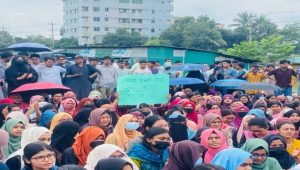
The delay has sparked protests among students. In recent weeks, students demanding the immediate issuance of the final ordinance have taken to the streets. On Wednesday and Thursday, they blocked several major roads in the capital, causing severe disruption to millions of commuters.




The uncertainty has also affected academic activities. In the 2024–25 academic year, 9,388 students were admitted to the proposed Dhaka Central University. However, due to the absence of a formal ordinance, their classes could not begin on time.
Although classes eventually started earlier this year, students say they have already fallen behind compared to other universities. The instability has also delayed the admission process for the 2025–26 academic year, which has not yet begun.
Officials say the government is trying to issue the ordinance as soon as possible to stabilise the academic environment and allow normal operations.
Professor AKM Elias, the interim administrator of the proposed university, said the final responsibility for issuing the ordinance lies with the ministries. He said a dedicated team is working on the matter.
“To my knowledge, only one or two steps remain before the final ordinance can be issued,” he said.
He added that divisions among teachers and students over the draft ordinance have damaged the academic atmosphere. Students admitted last year faced uncertainty, and the start of their classes was delayed.
He said the current instability has also prevented the administration from launching the admission process for the new academic year.
Elias said the situation needs to be resolved quickly. “A national election is approaching. The closer we get, the more everything will become election-focused. I hope the interim government will issue the ordinance as soon as possible,” he said.
He added that once the ordinance is issued, the proposed university will be formally established in practice, not just in name. According to him, the admission process for the new academic year will begin immediately, and classes are expected to start within a month.
He also said the academic gap faced by last year’s students could be covered within four months.
Since the beginning, teachers and students have been divided over whether the university should follow a school-based model or a hybrid model. After the draft ordinance was published, the disagreements turned into street protests.
To address the differences between the two sides, the University Grants Commission later revised the draft ordinance.