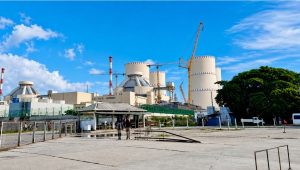
Despite a decrease in fuel oil prices on the international market, the government’s delay in adjusting domestic prices has severely impacted power generation. Most furnace oil-fired power plants remain shut as the government prioritises cost-cutting due to high production expenses.
Combined with a coal supply shortage and technical glitches at one plant, official records show that load shedding exceeded 3,400 megawatts (MW) on Sunday night.
Although a slight decrease in demand due to damp weather and the return of one plant to production on Monday offered some relief, electricity disruptions persist in suburban and rural areas.
Public frustration has mounted under the sweltering heat, leading to protests and road blockades in seven districts on Sunday, with reports of threats made against power department staff.
Officials from the Bangladesh Power Development Board (BPDB), speaking to TIMES on condition of anonymity, stated that oil-based power plants have reduced fuel imports due to the pressure of outstanding arrears.
Furthermore, while global prices have fallen, relevant domestic departments have yet to coordinate price adjustments, forcing plants to purchase oil at higher rates. Consequently, these plants are compelled to limit production by purchasing smaller quantities of fuel.
One official noted that oil-based plants were purchasing fuel at Tk70 per litre as recently as early April. Following the Iran-US-Israel conflict, the price was adjusted twice to reach Tk113.58.

Despite the subsequent drop in international rates, domestic prices remain unrevised, preventing plants from securing adequate fuel from the Bangladesh Petroleum Corporation (BPC).
Power division officials explained that diesel-powered plants are generally not operated except in emergencies due to exorbitant production costs. However, furnace oil-fired plants are frequently utilised during peak hours.
While the total production capacity of oil-fired plants stands at 6,000 MW, generation is currently being limited to between 1,500 MW and 2,000 MW to contain costs.
Another BPDB official mentioned that electricity prices were increased in June to alleviate the subsidy burden, which is expected to boost revenue and prevent further arrears.
However, clearing previous debts will take more time, and reducing the use of oil-fired plants will further lower the subsidy pressure.




On 18 May, the Bangladesh Energy Regulatory Commission (BERC) increased the price by Tk18.85 per litre, following a Tk24.59 hike on 12 April. Prices in Bangladesh were raised after international crude oil prices surpassed $100 per barrel during the Iran conflict.
Although global prices have since dropped to $70, domestic rates have not been revised.
An analysis of Power Grid Bangladesh (PGB) PLC data reveals that while the country’s power generation capacity exceeds 28,000 MW, actual production fluctuates between 13,000 and 14,000 MW due to fuel shortages and mechanical faults.
With average demand exceeding 15,000 to 16,500 MW, the country faces regular load shedding of 2,000 MW to 3,000 MW.
The crisis is not solely due to oil-based plants. One unit of the coal-fired Rampal power plant remains shut due to mechanical failure, and the 1,320 MW SS Power plant in Chattogram was closed for a significant period due to coal import delays.
Although SS Power resumed production on Sunday, it remains unknown when the 600MW unit at Rampal will return to service. Additionally, a large portion of gas-fired power plants are idle due to fuel shortages, with the power division unable to provide a timeline for a resolution.
When contacted, Zahurul Islam, member (Generation) of BPDB, told TIMES of Bangladesh, “Along with the rise in oil prices, there is a gas shortage and some supply chain issues with coal. The cumulative effect of low generation is putting us under pressure.”
When asked if there is any hope for improvement, he said, “Despite the high price of oil, a decision was made yesterday to increase generation. Except for one, all coal plants are operational, and that one may start within a day or two.
“Therefore, we hope the situation will improve soon.”
Disaster follows whenever clouds clear
After a month and a half of relative relief due to continuous rainfall, the power crisis has resurfaced as the rain subsided. As temperatures rose slightly, load shedding reached 3,400 MW on Sunday night, the highest in recent times.
According to PGB data, load shedding fluctuated between 2,000 MW and 3,000 MW at various times on Friday, Saturday, and Sunday.
Monday’s production forecast suggests a similar trend, indicating that for three out of these four days, load shedding remained near 2,000 MW for most of the day.
While the situation was slightly better for parts of Friday, it remained severe during the morning and night, meaning consumers are not spared even on holidays when demand is typically lower.
The BPDB is the primary agency for power generation and supply, with Power Grid Bangladesh (PGB) responsible for transmission. At the consumer level, electricity is supplied by six distribution companies, the largest being the Rural Electrification Board (REB).
In April, the Power Advisor had assured that the situation would improve, with load shedding expected to drop significantly to 800MW–900MW daily.
However, as demand rose with the cessation of rain, the situation deteriorated again. Severe load shedding has forced residents in many areas to take to the streets in protest. Customers under the REB in rural areas are suffering the most, with some regions facing over 12 to 14 hours of outages daily.
Protesters in Tangail, Jhalakathi, and Dohar in Dhaka have held human chains, blocked highways, and encircled power offices over allegations of load shedding and irregularities. In Kendua, Netrokona, a power office was attacked by people unable to watch World Cup football matches due to outages.
In Sherpur, REB officials have sought security from law enforcement after receiving telephonic threats from residents during World Cup match broadcasts. According to PGB data, load shedding typically increases after 10pm, with the most severe outages occurring between midnight and 4am.