
Parvez Babul
Just close your eyes, and keep them closed for a few minutes. What did you see? Nothing at all! That is the same impression of a visually impaired/ blind person. It’s quite a different world of darkness! No one can feel if he or she does not have an empathetic heart of fellow feelings. World acclaimed blind, deaf American author and social reformer Helen Keller perfectly said, “Blindness separates people from things; deafness separates people from people.”
The central, transformative promise of the 2030 Agenda for Sustainable Development and Sustainable Development Goals (SDGs) of the UN is “Leave no one behind.” But the reality is totally opposite. Sadly, the people with disabilities are excluded and left behind from the family, society, state and all the sectors.
Even they are not included in any decision-making process for the welfare of the people with disabilities locally, nationally, regionally or internationally. They are not heard by the policy makers, government or the stakeholders. So, they are underrepresented and underreported due to negligence in the media and other platforms. For the lack of necessary opportunities, they are unable to raise their voice, human rights and demands.
Fahima Khatun, a brilliant banker and principal officer at the Al Arafah Islami Bank, is a visually impaired and combatant lady faced lifelong struggles. But her daring journey with disabilities was rough. She had overcome many challenges, odds and obstacles continuously to survive, for her education and job.

In Bangladesh, the people with disabilities are ill-fated and deprived of their basic human rights. Women with disabilities are more vulnerable than men. Even the parents and guardians feel ashamed of their children with disabilities to introduce with the neighbours, relatives and others.
Fahima lost her eye sight due to small pox at the age of one. Since then, her whole world is covered with darkness. Then all the treatments were failure and her weeping started.
Her father was a farmer and her mother, a home maker respectively. They were very shocked for Fahima’s suffering, sorrows and agony. It is apparently impossible, for visually impaired poor girls like Fahima, to manage a man to marry. Because ignorance, superstitions and misconceptions are there that a blind woman will give birth to a blind child.




Though Fahima fell in love twice before, those love affairs, relationships broke up. At one stage, both of her boyfriends moved back while they thought that a blind girl can be a lover, but not a wife or life partner.
There are many women like Fahima who dream of marriage and conjugal life which did not come true for the same reasons. That is why they commented with great regret that life is not a bed of roses especially for the visually impaired and disabled women. Even it is a matter of great regret that some husbands had divorced their sighted wives blaming them due to so-called fault of giving birth of children with disabilities. The negative mindsets and ignorance of such men must be changed immediately for an inclusive, rights-based society.
There are some other familial and societal misbelief in Bangladesh that girls with disabilities have to go to their husband’s house only to cook. For this, some of Fahima’s family members and relatives discussed and decided not to provide sufficient education.
Fahima started going to a nearby primary school. She learnt the Braille language, the medium of education for the blind invented by the French blind man Louis Braille. Fahima was a very talented student, so the teachers and classmates inspired her to continue studies. She successfully completed her Masters’ Degree in Political Science at Dhaka University.
After that she accomplished another special degree: Bachelor of Special Education (BSED) with her own interest and initiatives in 2004. In the meantime, she joined the Bangladesh Blind Mission, a national voluntary organization, at the Inclusive Education for the Blind project. Then she worked at the Bangladesh Protibondhi Foundation for the welfare of the people with additional disabilities of visually impaired.
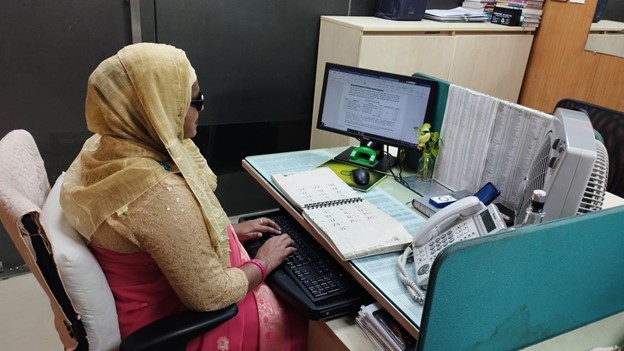
Currently, Fahima works at Al Arafah Islami Bank. She operates a computer using the Non-Visual Desktop Access (NVDA), which allows blind and vision impaired people to access and interact with the Windows operating system and many third-party applications.
In Bangladesh, social stigma exists and population with disabilities is on the rise. According to the survey of Bangladesh Bureau of Statistics 2022, visual impairment has the larger prevalence than any other kind. There are 12 types of disabilities in Bangladesh. Among the persons with disabilities, percentage share of different types of impairments with hearing (18.6 %), visual (32.2 %), speech (3.9 %), physical (27.8%), intellectual (6.7 %), and multiple (10.7%).
Articles 15, 17, 20 and 29 of the Constitution upholds the same rights and dimensions for the persons with disabilities with other citizens. The Rights and Protection of Persons with Disabilities Act, 2013 of Bangladesh mentioned some of the Rights of persons with disabilities.
Once I asked Fahima who was her inspiration behind the daring journey in her life? She said, “I am very glad to mention that she was definitely greatest woman Helen Keller inspired me a lot in many ways. I have gone through the biography of Helen Keller and accepted her as my ideology, philosophy, guide and lifelong mentor. And I took some training about inclusive education for the blind at Helen Keller International- Bangladesh.” Fahima concludes.
The writer is a Journalist and columnist