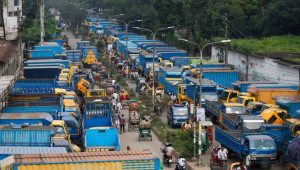
Petrol pumps and major commercial fuel users in Chattogram are facing growing difficulties because of a sharp reduction in fuel supply triggered by the ongoing Iran-Israel war in the Middle East.
The situation has raised concerns among drivers, filling station owners and stakeholders in the port transport sector.
At Shawkat Filling Station in Mirsarai upazila, diesel was previously supplied regularly through 20 vouchers a week, each with a capacity of 9,000 litres. However, amid the current crisis, Jamuna Oil Company supplied only 12 tanker vouchers of diesel to the station last week.
Md Abu Toiyab Patwari, owner of Shawkat Filling Station and convener of the Chattogram Divisional Petrol Pump Owners Association, said that although Bangladesh Petroleum Corporation (BPC) has introduced rationing, the policy is not being properly enforced in practice.

“Many petrol pumps are currently receiving no more than 30 per cent of their required fuel supply. Meanwhile, some stations in divisional and district towns are receiving up to 70 per cent of their demand,” he said.
He added that the supply of octane and petrol to filling stations at the upazila level has almost come to a halt. As a result, vehicles are crowding pumps in district towns, leading to long queues at many stations.




“Such a crisis would not have occurred if fuel had been supplied according to BPC’s declared distribution plan,” Patwari said.
Responding to the issue, BPC Secretary Shahina Sultana said fuel rationing had recently been reduced from 25 per cent to 15 per cent. She also confirmed that a complaint cell had been set up where regular customers who are not receiving their allocated fuel can lodge complaints.
Industry insiders warn that if fuel supply does not return to normal soon, operations in the port and transport sectors could face serious disruption.
Chattogram has 21 private fuel depots, which are among the largest commercial consumers of diesel in the region. These depots collectively require around 65,000 litres of diesel a day. However, they are currently receiving only 50 to 60 per cent of their required allocation.
As a result, depot operators are being forced to ration existing stocks alongside the reduced supply.
Ruhul Amin Sikder, secretary general of the depot owners’ organisation BIKDA, said the ongoing fuel shortage could soon halt the movement of more than 1,000 prime mover trailers transporting containers between the depots and the port.
“If the situation continues, even the equipment used for container handling may have to be shut down because of the lack of fuel,” he warned.