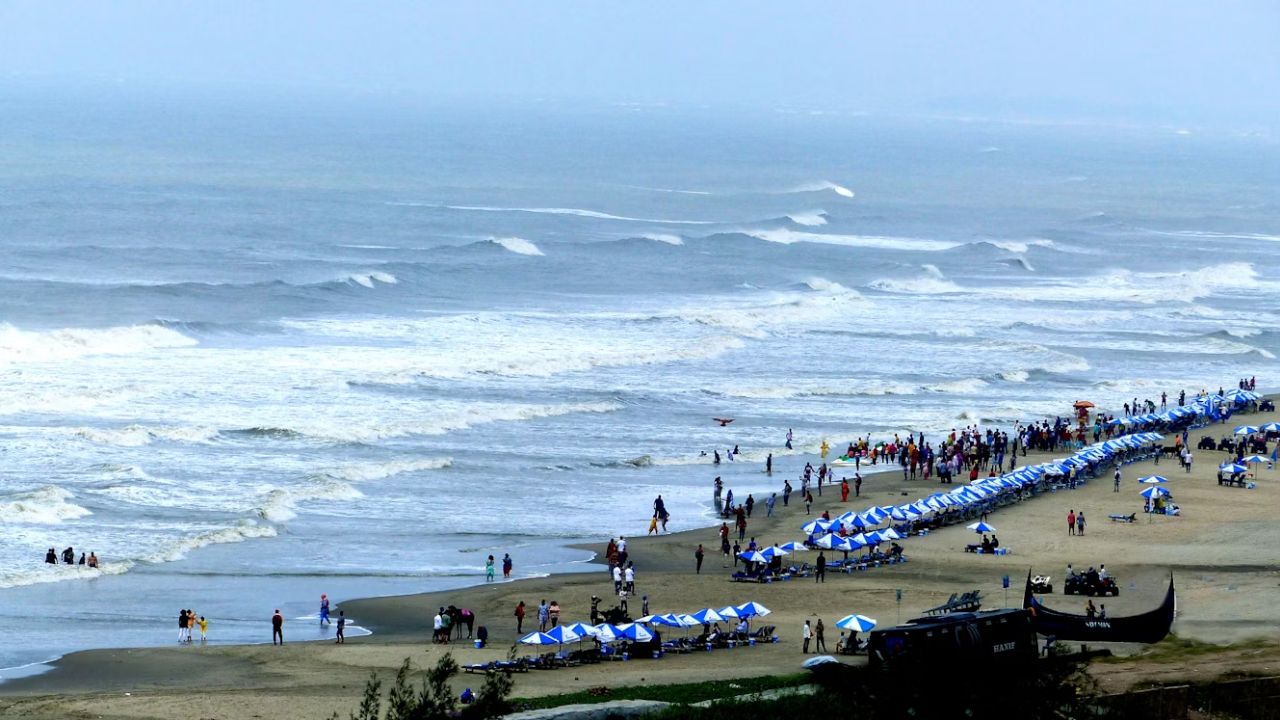



Whilst millions flock to Cox’s Bazar for its famous coastline, just beyond the tourist strip lies a starkly different reality of overflowing drains, towering waste heaps, and polluted rivers choking the historic “City of Health”.
The true scale of the crisis is most visible at Kasturaghat, situated beside the Bakkhali River, where decades of indiscriminate dumping have created a sprawling waste mountain covering nearly 11 acres.
Local residents estimate that parts of this immense rubbish heap rise between 70 and 100 feet, whilst alternative estimates place the height closer to 50 to 80 feet.
Decades of unmanaged accumulation have transformed a historically and ecologically significant riverside location into an enormous open dump.
The site continuously emits foul odours, attracts cattle and scavenger birds, and raises critical concerns regarding the contamination of surrounding land, soil and groundwater.
The problem, however, extends far beyond the Kasturaghat dumping ground.
Across popular tourist hot spots including Kalatali, Sugandha and Laboni, plastic bottles, polythene, coconut husks and general food waste litter the surroundings.
Blocked drains near major beach entrances frequently cause sewage-contaminated water to overflow onto public roads before running down directly onto the sand and into the sea.

Data from Cox’s Bazar Municipality reveals that the city generates approximately 170 tonnes of waste daily.
However, municipal collection efforts gather only 120 to 130 tonnes, leaving 40 to 50 tonnes outside the regular collection system every day.
Local residents allege that 15 to 20 truckloads of untreated rubbish are unloaded daily at the riverside.
Uncollected waste across the urban area and hotel zones is routinely washed through drainage channels, eventually reaching local rivers and the marine ecosystem.
Environmental campaigners and regulatory authorities have raised urgent alarms regarding the ecological impact of the situation.
Karim Ullah Kalim, a central committee member of the environmental organisation Bangladesh Paribesh Andolan, described the state of affairs as deeply concerning for an international tourist hub.



He warned that toxic leachate, the contaminated liquid produced by decomposing waste, seeps into the soil and river system, spreading hazardous germs and gases.
Kalim also voiced strong criticism of municipal priorities, suggesting that local authorities have focused more on issuing operational licences for battery-powered auto-rickshaws, known locally as TomToms, than maintaining basic public sanitation infrastructure.
Officials from the Department of Environment have echoed these grave concerns. Khandaker Mahmud Pasha, deputy director of the department’s Cox’s Bazar office, confirmed that substantial volumes of toxic black runoff flow continuously into the Bakkhali River.
He noted that this discharge causes irreparable harm to marine biodiversity and degrades air quality throughout neighbouring residential areas.
The department has formally challenged the municipality over environmental violations, highlighting that earlier pledges to clear the Kasturaghat site by 2025 were missed, with official project completion dates now deferred to 2028.
Tourism representatives and visitors have expressed growing frustration over the degradation of the resort city.
Mizanur Rahman Milky, convener of the Tour Operator Association of Cox’s Bazar, cautioned that neglected waste at key junctions like Dolphin intersection and untreated sewage entering the sea threaten the region’s global reputation.
He said that unless systemic improvements are made, Cox’s Bazar risks becoming known as a destination for “waste tourism” rather than a world-class coastal resort.
This contrast is highlighted further by public art initiatives along the coastline.
Near the beach, voluntary organisation Bidyanondo Foundation constructed a large sculpture named the “Plastic Monster”, utilising five tonnes of collected plastic to raise public awareness.
However, holidaymakers note the irony of awareness campaigns operating alongside uncleaned groves and heavy pollution.
Visitors have expressed deep disappointment at the deteriorating conditions.
Tanvir Talha, a holidaymaker from Rajshahi, recalled his dismay upon reaching Kalatali beach.
“When I went to swim, I saw dirty drainage water flowing directly into the sea,” he said.
“It ruins the natural beauty of the destination and harms the environment. The authorities urgently need to put proper waste management in place.”
Meanwhile, Mousumi Sultana, a visitor from Jashore, acknowledged the merit of local plastic awareness campaigns but felt they meant little without real action.
“The surrounding casuarina groves are strewn with rubbish, and plastic is discarded everywhere,” she told TIMES.
“These awareness exhibitions shouldn’t just be a form of entertainment; the authorities must deliver genuine, practical waste management on the ground.”
At scenic locations like the Khurushkul Bridge over the Bakkhali River, visitors seeking sunset views are met with unbearable stench from the nearby dumpsite.
Long-term solutions remain years away.
Plans are underway by the Cox’s Bazar Hotel-Resort Owners Association to establish a waste facility at Mithachhari in Ramu, whilst municipal authorities are acquiring 10.5 acres at SM Para for a separate management plant scheduled for 2028.
Until these facilities become fully operational, Cox’s Bazar remains caught between its natural heritage and an unchecked accumulation of waste.