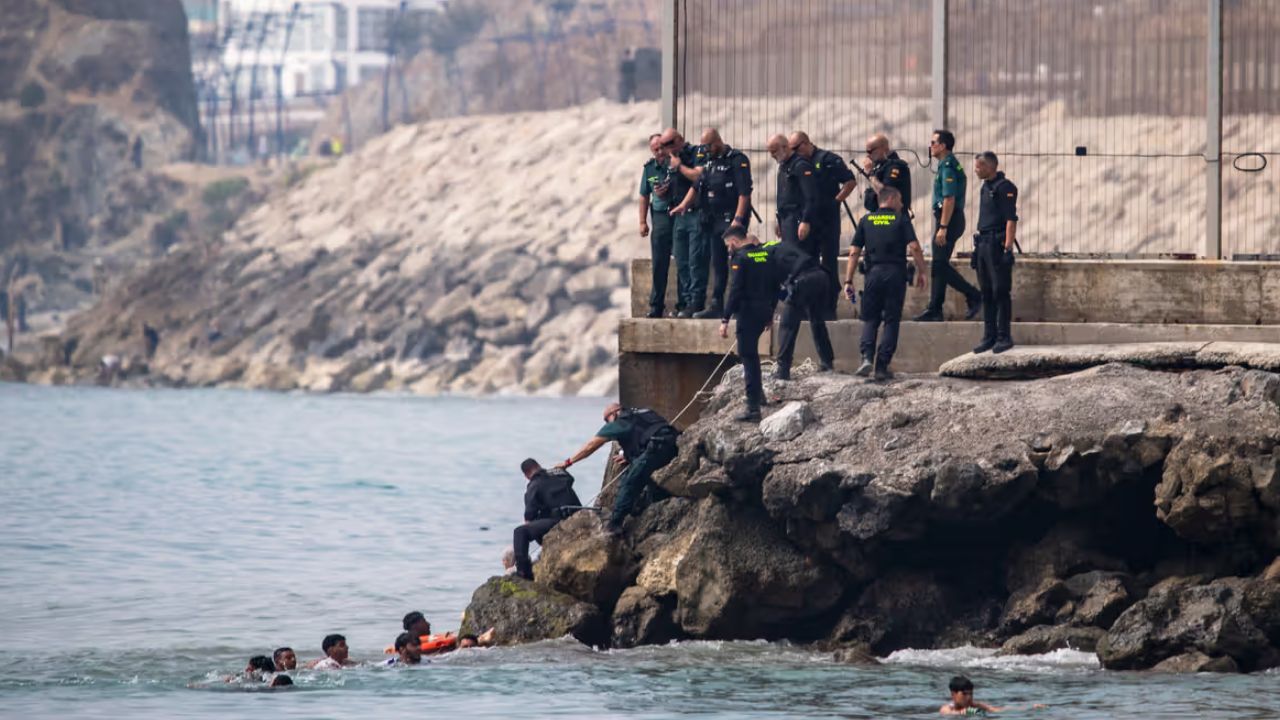



Migrants who recently scaled fences or swam into the Spanish enclave of Ceuta began returning to Morocco on Saturday, citing starvation, exhaustion, and local antagonism as the primary reasons for their failed attempts to reach Europe.
Many of those retreating explained that they were motivated to cross the heavily fortified border by viral social media posts and messages suggesting the frontier was vulnerable, reports Reuters.
However, upon entering the territory, they discovered they were unable to progress toward mainland Spain.
Brahim, a bakery worker from Fez, admitted he resigned from his job to join the crossing after viewing videos of thousands of others doing the same.
He described his three-day ordeal in the enclave surviving only on water, unable to afford food prices where a single tuna sandwich cost 100 dirhams (approximately $10.75). “I thought I’d build a better future there. But I was surprised in Ceuta,” he said.

In the Moroccan town of Fnideq, situated across from the enclave, the streets leading to the crossing were largely deserted on Saturday, representing a significant shift from the thousands gathered there just two days prior.
Returning migrants were seen walking away from the border or seeking taxis to leave the town, where many businesses remained closed for several days.




The returnees reported a lack of access to necessities, describing a situation where shuttered supermarkets and shops forced them to scavenge for food and water while waiting for their wet clothing to dry. A worker from Tanger Med port, who requested anonymity, compared the enclave to a “prison” where “everything was closed”.
Accusations of violence also surfaced, with some migrants alleging that residents of El Principe, a largely Moroccan neighbourhood in Ceuta, attacked or expelled them.
Moroccan waiter Yassine Ichou claimed he was struck and chased out of the area, describing the shop closures as a “siege” designed to force migrants to leave.
Spain’s Interior Ministry confirmed that while police arrested one individual following two separate knife attacks that caused minor injuries, no deaths related to such incidents have been recorded in Ceuta since Thursday.
The mass movement has also impacted the local Moroccan economy. Rachid, an employee at a hotel in Fnideq, noted that the establishment’s entire six-person kitchen staff had crossed into Ceuta during the height of the influx and had yet to return, forcing hotel to seek new employees.
Conditions within central Ceuta showed signs of stabilising on Saturday as cafes began to reopen despite a heavy police presence. Marina Castaño, a 24-year-old cafe operator, added that while staff safety remains the priority, there was a need for life to “return to its normal rhythm”.
While some locals expressed fear regarding the sudden influx, others, such as hardware store owner Tito, voiced sympathy. He suggested the young migrants were being “completely exploited” and utilised as “bargaining chips”.
Despite the departures, an aid worker at a local reception centre estimated that thousands of migrants remain in the enclave, even though the facility is at maximum capacity.
Among those refusing to leave is Mohamed Ahmed, a 43-year-old Sudanese man who reached the enclave after a four-hour swim.
Though currently blocked by police from reaching a migration centre, he remains resolute. “I’m not going back,” he said. “I’d rather die trying here”.