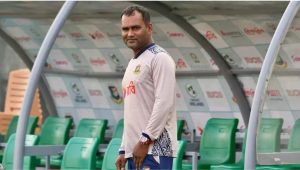
Najmul Hossain Shanto marked his fourth ODI century the way he does most things, quietly, and on his own terms.
Off a full-length delivery from Jayden Lennox, he drove firmly to long-on and jogged a single. As he crossed to the non-striker’s end, there was no leap, no roar. Just a helmet lifted off a sweat-soaked head, and a flying kiss floated toward the dugout. Exhausted, drenched, and visibly spent, he had said everything without saying a word.
The masterclass didn’t last much longer. A lofted drive to long-on ended his innings at 105 off 119 balls, nine fours, two sixes, but not before he had demonstrated, once again, exactly how to build an ODI hundred the Shanto way.
This was Chattogram on Thursday. The series decider against New Zealand. The temperature at the Bir Sreshtho Shahid Flight Lieutenant Matiur Rahman Cricket Stadium sat between 35 and 36 degrees Celsius, with a real-feel nudging 43. The kind of heat that bends the air and breaks concentration. New Zealand captain Tom Latham, for one, was not about to downplay it. “It was really hot, probably one of my hotter experiences playing in these conditions,” he said afterwards. “People probably don’t see it necessarily on TV.”
But the conditions were only part of the story. Before this series, Shanto had been mired in one of the worst runs of his career. After being controversially stripped of the ODI captaincy last year, the runs had dried up alongside the armband. Twelve consecutive innings without a fifty. A duck in the first match of this very series. His place was not heavily questioned, given the lack of alternatives, but his form was plain to see.

The second match offered a flicker of hope. He ended a 13-innings drought with a fifty before cramp forced him off the field before he could build further. It was a reprieve, not a revival.
The final match demanded something more. Bangladesh lost three wickets for 32 runs. With Rishad Hossain and Taskin Ahmed absent from the XI, the batting tail stretched alarmingly. A substantial innings from Shanto was not just desirable, it was necessary.
When Shanto walked to the crease, the scoreboard read 9 for 2. By the time he left, 186 minutes later, he had turned a crisis into a platform.




There were early signs he had found his touch. Soon after arriving at the crease, he struck a superb on-drive for four off Nathan Smith, the kind of shot that, when it comes early, tends to tell the full story of what follows. It did. He was moving fluently, reading lengths quickly, and the footwork that had deserted him for months was suddenly back.
The situation had grown grimmer before it improved. Soumya Sarkar fell to Will O’Rourke, caught fatally between leaving and playing. But where others wavered, Shanto held. He found an ally in Litton Das, and together they dismantled the pressure, brick by brick, run by run.
Shanto got off the mark with a straight-driven double off O’Rourke, a signature stroke, wristy and assured. The Kiwis responded by pulling their lengths back. It was the wrong adjustment. Shanto feasts on the back foot. His pull shot, angled hard through the square region, became the weapon of the afternoon, 31 runs from that arc alone, including four fours and a six, carved out with the unhurried precision of a craftsman who knows exactly where his bread is buttered.
Between the thunderous pulls and commanding straight drives, he worked the gaps, rotated the strike, and despite the onset of cramps, ran hard. Singles, twos, the occasional three. Every run a small act of defiance against the conditions.
He brought up his 14th ODI half-century off 70 balls. At the other end, Litton batted with equal composure, ending a 19-innings drought of his own with a fifty off 71 balls. Their partnership crossed a hundred, then 150, and eventually settled at a record 160-run fourth-wicket stand against New Zealand. Captain Mehidy Hasan Miraz watched it all from the dugout and was unequivocal about its significance. “The responsibility they showed was unbelievable and it changed the whole momentum for the team,” he said. “Everyone in the side felt confident that, whatever total we put up, we could win the match.”
Litton fell for 76 off 91 balls, bowled by Lennox. Shanto was on 92.
Even without his partner, he did not flinch. He had taken 70 balls to reach fifty, and just 44 more to reach three figures. Calm and unhurried throughout, he converted in a manner that felt entirely in keeping with the innings, no rush, no recklessness, just the next ball, and the next.
When the moment finally came, Towhid Hridoy rushed in to embrace him. The entire dugout rose. And Shanto, bat raised, eyes closed, sent that flying kiss into the air one more time.
It was his fourth ODI century, and his second in Chattogram, arriving after 20 innings without three figures, in a must-win match, under a sun that had no mercy. Latham was generous in defeat. “Full credit to the way that they played,” he said.
Miraz, meanwhile, left no doubt about where he felt the match had been won. “I think it was because of those two that we were able to win today. If we hadn’t put up a total, it would have been very difficult for us.”
Shortly after reaching three figures, Shanto attempted to clear the boundary and was caught. He walked off with his head held high. Bangladesh had found stability from the wreckage, though just 44 runs in the last seven overs after his dismissal meant the total never grew as large as it could have.
No fireworks. No theatre. Just a man, his craft, and the quiet, stubborn refusal to be beaten.