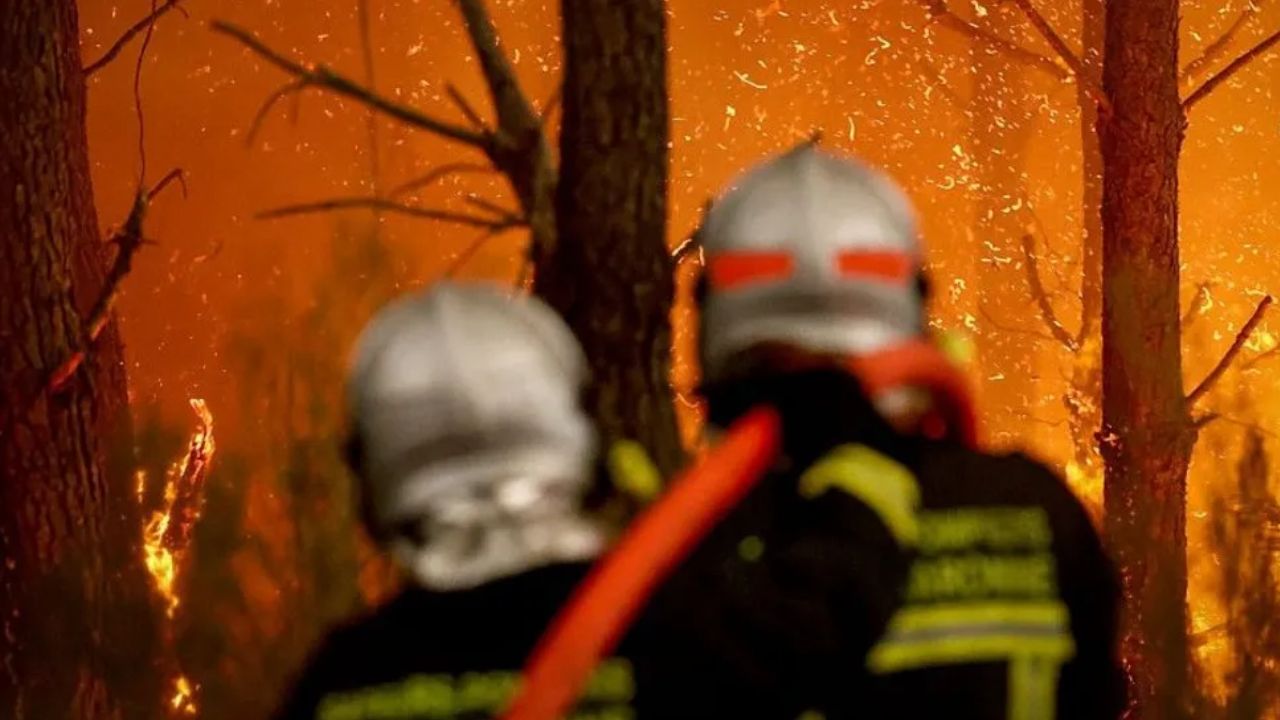



Firefighters remain at the centre of battling devastating wildfires despite rapid advances in artificial intelligence(AI) and drone technology, with experts saying innovation is improving detection and safety rather than replacing crews on the ground.
Across France, Spain and Portugal, massive wildfires have forced hundreds of thousands of residents to evacuate. In France alone, four firefighters have died this year while another 150 have been injured, reports BBC.
Although drones are widely used in modern warfare, wildfire response continues to depend heavily on firefighters and ageing water-bombing aircraft. However, new technology is changing how fires are detected and monitored.
Chief Sergeant Guillaume Millet, who has served as a firefighter for 24 years and heads the Fire and Rescue Service branch of the CFDT union in Gironde, France’s hardest-hit region this summer, says the biggest transformation has come in fire detection rather than firefighting itself.
“The big change, especially in my département, is that now we’ve got cameras assisted by artificial intelligence to watch the forest and see where fires are starting,” Millet says.
He explains that AI-powered cameras have replaced seasonal human observers who previously monitored forests from watchtowers.
“In the Gironde, cameras have replaced the human look-outs we had in watch towers in every town throughout the summer months,” he says. Those lookouts were often students.
According to Millet, the technology has significantly reduced unnecessary callouts.

“An AI-assisted camera can distinguish with almost total certainty between smoke and dust thrown up by a tractor in a field, for example.”
The cameras are capable of spotting fires from as far as 20 kilometres away.
Gironde uses a system developed by Midgard, while other French regions rely on another start-up, FireTracking.
FireTracking chief executive Jean-Simon Chaudier says the system immediately alerts firefighters once it identifies a fire.
“As soon as the system detects a fire, there’s an alert on the fire fighters’ telephones. They open the application and see what the camera is seeing with a x40 [40 times] zoom,” explains FireTracking’s CEO Jean-Simon Chaudier.




He says the application also provides detailed information alongside the live camera feed.
“Next to that real-time video there’s a map with the exact location of the fire, the position of any nearby houses and a simulation of how, given the weather, the level of humidity and so on, it is expected to spread from minute to minute,” he adds.
Chaudier says early detection can dramatically reduce the scale of a wildfire.
“For the past 10 days, for example, we have the feedback from a firefighter that our AI detected seven fires 15 minutes before the first phone call. If you can help a firefighter to save 15 minutes, it’s the difference between a catastrophe and a fire which can be limited to two or three hectares,” Chaudier says.
He stresses how quickly fires escalate.
“After one minute you can put out a fire with a glass of water, after two you need a tank of water, after three minutes you need to send a Canadair,” Chaudier says.
FireTracking’s network currently monitors around one million hectares, mainly in France.
In the French département of Indre-et-Loire, the company has installed 11 detection sites. “In all €1.2m [$1.4m; £1m] was spent to cover the whole 6,000 sq km area [2,300 sq miles],” says Chaudier.
The area is largely agricultural, where crop fires are a frequent and costly issue, with around 300 incidents recorded annually, according to Chaudier.
AI-based detection is expected to advance further. France’s civil protection service is testing solar-powered drones equipped with electro-optical cameras and artificial intelligence under its Condor programme.
Other initiatives include sensors placed throughout forests, such as Spain’s SenForFire project, which monitors gases emitted before flames become visible.
While drones are also being evaluated for emergency response, Millet says their role in firefighting remains limited.
“In fact, the usefulness of technology is very limited in this area,” Millet says. “It can help us with detection but it’s not technology that puts out fires; you need people to pull the hoses through the forest to attack them.”
He says even firefighting aircraft cannot replace crews working on the ground.
“When a Canadair drops 6,000 litres of water on a wildfire it reduces its intensity but then firefighters on the ground have to finish what the Canadair started.”
France is also increasingly deploying Dash aircraft that release fire retardant ahead of advancing flames to slow the spread of fire, but these aircraft still rely on firefighters to complete the operation.
Research continues into more advanced aerial firefighting systems. French start-up Daidelos is seeking investment for a petrol-powered heavy-lift drone capable of hovering above fires while spraying 1.2 tonnes of water.
Other companies are developing drones that release grenades filled with chemical powder designed to explode in extreme heat, suppressing flames by cooling and interrupting combustion. The goal is to create a rapid, automated response capable of extinguishing fires in their earliest stages, although such systems would not be effective against large, established wildfires.
Researchers in France are also working on drones that can safely fly close to active fires to collect critical information on smoke, weather changes and structural hazards before firefighters enter dangerous areas.
Although technology is helping emergency services detect fires sooner, improve decision-making and potentially reduce risks for crews, Millet believes it will not replace firefighters.
“It’s always the firefighters on the ground, pulling the hoses, who extinguish the fires,” he says.
“This has been the case since the creation of the first modern fire brigade in the Netherlands in the 1670s. It is not about to change soon.”