



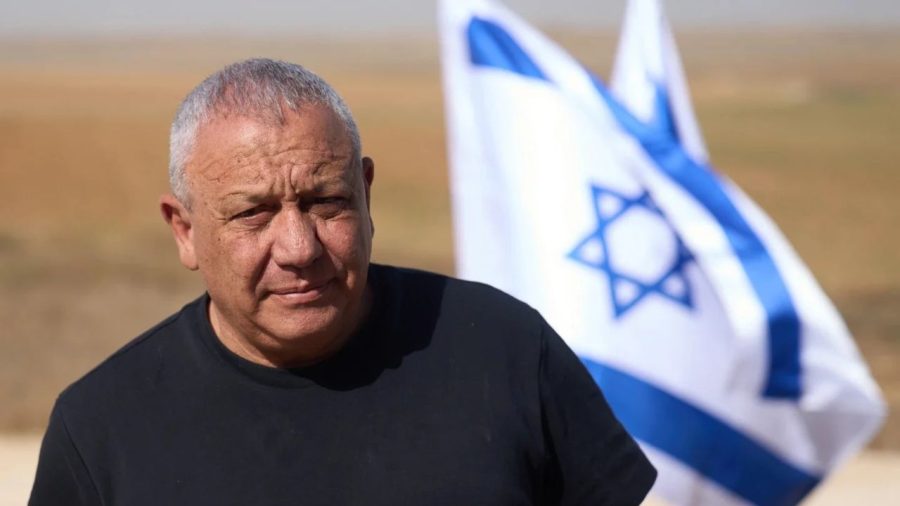



Gadi Eisenkot’s emergence as the leading candidate to form Israel’s next government has raised a crucial question: will a change of leadership bring a change in the country’s policies towards Palestinians and the wider Middle East, or will Israel simply have a new face pursuing familiar objectives?
Israeli President Isaac Herzog has tasked the leader of the Yashar (Straight) party with forming a government after an election left no political alliance with a majority in the Knesset.
A former chief of staff of the Israeli military, Eisenkot has 28 days to assemble a coalition, with the possibility of a 14-day extension. If he fails, Herzog could invite another political leader, most likely Prime Minister Benjamin Netanyahu, to try to form a government. Failure again would lead to fresh elections.
Eisenkot has considerable public support, partly because he is seen as an alternative to Netanyahu, whose long tenure has been marked by deep political divisions, the devastating war on Gaza, and an increasingly confrontational regional policy.
But his rise does not necessarily signal a fundamental shift in Israel’s approach to the Palestinians or its neighbours. His military record, including his association with the controversial Dahiyeh Doctrine, raises serious questions about how far his leadership would differ from Netanyahu’s.
The immediate challenge for any new Israeli government will be to address the country’s deteriorating international standing, particularly in the United States. Israel’s reputation among the American public has fallen sharply amid the destruction in Gaza and the US-Israel war on Iran, which Netanyahu has been accused of persuading US President Donald Trump to launch.

On the eve of the midterm elections, Trump announced an end to the annual $3.8 billion military aid package to Israel. His Republican Party subsequently suffered major losses, while senior officials, including Vice President JD Vance, faced pressure over the Iran war.
Whether Eisenkot can repair Israel’s relationship with Washington will depend not only on his personal diplomacy but also on whether he is willing to reconsider the policies that have alienated much of the international community.
Carnegie Endowment senior fellow Aaron David Miller said Israel’s standing in the United States had reached a low point. Eisenkot, who is not particularly comfortable in the public spotlight and is reluctant to speak in English, would face a difficult task in addressing those perceptions.


“In the eyes of many, Israel is no longer David but Goliath,” he said, describing the US political environment awaiting a new Israeli prime minister as potentially the toughest any Israeli leader has had to navigate.
The ‘anti-Bibi’ appeal
For now, Eisenkot’s appeal among Israeli voters rests as much on the contrast he offers with Netanyahu as on a clearly defined alternative policy agenda.
Born in Tiberias to parents from Marrakesh and Casablanca, he grew up in the southern port city of Eilat. He joined the military at 18 and rose through its ranks to become chief of staff. Like several senior Israeli military figures before him, he eventually entered politics.
His personal experience of the Gaza war has also shaped his public image. His son Gal was killed in Jabalia in northern Gaza in December 2023 while serving in the military. His nephew Maor was killed a day later, while another nephew, Yogev Pazy, died in Gaza in November 2024.
A military record that raises questions
For Palestinians, a change from Netanyahu to Eisenkot may offer little immediate reason to expect a different approach.
Eisenkot is associated with the Dahiyeh Doctrine, a military strategy that advocates the use of overwhelming and disproportionate force against areas from which attacks against Israel originate. The doctrine, named after a neighbourhood in Beirut heavily damaged during the 2006 Lebanon war, has drawn criticism for its implications for civilian populations and infrastructure.
During his tenure as chief of staff from 2015 to 2018, Israeli forces conducted repeated operations in Gaza and the occupied West Bank, while the military also expanded air strikes against Iranian targets and supported armed groups in Syria.

United Nations figures record around 650 Palestinians killed by Israeli forces or in conflict-related incidents between 2015 and 2018, including 295 in 2018 alone. The toll included 189 Palestinians killed during the Great March of Return protests in Gaza, among them 35 children, while thousands more were wounded.
A UN commission of inquiry into the protests subsequently found reasonable grounds to believe that Israeli forces had committed serious violations of international law. Some of those violations could amount to war crimes or crimes against humanity.
Eisenkot’s association with the Dahiyeh Doctrine also remains a significant part of his military legacy. During the 2006 war in Lebanon, Israel killed 1,109 people, around 860 of them civilians, according to figures cited in the draft.
A different image, but what about policy?
Eisenkot may seek to restore Israel’s international credibility, improve relations with Washington and reduce the political divisions that have intensified under Netanyahu. Such efforts could lead to changes in diplomatic tone and the way Israel presents its policies to the world.
But a genuine policy shift would require more than a change in leadership or public relations. It would mean reassessing the use of military force in Gaza and the West Bank, addressing Palestinian rights and reconsidering the approach to regional confrontation, particularly with Iran and Lebanon.
For Palestinians, the test will be whether a new government changes realities on the ground: the use of force, restrictions on movement, settlement policies and the treatment of Palestinian civilians. For the wider region, it will be whether Israel moves away from repeated military escalation towards a more sustainable political and security framework.


