
Deadly flooding and landslides triggered by exceptional rainfall have claimed at least 30 lives in southeastern Brazil, with dozens more still unaccounted for, authorities said Tuesday.
Following an intense overnight storm, rivers overflowed in Minas Gerais, turning streets into torrents of muddy water, reports The Guardian.
The hardest-hit areas included the cities of Juiz de Fora and Ubá, where emergency services confirmed the fatalities and reported that 39 people remained missing. More than 200 residents were rescued.
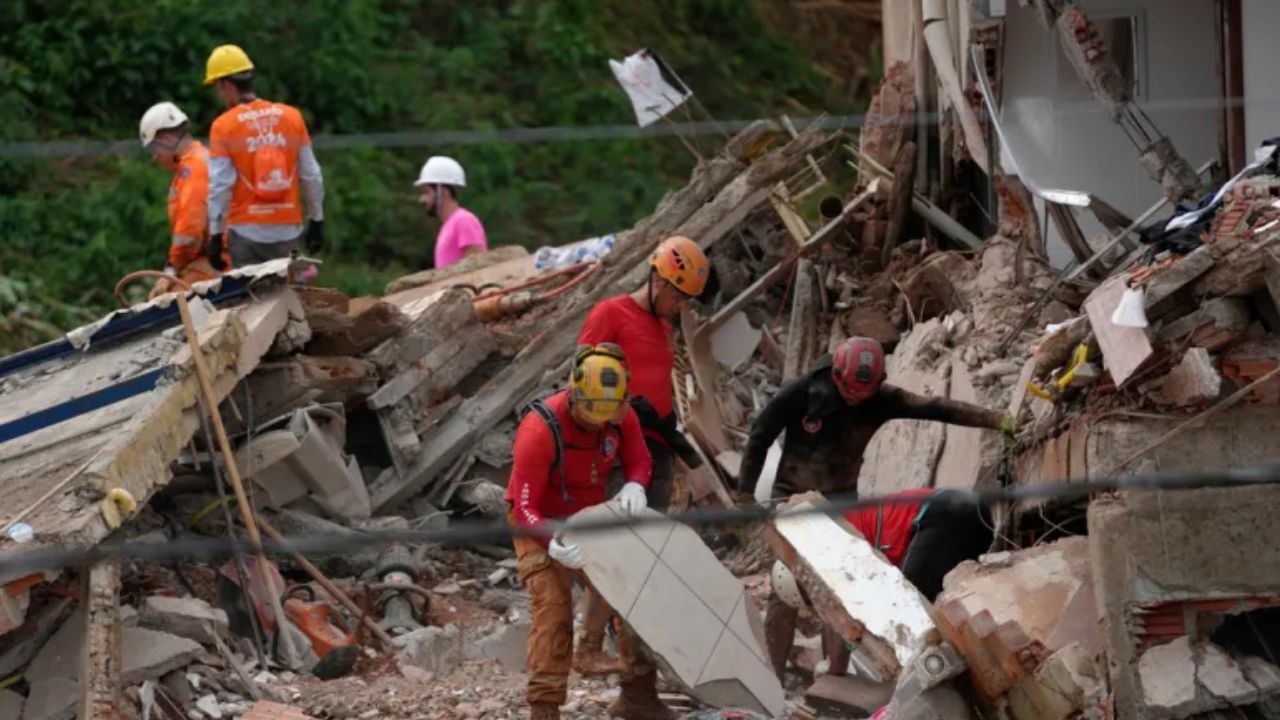
Search operations continued amid wreckage and unstable ground, with firefighters and trained dogs combing through debris.
According to fire brigade official Maj Demetrius Goulart, twelve homes in a hillside district of Juiz de Fora were destroyed in what he described as a “massive landslide.”

“Many people were inside their homes at night when it was raining,” he said.
Families gathered near the disaster zones, some clinging to hope, others already grieving.
Wilton Aparecido de Souza broke down while speaking about his 20-year-old son, believed to be trapped beneath the rubble.
“He was a good boy, he had just finished his military service and he wanted to buy a motorcycle,” the 42-year-old told AFP.
“At least find his body, so I can give him a proper burial.”



Periods of stillness fell over the crowds watching rescue efforts, interrupted only by heavy machinery or the distressed cries of animals.
Cleiton Ronan, a 32-year-old warehouse worker, said several relatives were missing.
“Almost everyone buried in this mud is family; there’s my sister, my niece,” he said.
Earlier in the day, Goulart reported that a boy around 10 years old had been pulled alive from the ruins after a two-hour operation, offering a rare moment of relief.
Still, officials cautioned that time was working against the rescuers. Paulo Roberto Bermudes Rezende, a state civil defence coordinator, warned that “the longer it goes on, the slimmer the chances of finding survivors become”.
Local residents joined the response, digging alongside professionals. Atila Mauro, a 33-year-old bricklayer, described the emotional toll of the work.
“When I dug up children’s belongings – balloons, teddy bears – it broke my heart. I’m a father too … I’m trying to help however I can.”
Authorities said the heavy rainfall caused both flooding and slope collapses, with videos circulating online showing buildings giving way. Juiz de Fora’s mayor, Margarida Salomão, declared a state of emergency as conditions worsened.
President Luiz Inácio Lula da Silva said on X: “Our focus is to guarantee humanitarian assistance, the restoration of basic services, aid to displaced people, and support for reconstruction.”
Salomão said the city—home to just over half a million residents—was enduring its wettest February ever, recording 584 millimetres of rain so far. She noted that at least 20 landslides had cut off several neighbourhoods, calling the situation “extreme”.
Municipal officials estimated that around 440 people were forced to evacuate and were receiving help with temporary accommodation. Classes were suspended across the city’s public school system.
Brazil has faced repeated disasters linked to severe weather in recent years, including floods, droughts and heatwaves. In 2024, catastrophic flooding in the south of the country killed more than 200 people and affected about two million others. In 2022, intense rainfall in Petrópolis, near Rio de Janeiro, resulted in 241 deaths.