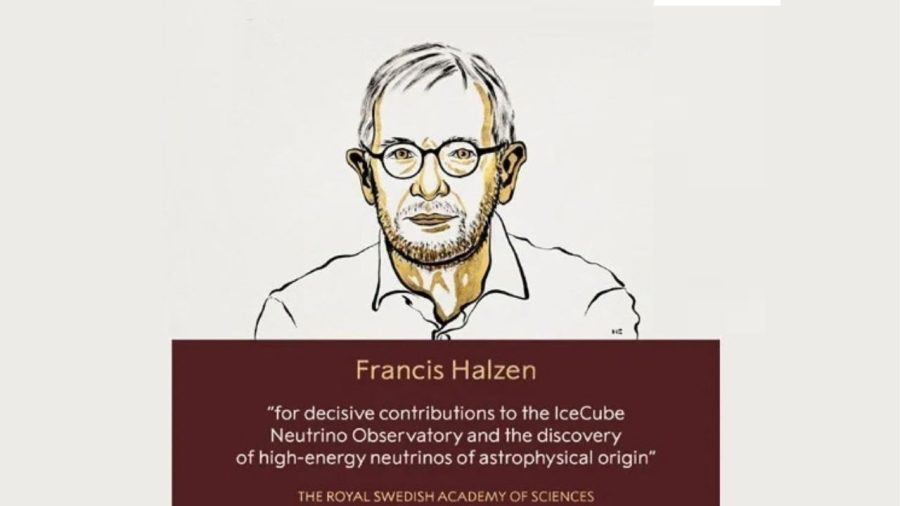



Belgian astrophysicist Francis Halzen has been honoured with the 2026 Nobel Prize in Physics for his pioneering work in developing a massive observatory in Antarctica to detect “ghostly” cosmic particles, the Royal Swedish Academy of Sciences announced on Tuesday in Stockholm.
Halzen, a professor based at the University of Wisconsin–Madison, laid the foundations for an “entirely new type of astronomy” through his creation of the facility, reports CNN.
He first presented plans for the apparatus – now known as the IceCube Neutrino Observatory – in 1988, conceiving a vast facility embedded in Antarctic ice to capture subatomic particles called neutrinos.

Arriving at Earth from the far reaches of the cosmos, neutrinos are dubbed “ghostly” because they are extremely volatile, or vaporous, possessing almost no mass and no electrical charge.
These particles can travel through the most extreme environments, including stars, planets, and entire galaxies, without changing or interacting with matter.




The IceCube observatory operates by harnessing a key property of neutrinos: when a neutrino collides with an atomic nucleus, it generates a flash of light that sensors embedded deep within clear, glacial ice can track.
In an official statement, Nobel committee chair Mark Pearce commended Halzen for leading an international team of researchers and engineers who provided a “fantastic instrument,” adding that his “tenacity and scientific vision has paved the way for a new kind of astronomy.”
Highlighting the historic nature of the award, Richard Fitzgerald, editor-in-chief of Physics Today (published by the American Institute of Physics), noted that it had been a while since the physics prize was awarded to a single individual.
He remarked that while constructing the massive facility required a team of hundreds of people, the breakthrough “all started with one person.”