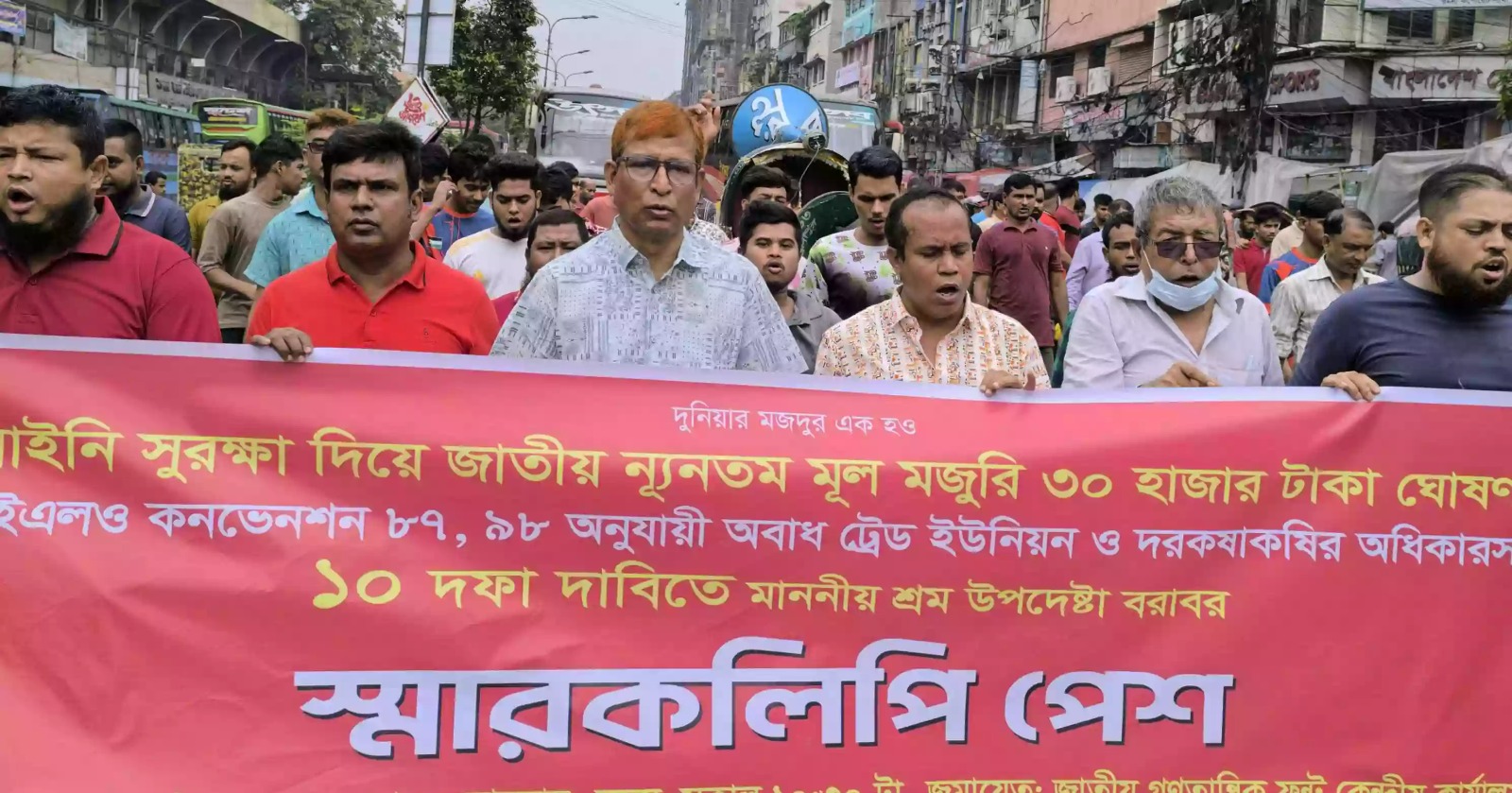



Bangladesh Trade Union Centre (BTUC) on Monday submitted a 10-point demand charter to the Labour Adviser, calling for the immediate formation of a National Minimum Wage Board and a declaration of Tk 30,000 as the minimum wage for workers across the country.
BTUC organised a rally in the capital to support these demands and improve workers’ living standards across Bangladesh. The protest began at the National Democratic Front office in Gulistan and ended in front of the Jatiya Press Club. The rally was led by BTUC President Choudhury Ashiqul Alam, with Joint Secretary Prokash Dutta conducting the event.
Protestors emphasized the challenges facing informal sector workers, highlighting discrepancies in government data. While official records show 73.4 million workers, other sources estimate the actual number to be closer to 85 million, with over 92% lacking formal recognition.

Speakers pointed out the lack of legal rights for informal workers, including the absence of appointment letters, identity cards, paid leave, maternity benefits, and compensation.




BTUC also criticized low wage standards, noting that only 43 out of 142 labor sectors have set minimum wages, most ranging between Tk 8,000 and Tk 10,000. With rising inflation and no regular wage updates, workers are facing increasing economic pressure.
The central demand of the rally was for a minimum wage that reflects the cost of living. Protestors stated that a six-member worker family now needs at least Tk 30,000 per month to cover essentials like food, rent, transport, education, and healthcare.
Key figures at the rally included NDF Joint General Secretary Shahjahan Kabir, BTUC General Secretary Rojot Biswas, Vice President of the Hotel, Restaurant and Sweetmeat Workers’ Federation Akhtaruzzaman Khan, President of the Sawmill Workers Federation Khalilur Rahman, President of the OSK Garments and Textile Workers Federation Md Yasin, and BTUC Dhaka Metropolitan Joint Secretary Atikul Islam Titu.
In addition to economic concerns, protestors raised alarms over growing geopolitical tensions between the US-led Western bloc and China-Russia, accusing both sides of attempting to drag Bangladesh into strategic conflicts. They called for unity among patriotic forces to defend workers’ rights and safeguard Bangladesh’s sovereignty.