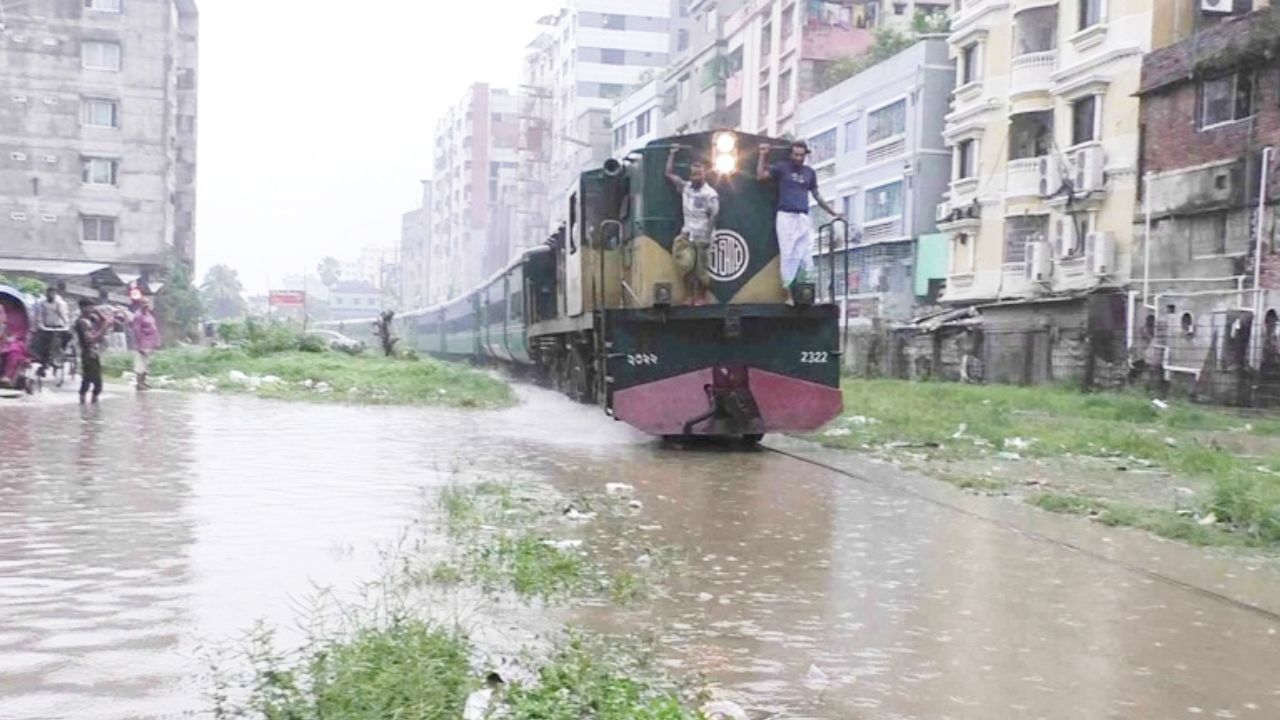

Billions of taka are being poured into railway rehabilitation, yet two of three major projects do not include raising flood-prone tracks, leaving large parts of the network exposed to worsening climate risks.
Three overhaul projects worth more than Tk6,236 crore are under way, but two state-funded schemes worth Tk3,820 crore have omitted the crucial task of elevating vulnerable tracks.
The contrast is stark. An Asian Development Bank-funded rehabilitation project in Sylhet will raise 34 kilometres of railway track by about two feet as part of a broader climate-resilience strategy.
By comparison, two major government-funded programmes covering the Eastern and Western railway zones focus on repairing embankments, drainage systems, bridges and tracks largely at their existing elevations.
The differing approaches highlight a growing policy dilemma for Bangladesh Railway: whether to continue repairing repeated flood damage or redesign vulnerable corridors to withstand increasingly unpredictable weather.
The question has become more urgent as extreme rainfall repeatedly disrupts railway services across the country, affecting passengers, freight movement and supply chains.
Bangladesh Railway operates more than 3,400 route kilometres, including 1,930.88 kilometres in the Western Zone and 1,390.78 kilometres in the Eastern Zone.
The network carries millions of passengers each year and transports agricultural produce, industrial goods and imported commodities, making its resilience increasingly important to the national economy.
According to Bangladesh Railway, floods have damaged at least 70 kilometres of track since 2019, washing away ballast, weakening embankments and repeatedly disrupting passenger and freight services.
Floods expose new vulnerabilities
The problem is no longer confined to ageing railway corridors.
Between 4 and 13 July, southeastern Bangladesh received 1,458 millimetres of rain, triggering widespread flooding that submerged sections of the recently completed Chattogram-Cox’s Bazar railway and suspended train services for nearly a week.

The disruption alarmed railway officials because the line, one of Bangladesh’s flagship transport projects, had only recently begun operating.
The flooding showed that even newly built infrastructure can become vulnerable when rainfall exceeds historical design assumptions.
Flooding has also repeatedly disrupted services on the Chattogram-Nazirhat railway, particularly between Sholoshahar and Chittagong University.
Railway officials said illegal encroachment along parts of the corridor had narrowed natural drainage channels, while newly built drains in some areas stood higher than the tracks, preventing floodwater from draining away quickly.
The country’s busiest railway corridor between Dhaka and Chattogram, linking the capital with the nation’s main seaport, has also faced repeated disruptions since 2020 because of flooding in Cumilla, Feni and Noakhali.
Other vulnerable sections include the Sylhet-Chhatak railway and corridors around Melandaha, Tarakandi and Sarishabari in Jamalpur under the Eastern Zone.
Railway engineers said operations become increasingly risky once floodwater rises about six inches above rail level, as it begins to wash away ballast, weaken embankments and destabilise track foundations.



One problem, two approaches
Bangladesh Railway’s largest climate-focused rehabilitation scheme is the Tk2,415.95 crore Sylhet-Chhatak Bazar metre-gauge railway project, financed by the ADB.
Besides rebuilding embankments, rehabilitating tracks, strengthening bridges and culverts and improving drainage, the project includes an adaptation measure rarely seen elsewhere in the network: raising about 34 kilometres of the Chhatak-Sylhet railway by around two feet.
Project Director Mohammad Mohiuddin Arif said the work was specifically designed to reduce the corridor’s vulnerability to recurring floods.
Progress, however, has been slower than planned. The project began in April 2023 and was scheduled for completion by June 2026, but only about 40 per cent of the physical work has been completed, according to the project director.
The approach contrasts sharply with two major government-funded rehabilitation programmes.
Bangladesh Railway’s Tk1,791.66 crore Eastern Zone maintenance and rehabilitation programme includes rebuilding damaged embankments, replacing weakened tracks, improving drainage, reconstructing bridges and culverts, installing slope-protection structures and strengthening vulnerable sections.
The four-year project began in July 2025 and is due to be completed in June 2029.
Yet it contains no provision to raise overall track elevations.
Eastern Zone Chief Engineer and Project Director Tanvirul Islam said the programme was designed to restore and strengthen existing infrastructure rather than redesign railway elevations.
Similarly, the government has approved a Tk2,028.59 crore rehabilitation and maintenance project for the Western Zone, to be implemented over five years from March 2026 to February 2031.
The Western Zone spans 1,930.88 route kilometres and 2,505.50 track kilometres, providing vital connections to major land ports, including Benapole, Darshana, Rohanpur, Birol and Chilahati.
Western Zone Chief Engineer Ahmed Hossain Masum confirmed that the project also contained no provision to raise track levels.
Designed for yesterday’s weather
Infrastructure specialists say the differing project designs reflect a broader challenge.
Many railway corridors were built using historical rainfall and flood records that may no longer reflect present-day climate risks.
Railway embankments in Bangladesh have generally been constructed between two and eight metres above surrounding ground level, but engineers say increasingly intense rainfall is exceeding earlier design assumptions.
A lack of coordination between agencies responsible for flood management and railway construction has compounded the problem.
Julfikar Tareq, additional chief engineer of the Bangladesh Water Development Board, said there was no formal mechanism for coordinating railway elevation standards with flood-management planning.
“There is no coordination between us and the railway,” he said. “However, we have suggested that railway tracks should be constructed at least 5.5 metres above mean sea level in vulnerable areas to reduce flood risks.”
Railway officials acknowledged that future projects would need to reflect changing climate conditions.
“We have to move beyond emergency repairs,” Tanvirul Islam said. “Future railway construction must be designed with changing climate conditions in mind.”
Repairing faster or preventing damage?
Bangladesh Railway is planning to establish a dedicated Flood Reserve Stock, according to Eastern Zone General Manager Mohammad Subuktagin.
The reserve would store rails, concrete sleepers, ballast, fastening components, bridge and culvert materials and signalling equipment at strategic locations, allowing repair work to begin immediately after floods instead of waiting for procurement.
Officials believe the measure could significantly reduce service disruptions after future flooding.
But while faster emergency repairs may restore operations more quickly, they do not address the deeper structural problem of railway corridors that remain increasingly exposed to severe floods.
The economic consequences extend well beyond the railway network.
When major routes are suspended, agricultural products are delayed, industrial supply chains come under pressure and freight shifts to already congested roads, increasing transport costs across the economy.
As extreme weather becomes more frequent, infrastructure experts say Bangladesh Railway must choose between continuing to repair flood damage after each major event and investing in long-term adaptation.
The contrast between the country’s three largest rehabilitation programmes suggests that although Bangladesh is spending billions to rebuild its railways, it has yet to adopt a consistent strategy to ensure the network can withstand the climate conditions of the future rather than the weather patterns of the past.
A punchier alternative headline is Tk6,236cr down the line, tracks still flood-prone.