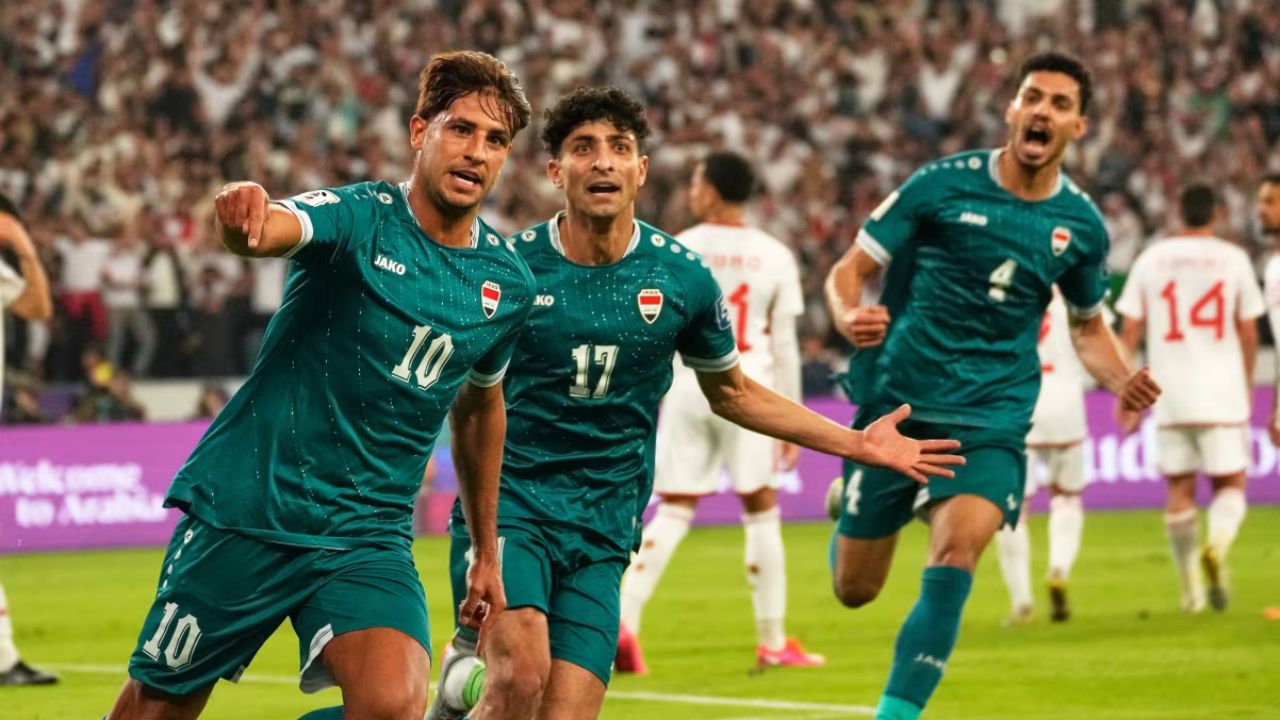



Road-side sellers of World Cup flags and the peripatetic vendors will be unanimous in saying that the best-selling colours are still that of Argentina since Brazil is no longer in contention.
Interestingly, this year, many of the large bamboo sticks showcasing flags on offer also featured flags of Iran and Iraq.
While Iraq, coming to the stage after 40 years, left with three defeats, Iran had to take the exit despite not losing a single match and bagging three points from three draws.
The fact that Iran has been in a conflict recently with the ceasefire currently unravelling, the country’s football team made it to the World Cup in the face of insurmountable odds and countless impediments.
This may have created a sympathetic spot for the Iran side among local football lovers, feels Mazhar Mithun – a renowned sports vlogger.
Iran is not new to the World Cup, having played at the apex stage six times before, seven with the ongoing one.
Appearing at the World Cup for the first time in 1978, Iran drew with Scotland and came back with a point – deemed a creditable achievement back then because Asian football was still somewhat behind Europe and, at that time, only one team from Asia was allowed to participate.
Any talk of Iranian and Iraqi football inevitably brings up the link with Bangladesh, and trust me, the relation, association with Bangladesh football of the 80s is an intriguing one.
Most modern-day football lovers in Bangladesh are not aware of the history, so for them, here’s a dive back in time, to 1979-1980, when Iran underwent a socio-political upheaval with far reaching implications with the eight-year Iran-Iraq War becoming a catalyst for a sudden upgradation of Bangladesh football clubs and leagues.
Bangladesh opens doors to Iranian students, Iraqi footballers
Soon after the change of power in Iran, the country became embroiled in a war with neighbour Iraq that would last for eight years.

Following the 1979 regime change in Iran, Bangladesh opened doors to Iranian students and, consequently, a large number of young men came to Bangladesh for education.
Naturally, among the students were football lovers and amateur players who made up a very formidable foreign student’s team at the University of Dhaka.
While some students stayed at the International Hostel, others rented flats, and, by chance, about twenty came and rented a newly constructed four storey building in Elephant Road, the area where this writer and his younger brother lived at that time.
They were all football loving young men who played regularly for their respective academic institutions in Bangladesh.
At about this time, the Bangladesh football league, so far totally reliant on local players, was opening up to footballers from outside the country.
Nepalese footballer Ganesh Thapa joined Mohammedan while Ibrahim, a student from Ghana, became the first African player to don the Mohammedan jersey, followed by Premlal and Pakir Ali, Sri Lankan footballers, who signed for Abahani KC.

Football in the early 80s slowly began to become an approved profession of sorts since the clubs started paying respectable wages.
By mid 80s, Bangladesh football had made a name in the region and through local Iranian students, Reza Naalchegar, Iranian national team player, who was with the team’s AFC Asian Cup in 1980, and most importantly, the famous Iranian goal keeper from their 1978 World Cup team, Nasser Hejazi, touted ‘Eagle of Asia’, came to Bangladesh to play for Mohammedan.
Actually, Hejazi came as coach cum player, taking the field in the 1987 match against Abahani for a short time.
Following these two, came Borhanzade and then, in 1988, another ace Iranian striker, Bijan Taheri.
Seeing this, Mohammedan’s arch-rival Abahani decided to go shopping and brought Iraq World Cup 1986 player, Samir Shaker.
Shaker, however, had a rather ignominious exit from the World Cup as he was red carded and then handed a one-year ban for spitting at the referee in the match with Belgium, which Iraq lost 2-1.
With Shaker came his compatriot, Karim Md Alawi and so, at the national stadium in Dhaka, it was proxy war between Iran and Iraq – much like the East India Companies of France and Britain in 1757.
Shaker may have had a disgraceful exit at the World Cup 1986, but in 1999, as coach of the Bangladesh national side, he went back to his country, head held high with the gratitude of all Bangladeshis after guiding the red and green side to the elusive South Asian Games football gold in Kathmandu.
Mohammedan’s rise to Asian glory
Adding to local talent, the Iranian footballers made Mohammedan into a powerhouse, which became evident at the qualification round for the AFC Club Cup for 1988-89.
Placed with Sri Lankan Club Sanders and Iranian champions Pirouzi (now Persepolis), Mohammedan’s crunch match was against the Iranian outfit.
Featuring Iranian striker Taheri, Mohammedan won the match 2-1, going to the final round of AFC, where they beat North Korean club April 25, 1-0, lost to Saudi champions, Al Ittifaq, by 3-1 and then drew 2-2 with Iraqi campion club Al Sadd, which eventually lifted the AFC trophy for 88-89.
Suffice to say, Mohammedan at that time was among the top 15 club sides from Asia.
In 1990-91, with the same Iranian players under coach Hejazi, Mohammedan topped the qualification group, beating Indian champions Salgaokar 2-1 and blanking Maldivian league toppers, Club Lagoons by 5-0.
At the next level, Mohammedan drew three matches, nil all with April 25, 1-1 with Bangkok Bank and then, one all with Iranian champions, Esteghlal.
The thing to note is that for both editions of the AFC Cup second round matches, Mohammedan drew with the eventual champions Al Sadd (88-89), Esteghlal (1990-91)
Interestingly, at this edition, Naalchegar who had played for Mohammedan in the past, was with Esteghlal and scored their goal.
Mohammedan narrowly missed the semi-final spot because April 25 had a better goal difference.
So much was the impact of Nasser Hejazi on Mohammedan that in 1989, he was given charge of the national side at the SAF Games in Pakistan.
In the final against Pakistan, Bangladesh conceded a 90th minute goal and settled for silver.
In 1989, Bangladesh national side also played Iran’s main team for the 1990 World Cup qualifiers, losing, narrowly, 2-0 in Dhaka and 1-0 in Tehran.
Both Iraq and Iran have played at the 2026 World Cup with the latter showing dogged resolve on the field despite having a slew of hurdles that made their participation almost uncertain.
Seeing these teams, one often becomes wistful because once top players from Iran, Iraq played in our leagues while the Bangladesh national side displayed a lot of promise.
Today, they play at the highest level while Bangladesh team is desperately looking for a way to regain regional supremacy.
Oh well, that is reality, which one needs to accept.
Amidst all the frenzy, debate and brouhaha over the World Cup, one often feels that such craze in Bangladesh and fanatic passion for certain teams, stem from a deep- rooted frustration over seeing our national side failing to capitalise on the SAFF trophy won last in 2003.
We need to be satisfied with the knowledge that for us, the ‘World Cup’ moment will be winning the SAFF trophy.
I can live with that, and maybe should you.