


Bangladesh is betting on agro-processing to turn a largely raw agricultural export base into a higher-value business, with the government preparing a farm-to-export overhaul to push the sector back beyond the $1 billion mark and into premium international markets.
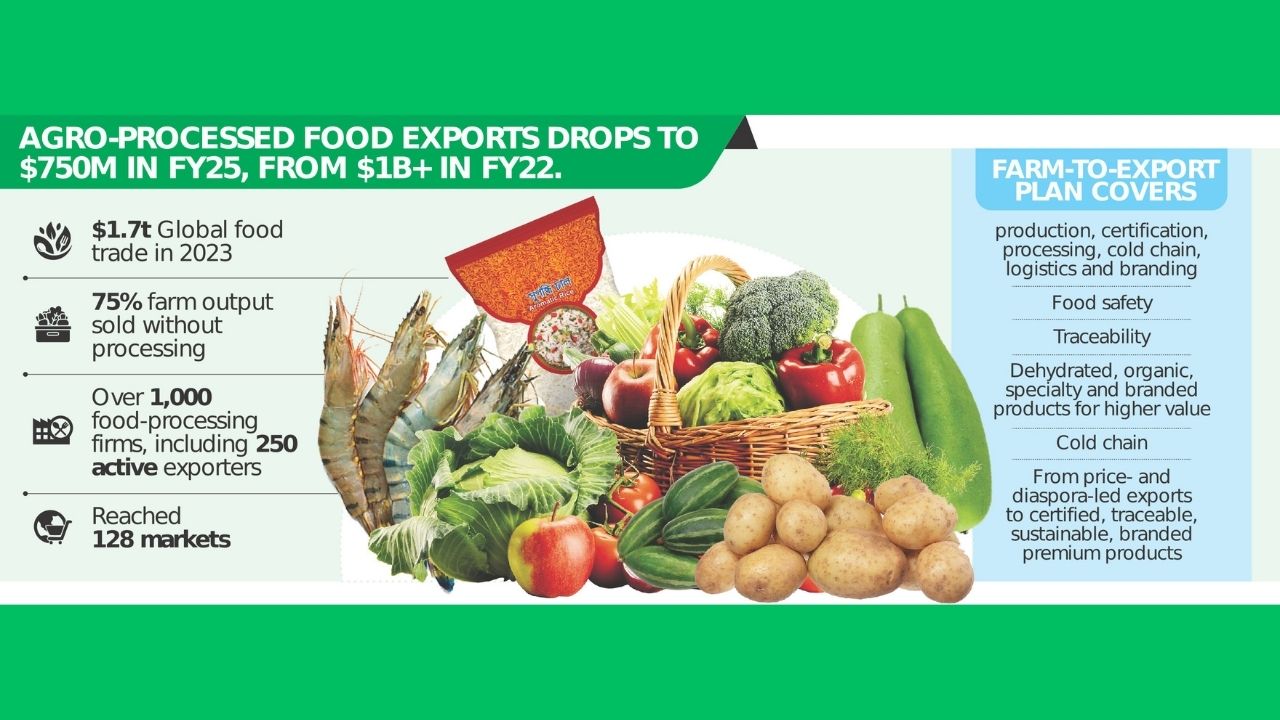
More than 75 per cent of agricultural produce currently leaves farms without processing, while agro-processed food exports stood at about $750 million in FY25, down from more than $1 billion in FY22.
The government’s strategy is to capture more value before products leave the country by upgrading quality, certification, processing, cold-chain logistics and branding.
The plan, outlined in the government’s Five-Year Strategic Framework for Reform and Development, covers the agricultural supply chain from farm production and raw-material quality to testing, processing, storage, transport and export.
The opportunity is large. Global food trade was worth around $1.7 trillion in 2023, but Bangladesh’s agro-processed food exports accounted for only a fraction of that market. The country’s products reached 128 countries in FY24, yet its share of the global market remains well below 1 per cent.
Bangladesh has more than 1,000 food-processing firms, including around 250 active exporters. Yet agro-processing contributes only 1.7 per cent of gross domestic product (GDP) and 2.2 per cent of employment, compared with agriculture’s 11.7 per cent contribution to GDP and 44.7 per cent share of the workforce.

The government sees the gap as an opportunity to diversify exports and drive rural industrialisation. Rather than relying mainly on low prices and diaspora demand, it wants processors to supply certified, traceable, sustainable and branded products to premium retail markets.
Fixing the farm-to-export chain
The first stage of the strategy focuses on recovery and stabilisation across five areas.
The government plans to expand irradiation facilities and strengthen the international certification and food-safety system. It will initiate International Laboratory Accreditation Cooperation accreditation for testing laboratories, expand the halal accreditation roadmap and operationalise organic certification systems.
It also plans to begin harmonising national systems with Codex Alimentarius and international traceability standards, helping Bangladeshi products meet the requirements of more demanding overseas markets.




At the farm level, a quality and traceability programme will be launched in major production zones. It will introduce good agricultural practices, integrated pest management, food-safety and cooperative certification programmes to improve raw-material quality, reduce contamination and make products export-ready.
The strategy also targets factories. The government plans programmes on lean manufacturing, sanitation, waste reduction and process optimisation, along with feasibility studies for dehydrated foods, organic products, specialty foods and other high-value agro-processing segments.
Cold-chain and export logistics are another major focus. Proposed infrastructure includes cold-storage hubs, refrigerated transport, airport cold-cargo facilities and integrated logistics networks linking farms, processors and export markets.
On the market side, the government plans to expand participation in international food fairs, buyer-seller matchmaking, inbound buyer missions, diaspora engagement and export-branding campaigns.
From stabilisation to industrial clusters
The overhaul is designed to extend beyond immediate recovery.
In the restoration phase, the government plans to expand internationally accredited laboratories and irradiation facilities, scale farmer-level traceability and quality-assurance systems and strengthen producer-exporter linkages.
It also proposes concessional financing and technical assistance for modern processing, packaging, dehydration, cold storage and automation.
Japan, China, India, the Middle East and premium European retail markets have been identified as priority destinations for internationally certified and branded agro-products.
In the longer-term reconstruction and acceleration phase, the government wants to establish technology-driven agro-industrial clusters with modern production systems, automation, innovation capacity and diversified high-value product portfolios.
It also envisages a nationally integrated cold-chain and agro-logistics network connecting farms, processors, industrial zones, ports and airports with international markets.
Why exports stalled
Bangladesh’s agro-processed food exports rose from around $330 million in FY12 to more than $1 billion in FY22, but subsequently fell to about $750 million in FY25.
The government attributes the sector’s weak competitiveness to interconnected problems: inadequate compliance infrastructure, insufficient internationally recognised certification, inconsistent raw-material quality, limited traceability, weak cold-chain and logistics systems, and gaps in productivity, packaging, storage, technology adoption and market linkages.
For small and medium-sized processors, these weaknesses can be particularly difficult to overcome because meeting international standards requires investment in testing, certification, technology, packaging and logistics.
The strategy therefore seeks to change the economics of the sector by building quality and compliance into the supply chain rather than addressing them only when products are ready for export.
The ultimate objective is to position Bangladesh as a globally recognised supplier of organic, specialty, certified, geographical indication-protected and branded agro-processed products.
Breaking back through the $1 billion export level would be an early milestone. The larger ambition is to make processing—not simply farm output—the source of Bangladesh’s next phase of agricultural export growth.