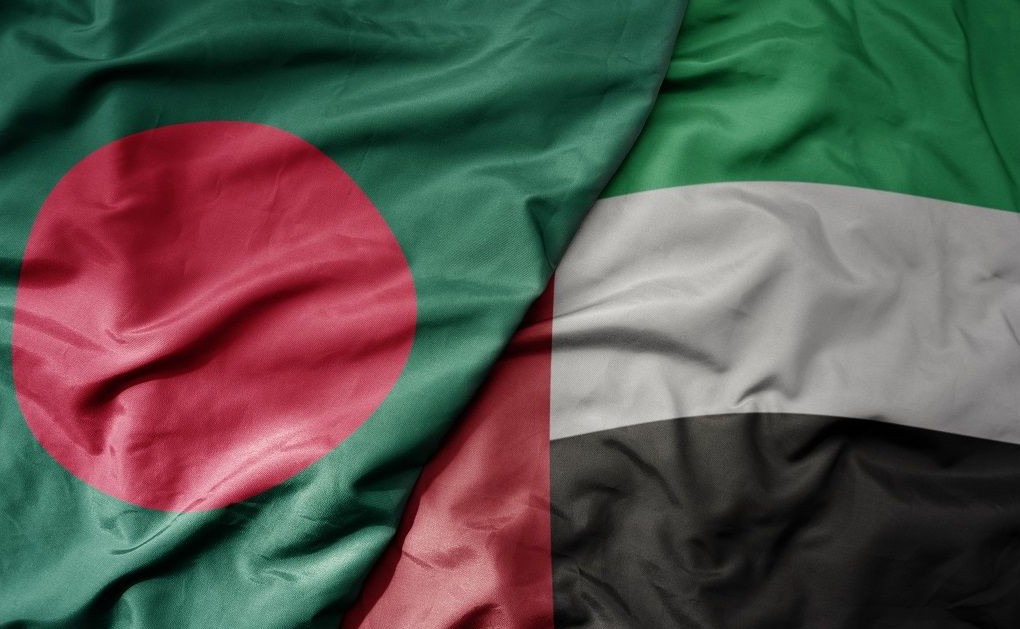

Bangladesh and the United Arab Emirates (UAE) have shared diplomatic ties for 51 years. Yet the economic relationship remains surprisingly narrow, defined by a single channel, low-skilled labour migration and the remittance it generates. In FY23-24, the UAE became Bangladesh’s largest remittance source, contributing $4.6 billion, nearly a fifth of the total $23.9 billion. When remittance dominates the entire bilateral equation, something is fundamentally wrong with the strategy.
Considering the numbers, bilateral trade in FY23-24 stood at approximately $1.7 billion. Bangladesh’s exports totaled just $405 million, down from a peak of $864 million in FY21-22. When home textile shipments alone reached $382 million before collapsing to $4 million, the government did not find it important to conduct a rigorous soul search to know why did it collapse. The UAE recorded total merchandise imports of $539 billion in 2024. Bangladesh’s share is roughly 0.07%. The UAE has signed 27 Comprehensive Economic Partnership Agreements with countries including India, Indonesia, Cambodia, and Vietnam. Bangladesh is not among them.
The export basket tells a story of fragility. Knitwear and woven garments account for over $260 million, with the rest spread thinly across agricultural products, jute goods, and ceramics. Fewer than seven product lines cross the $5 million threshold annually. Pharmaceuticals, leather goods, light engineering, and halal-certified processed foods all have demand in the UAE and GCC markets. The GCC halal food market alone was valued at $65 billion in 2024, but Bangladeshi firms lack the market intelligence and distribution networks to compete.

The investment picture is equally modest. The UAE’s FDI stock in Bangladesh stood at $530 million as of September 2022, negligible against Abu Dhabi’s sovereign wealth ecosystem managing over $1.7 trillion. Multiple MoUs signed between 2015 and 2022, covering LNG power plants, a Matarbari special economic zone, and a port, remain unimplemented. At the Investment Summit in April 2025, DP World expressed interest in Chattogram port’s container terminal and announced a ‘Bangladesh Mart’ plan for the UAE, but the concession agreement remains unsigned.
The labour dimension is now the most urgent crisis. Worker deployments to the UAE collapsed from 98,422 in 2023 to 47,166 in 2024, and barely 12,900 in 2025, according to BMET. Since mid-2024, visa restrictions, formalised through a UAE immigration circular in October 2025, have frozen new work and tourist visas for Bangladeshis. Authorities cite that over 25% of visa violators in the country are Bangladeshi. With the UAE, Malaysia, Oman, and Bahrain all effectively closed, 67% of workers sent abroad in 2025 went to Saudi Arabia alone.




The logistics gap compounds everything. Sea freight from Chattogram to Dubai takes 18-20 days versus three to four from Karachi or Mumbai. There is no direct shipping line between the two countries. Garment container shipments to Ajman, once 300-350 per month, have fallen to 35-40 as Chinese and Vietnamese suppliers captured the re-export market Bangladesh once served.
Three things must be changed immediately for the better cause. First, Bangladesh must pursue a Comprehensive Economic Partnership Agreement with the UAE as an urgent trade policy priority. India’s CEPA boosted bilateral non-oil trade by 20.5%; Cambodia’s opened preferential access across 92% of product lines. Bangladesh’s absence from this architecture is a competitive failure that worsens with every agreement the UAE signs with a rival supplier. The February 2026 meeting between the UAE Ambassador and Bangladesh’s Foreign Secretary to discuss accelerating CEPA talks is encouraging, but discussions must now move from diplomatic pleasantries to actual negotiating rounds. Second, the visa crisis must be resolved through structured, credible engagement, not ad-hoc appeals during summit sidelines.
Bangladesh needs to address the UAE’s legitimate concerns over recruitment fraud and visa violations with verifiable institutional reforms: cleaning up the recruiting agency ecosystem, digitising worker documentation, and establishing a joint verification mechanism with UAE authorities. Without this, the labour corridor will not reopen, and the remittance lifeline will erode. Third, Bangladeshi firms must treat the UAE as a strategic market, not an afterthought. This means establishing showrooms and warehousing in Dubai and Ajman free zones, pursuing halal certification for food exports, building distribution partnerships with Emirati firms, and using the UAE as a gateway to MENA and African markets. The GCC alone imports over $800 billion annually, and Bangladeshi products, from processed foods to ceramics to footwear, can compete if firms invest in branding, compliance, and local presence.
As Bangladesh navigates LDC graduation, now requested to be deferred to November 2029, and faces rising tariff headwinds in the EU and the United States, the UAE offers something different: a low-tariff, high-growth, diversification-ready market at the crossroads of Asia, Africa, and Europe. The relationship has survived on remittance alone for far too long. It is time Bangladesh built something broader, deeper, and far more resilient. The tools are available. What has been missing is the strategic ambition to use them.
The writer is a trade, development and innovation economist, and Chief Research Officer at Bangladesh Textile Today. E-mail: [email protected]