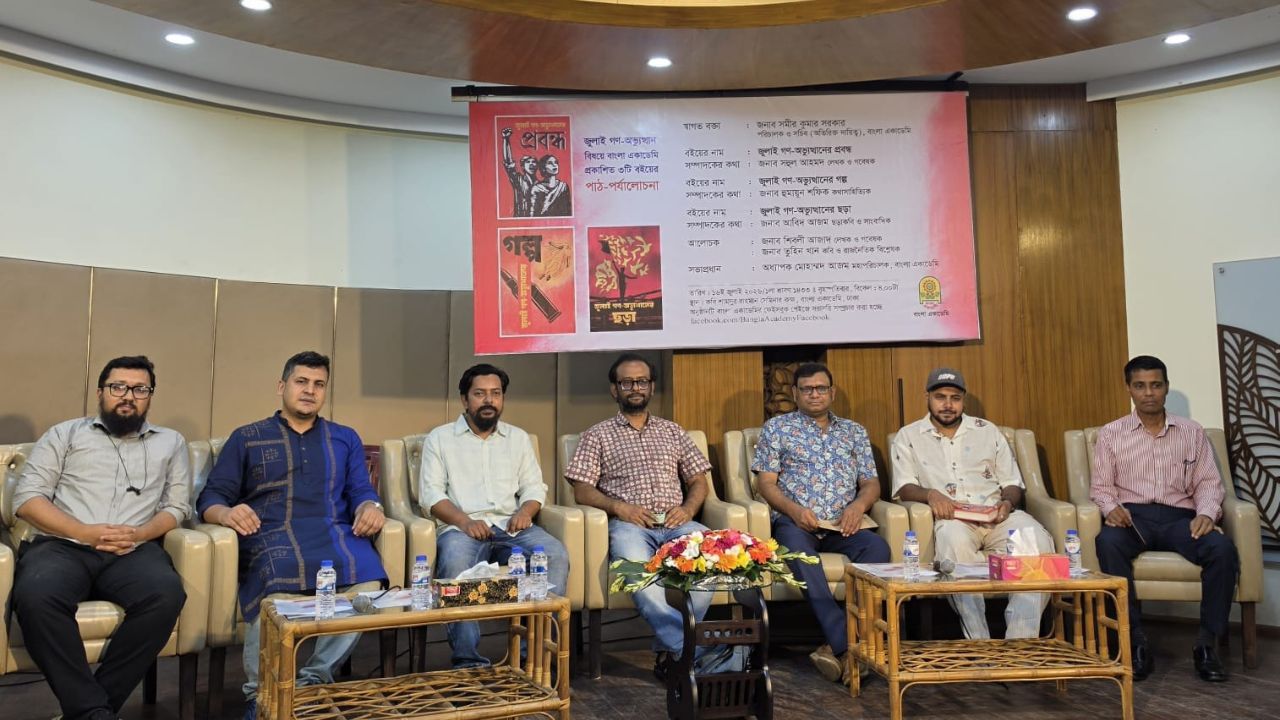

Bangla Academy on Thursday organised a review session on three books published by the Academy on the July Mass Uprising as part of its July Mass Uprising Day 2026 observance.
The programme took place at 4:00 pm on 16 July at the Poet Shamsur Rahman Seminar Hall of the Academy. Director and Secretary (acting) Samir Kumar Sarkar delivered the welcome address.
Writer and researcher Sohul Ahmed discussed Essays on the July Mass Uprising, which he edited. Novelist Humayun Shafique reviewed Stories of the July Mass Uprising, while children’s writer Abid Azam discussed Rhymes of the July Mass Uprising. Writer and researcher Shibli Azad and poet and political analyst Tuhin Khan also took part in the discussion. Bangla Academy Director General Professor Mohammad Azam chaired the event.

The programme began with a one-minute silence in memory of those who were killed during the July Mass Uprising of 2024.
Samir Kumar Sarkar described the July Mass Uprising as an important chapter in the country’s political and social history. He said it reflected the aspirations of the people and that its multidimensional significance had found artistic expression in the works of the country’s writers, litterateurs and researchers.




Sohul Ahmed said the essays in the collection examined the uprising from diverse perspectives and added that the subject required further in-depth research.
Humayun Shafique said the stories in the collection were not merely works of fiction but also reflected true history. He said they captured the turbulent days of July and documented real experiences from the uprising.
Abid Azam said rhymes, songs and poems spread inspiration during the historic July Mass Uprising. He noted that many rhymes and slogans motivated students and the public, and that those works had been included in the anthology.
The two discussants said the collections of essays, stories and rhymes preserved the ideas and inspiration of that period. They described every contribution as significant and said the books served as valuable historical documents. They also said people from different sections of society had united during the uprising for various reasons, adding that its socio-economic context deserved analysis alongside its political background.
Professor Mohammad Azam said the July Mass Uprising had many dimensions and immense historical value. He said the three collections documented not only the events of those turbulent days but also the political, intellectual and psychological background of the uprising.
Bangla Academy Deputy Director (acting) Dr Mahbuba Rahman conducted the programme.