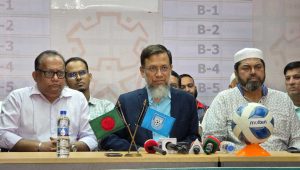
Bangladesh Cricket Board (BCB) director and popular singer Asif Akbar has demanded an immediate settlement with football authorities, accusing footballers of damaging cricket pitches and occupying stadiums across the country.
Speaking on Sunday (9 November) at the opening day of the Bangladesh Cricket Conference, which brought together district cricket presidents, sports officers, coaches and women entrepreneurs, Asif said football had become one of the biggest obstacles to cricket’s development in Bangladesh.
“We can’t play cricket anywhere in the country because of footballers,” Asif said. “They destroy the wickets and damage the fields. That’s why the Cumilla Cricket League, starting on the 12th, will be played on mats — something we’ve never done before. It feels like we’ve gone 30 years backwards.”
Asif, who represents the Chattogram division and now serves as chairman of the BCB’s Age-Level Tournament Committee, claimed that district stadiums nationwide are being monopolised by football, even where no football activities are scheduled.

“On the 24th, there’s an Abahani–Mohammedan football match in Cumilla Stadium. This is not just Cumilla’s problem — in every district, football has taken over the grounds,” he said. “Even where football has no reason to be, it occupies the stadium. Their behaviour is often very poor. Cricket, on the other hand, is a disciplined and elegant sport, one of structure and rules.”
Calling on the BCB president and senior officials to act, Asif urged them to engage with the Bangladesh Football Federation (BFF) to resolve the long-running turf conflict.
“I request our board president and senior members to sit with the BFF immediately. We’re not looking for a fight, but if it becomes necessary, we’ll fight. Because we have to play, and our children must play. Our boys and girls have the right to the field.”




Asif emphasised that the clash between football and cricket affects the entire grassroots structure — from school cricket to talent hunts and age-level competitions.
“There are many levels of cricket in the pipeline — school, age-group, talent hunt, home and away tournaments,” he said. “If we can’t even start our leagues because of ground issues, it will stall the game’s future.”
He warned that being forced to use matting wickets instead of turf would severely hinder Bangladesh’s cricketing progress.
“I’ve spoken to the National Sports Council (NSC) and even tried to bring it to the sports adviser’s attention,” Asif said. “They’ve taken us back decades. We need change immediately. The time has come for a clear, national sports policy.”
Asif also said he was prepared to “stand up” if the situation escalated.
“Cricket people are usually polite, but I’m not always that polite,” he admitted. “If footballers fight, I’ll fight too — no problem. We’re not asking for money or favours; we’re only asking for the right to play.”
He concluded by demanding an annual sports calendar from the National Sports Council to prevent overlapping use of venues and ensure fairness between sports.
“We need a yearly calendar specifying how many days are for football, cricket, hockey, athletics and indoor games,” said Asif. “If we can’t fix this, no matter how much we try, it won’t bring results — because we won’t have fields to play on. Across Bangladesh, from Bandarban to Satkhira, people play cricket passionately. It’s time that passion is given proper space.”