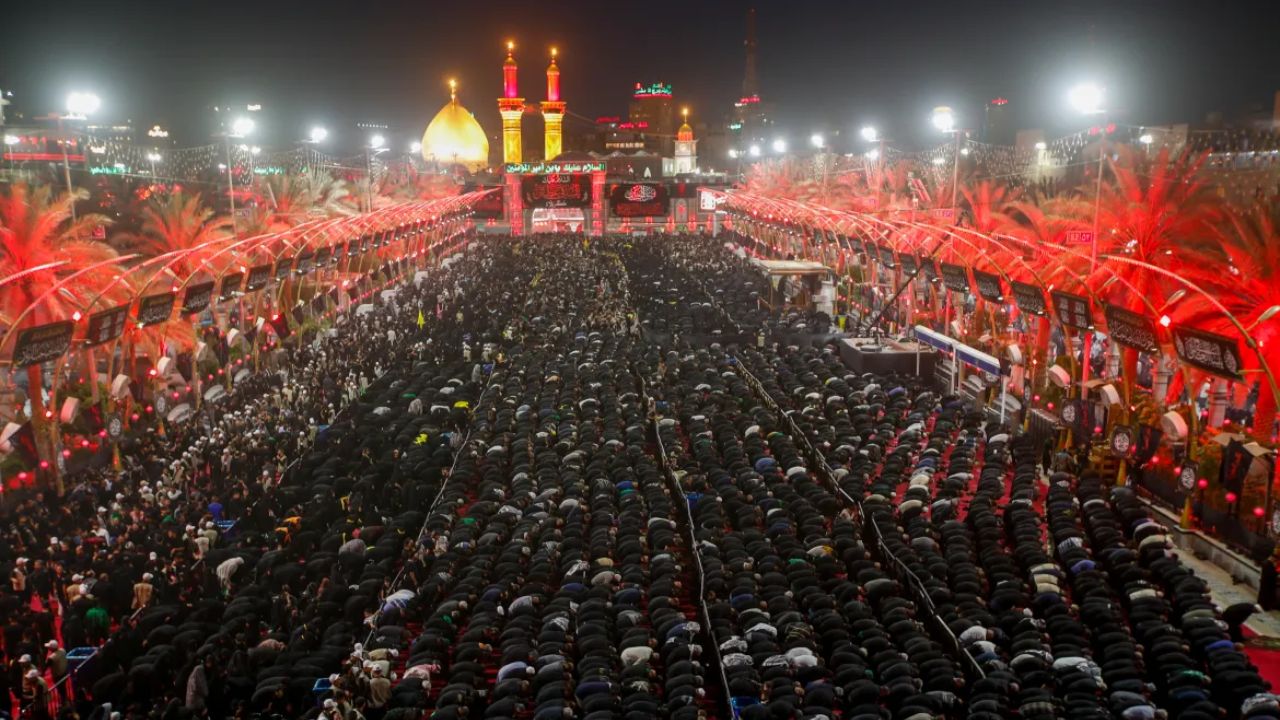



Shiite Muslims around the world are observing Muharram with days of mourning culminating in Ashura, the annual commemoration of the seventh-century killing of Imam Hussein, the grandson of the Prophet Muhammad.
The observance, held on the 10th day of the Islamic lunar month of Muharram, honours Hussein’s death at the Battle of Karbala and remains one of the defining events in Shiite Islam, according to AP.
This year’s commemorations come against the backdrop of the recent war in Iran, whose population is overwhelmingly Shiite, and an interim agreement to end the conflict.
In Lebanon, many Shiites are also marking Muharram after the destruction caused during the war between Israel and the militant group Hezbollah, giving renewed significance to rituals centred on sacrifice, resilience and resistance to oppression.
For Shiites, Ashura symbolises the struggle against injustice and tyranny. Imam Hussein was killed in present-day Iraq after refusing to pledge allegiance to the Umayyad Caliph Yazid during the Battle of Karbala.
His death deepened the divide between Sunni and Shiite Muslims, a split rooted in disagreements over who should succeed the Prophet Muhammad as leader of the Muslim community. Shiites believed leadership should remain within the Prophet’s family through Ali, his cousin and son-in-law, who was also Hussein’s father.

Today, Hussein’s martyrdom remains central to Shiite religious identity and historical memory.
“The gathering every year and the reaffirming of collective memory and collective grief allows every year for the story and the message to adapt to its current context,” said Noor Zehra Zaidi, assistant professor of history at the University of Maryland, Baltimore County, whose research focuses on Shiite Islam.
Across the United States, Shiite communities representing a wide range of ethnic and racial backgrounds hold assemblies featuring Quran recitations, elegies, lamentations and religious lectures.


“In many communities, emotional lamentation and weeping are considered acts of devotion because they express solidarity with the suffering (of) the Prophet’s household,” Zaidi said, adding that American communities reflect much of the ritual diversity found across the wider Shiite world.
For many participants, the gatherings strengthen both faith and community ties. “Our community comes to life. It pulsates with a beautiful group unity, where everybody comes together,” said Adam Almaleky in Michigan.
“It’s a programme of self-development, self-purification, gaining closeness to God through Hussein.” In Texas, 23-year-old Sakina Ali joins commemorations alongside four generations of her family. “We learn and we mourn,” she said, describing an atmosphere that gives her goosebumps.
Around the world, Muharram observances include public processions and rhythmic chest-beating performed in unison. Some Shiites also practise self-flagellation and draw blood as an expression of grief, although those rituals remain controversial within Shiite communities, embraced by some and rejected by others.
In Iraq, vast numbers of pilgrims travel to the holy city of Karbala, where Hussein is buried. Volunteer stations provide food and drink to visitors, reflecting what Zaidi described as one of the most universal traditions associated with Ashura.
“One of the remarkable enduring features of Ashura commemorations is the way that rituals and communities reflect local cultures, traditions and languages while still remaining centred on Karbala,” she said.
Alongside traditional observances, many communities have embraced blood donation campaigns inspired by Hussein’s sacrifice.
Ali has helped organise a blood drive in Texas through Who is Hussain, a London-based charity with teams in dozens of cities worldwide.
“It’s to save lives. It’s to do good in the name of Hussein,” she said. “Since this is such an emotional time and the community is coming out from everywhere … the impact is much bigger.”
She added that Hussein “sacrificed his life … for morality and for justice”, saying his example inspires her to serve her own community. Similar blood drives are held elsewhere in the United States. Mustafa Jafri, a physician and board director at Masjid-e-Ali in New Jersey, said his mosque has organised them for years.
“We do it really to honour Imam Hussein and his companions and his family,” Jafri said. “He gave his blood to stand against injustice and so we resonate and want to give our blood to save lives.” Zaidi noted that blood donation campaigns are a relatively recent development in Shiite commemorations.
Participants say Ashura continues to provide lessons that extend beyond religious observance. Jafri described it as an opportunity to reflect on personal improvement and “tackling injustices that are all throughout the world”.
Almaleky said Hussein’s legacy teaches “altruism”, “principle” and “dedication”, adding that despite tragedy, the community continues to draw strength from remembering the sacrifices made by Hussein, his family and his companions.